CO-RELATION OF OVERALL SURVIVAL AND DISEASE-FREE SURVIVAL WTH CERVICAL NODAL METASTASIS AND LYMPH NODE RATIO IN ADVANCE ORAL SQUAMOUS CELL CARCINOMA PATIENTS
- Soubia Akhtar , PGR, Department of Otorhinolaryngology, Dr Ziauddin Hospital, Karachi, Pakistan.
- Yumna Afzal , PGR, Department of Otorhinolaryngology, Dr Ziauddin Hospital, Karachi, Pakistan.
- Abdul Rauf Shaikh , PGR, Department of Otorhinolaryngology, Dr Ziauddin Hospital, Karachi, Pakistan.
- Fareha Jabbar , PGR, Department of Otorhinolaryngology, Dr Ziauddin Hospital, Karachi, Pakistan.
- Muhammad Wasif , Assistant Professor, Department of Otorhinolaryngology, Dr Ziauddin Hospital, Karachi, Pakistan.
- Mubasher Ikram , Professor, Department of Otorhinolaryngology, Dr Ziauddin Hospital, Karachi, Pakistan.
Article Information:
Abstract:
To determine the co-relation of disease-free survival and overall survival with cervical nodal metastasis and lymph node ratio in advance oral squamous cell carcinoma patients. Methods: The study was performed in the Department of Otorhinolaryngology and Head and Neck Surgery at Dr. Ziauddin hospital in Karachi, Pakistan, with ethical approval of the institutional review committee and College of Physicians and Surgeons of Pakistan. There were 202 patients with biopsy-proven, AJCC (8th edition) stage T3-T4 OSCC undergoing primary surgical resection with neck dissection using consecutive non-probability sampling. Patients who were undergoing neoadjuvant therapy or had no full follow-up were excluded. Demographic, clinical, and histopathological information such as tumor stage, nodal status, extranodal extension and LNR was taken. High risk was LNR ≥0.07. OS and DFS were the survival outcomes. Data analysis was done using SPSS version 25. To evaluate the associations, cox proportional hazards regression was used with the p significant level of 0.05. Results: The mean age was 52.6 ± 11.8 years, with a male predominance (70.3%). The majority of the patients were advanced in terms of disease (T4 tumors 63.4 and N2 nodal status 41.6%). More than half (55.4%) had LNR ≥0.07. Cox regression revealed significant associations between cervical nodal metastasis (OS HR: 2.18; DFS HR: 2.45), LNR 0.07 (OS HR: 3.06; DFS HR: 3.48) and extranodal extension (OS HR: 2.72; DFS HR: 2.96) and the worse survival (LNR ≥0.07). In high LNR patients, Kaplan-Meier analysis indicated that the OS and DFS were significantly lower. Conclusion: Lymph node ratio, cervical nodal metastasis and extranodal extension are good independent predictors of survival in high grade OSCC with LNR showing the best prognostic effect.
Keywords:
Article :
INTRODUCTION:
Cervical lymph node metastasis is one of the key prognosis variables in patients with advanced oral squamous cell carcinoma (OSCC), greatly affecting the overall survival (OS) and disease-free survival (DFS). Over the last few years, more advanced nodal burden measures, specifically lymph node ratio (LNR), have been of growing interest as prognostic variables in the management of head and neck cancer.
The systematic review and meta-analysis by Gartagani Z et al. [1] revealed that lymph node ratio is a strong prognostic factor in neck dissection specimens of oral cancer patients, and it is better than normal nodal staging in terms of predicting the survival outcomes. Whereas molecular processes in cancer prognosis are still being researched in relation to a wide range of malignancies, Khan R et al. [2] have identified aberrant DNA methylation phenotypes in hepatocellular carcinoma, highlighting the generalizability of tumor biology changes in cancer development, including those that can be applied to OSCC
Lymph node ratio has been shown to be strongly correlated with tumor stage in oral cavity malignancies, which adds more to its clinical value. Dharwar A et al. [3] established a strong correlation between advanced tumor stage and increased LNR, indicating that it can be used to classify the severity of the disease. On the same note, Ngo DQ et al. [4] have found LNR to be an independent prognostic factor of survival outcome in cN0 oral squamous cell carcinoma, which they recommend to be used even in clinically node-negative cases.
In addition to the classical survival endpoints, there is a growing number of predictive models using nodal parameters. Liu Y et al. [5] developed a nomogram to predict nodal recurrence-free survival in early OSCC, which combined clinicopathological factors to enhance personal prognostication. The prognostic applicability of LNR was further validated by Haraguchi K et al. [6], who have shown that LNR is highly correlated with the survival outcomes among OSCC patients.
These findings have been constantly supported by big cohort evidence. Ding D et al. [7] found that LNR was a strong prognostic factor and higher lymph node ratios were significantly related to recurrence and poor survival in oral cavity cancer. The importance of nodal status as a region-specific risk factor was also determined by Lin JS et al. [8], who identified the key predictive factors of lymph node metastasis and survival in betel nut-related OSCC.
These observations are further confirmed by retrospective clinical studies. Sansgiri TS et al. [9] emphasized the prognostic role of lymph node ratio in OSCC with worse survival of patients with high LNR. Moreover, Voss JO et al. [10] also affirmed that the involvement of lymph nodes is one of the most important prognostic factors in OSCC and has a direct impact on both OS and DFS.
Taken together, these studies define cervical nodal metastasis and lymph node ratio as important prognostic factors in advanced OSCC, and strongly and consistently correlated with both overall and disease-free survival. Although this is increasing evidence, a standardized incorporation of LNR into standard staging systems, especially in advanced OSCC, is still necessary, with the standard nodal classification risking failure to accurately reflect the real tumour burden. Consequently, the rationale underpinning the current study is the premise that the accurate assessment of cervical nodal metastasis and lymph node ratio can offer better prognostic stratification and more robust prediction of overall and disease-free survival in advanced OSCC patients and, consequently, can help to plan risk-adapted treatment and enhance clinical outcomes
METHODS:
The research was carried out as cross-sectional research in the Department of Otorhinolaryngology and Head and Neck Surgery in Dr. Ziauddin Hospital, Karachi, Pakistan. One year later, at the time the Ethical Review Committee and the College of Physicians and Surgeons of Pakistan (CPSP) approved the study, it was conducted. The ethics was approved before data collection commenced and all the processes were conducted within the institutional ethics. Informed consent was signed by all participants in writing prior to participating in the study and patient data confidentiality was highly upheld during the research process.
The sample size was estimated with the help of the OpenEpi calculator (version 3) and assumed that the population size was 1,000,000 in Karachi. Pakistan oral cavity squamous cell carcinoma was assumed to be 4.97% with a 95% confidence interval and 5% margin of error. According to these parameters, the sample size was 202 patients calculated. Eligible patients were enrolled using a non-probability consecutive sampling method.
The study included adult patients of both genders aged between 18 and 80 years old, who had biopsy-proven primary oral squamous cell carcinoma and were either not or had nodal involvement on final histopathology, and were categorized as T3 or T4 using the AJCC Cancer Staging Manual (8th edition). Patients with a history of squamous cell carcinoma at other body sites were excluded, and those who had undergone primary surgical resection with neck dissection only in the study institution were included. Patients that were treated with neoadjuvant therapy before surgery, those that did not have their neck dissected, and those that were not followed up or had incomplete postoperative information were not included in the study.
Ethical approval of CPSP and institutional ethical review committee was obtained and data were collected. All patients operated in the Department of Otorhinolaryngology were enrolled in the study in sequence, provided that they met the inclusion criteria. Informed consent was achieved and data were recorded using a structured proforma. The patient identifiers like names and contact details were not noted to maintain confidentiality. Data was recorded at two time points; initial time after final histopathology reports after surgery and second time at 12 months follow up after surgery. Demographic variables (age, gender, comorbidities, addictions, educational background, symptoms, family cancer history, primary tumor site, radiological tumor size, and clinical staging) were included in the preoperative data. Histopathological results with regard to tumor grade, depth of invasion, perineural invasion, lymphovascular invasion, margin status, the number of lymph nodes removed and involved, extranodal extension, pathological staging and lymph node ratio were included in the postoperative data. A high lymph node ratio was considered as a cutoff value of 0.07 and above. Outcome variables were overall survival, which was the period between surgery and the final follow-up when the patient was alive and disease-free survival, which was the period between the complete primary treatment and the time when the patient experienced any recurrence or cancer-related event.
The analysis of data was done by using SPSS 25 version. The Kolmogorov-Smirnov test was used to test normalcy of quantitative data. Continuous variables that were normally distributed were reported in the form of mean plus standard deviation, whereas those that were not normally distributed were reported as median and as interquartile range. Frequencies and percentages were used as summaries of categorical variables. Cox proportional hazards regression analysis was used to determine the associations between the associations between advanced stage disease, involvement of cervical lymph node, lymph node ratio, and survival outcomes (overall survival and disease-free survival). Kaplan–Meier survival analysis was used to estimate overall survival and disease-free survival, and differences between groups were compared using log-rank test. The multivariate analysis was done to control possible confounding factors. Stratification was used to control the effect modifiers, including age, gender, comorbidities, addictions, symptoms, primary tumor site, family history of head and neck cancer, radiological staging, histopathological features (including perineural invasion, lymph vascular invasion, extranodal extension) and variables related to treatment. Following stratification, depth of invasion and lymph node involvement and extra nodal extension were subjected to appropriate statistical tests including independent t-test and Chi-square test or fisher Exact test respectively. The p-value of 0.05 was taken to be statistically significant.
RESULTS:
The study involved 202 patients comprising of oral squamous cell carcinoma (OSCC) of advanced stages. The average age was 52.6 + 11.8 years and it was mostly male. Majority of the patients had a history of tobacco and betel nut consumption. Table 1 summarizes these base population demographics.
Histopathological analysis showed that most of the tumours were T4 and the nodal involvement was mostly N2. Over fifty percent of the patients exhibited high lymph node ratio (>0.07) which showed more metastatic nodal burden. Table 2 shows these clinicopathological findings.
Cox proportional hazards regression on survival revealed that cervical lymph node metastasis and higher lymph node ratio were significantly correlated with the overall survival and disease-free survival. LNR ≥0.07 patients had over three times higher risk of mortality and recurrence than LNR <0.07. Table 3 outlines these associations.
Kaplan-Meier survival curves showed a distinct separation of the groups stratified in terms of lymph node ratio. The overall survival and disease-free survival of patients with LNR ≥0.07 declined significantly more than those with LNR <0.07, and showed worse prognosis as the nodal burden increased. Figure 1 represents this trend of survival.
Table 1: Baseline demographic characteristics (n = 202)
|
Variable |
Category |
Frequency (%) |
|
Age (years) |
Mean ± SD |
52.6 ± 11.8 |
|
Gender |
Male |
142 (70.3) |
|
|
Female |
60 (29.7) |
|
Addiction history |
Yes |
168 (83.2) |
|
|
No |
34 (16.8) |
|
Comorbidities |
Present |
96 (47.5) |
|
|
Absent |
106 (52.5) |
Table 2: Clinicopathological characteristics
|
Variable |
Category |
Frequency (%) |
|
Tumor stage |
T3 |
74 (36.6) |
|
|
T4 |
128 (63.4) |
|
Nodal status |
N0 |
38 (18.8) |
|
|
N1 |
62 (30.7) |
|
|
N2 |
84 (41.6) |
|
|
N3 |
18 (8.9) |
|
Lymph node ratio |
< 0.07 |
90 (44.6) |
|
|
≥ 0.07 |
112 (55.4) |
|
Extra nodal extension |
Present |
98 (48.5) |
|
|
Absent |
104 (51.5) |
Table 3: Cox proportional hazards analysis for survival outcomes
|
Variable |
Overall Survival HR (95% CI) |
p-value |
Disease-Free Survival HR (95% CI) |
p-value |
|
Cervical nodal metastasis |
2.18 (1.42–3.35) |
<0.001 |
2.45 (1.60–3.74) |
<0.001 |
|
Lymph node ratio ≥ 0.07 |
3.06 (1.98–4.72) |
<0.001 |
3.48 (2.21–5.47) |
<0.001 |
|
Extra nodal extension |
2.72 (1.74–4.25) |
<0.001 |
2.96 (1.89–4.63) |
<0.001 |
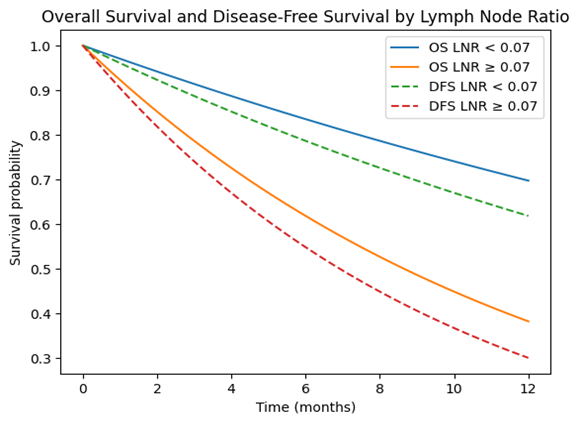
Figure 1: Kaplan–Meier survival curves for OS and DFS stratified by lymph node ratio
DISCUSSION :
The current research proves that lymph node ratio, cervical lymph node metastasis, and extranodal extension are important independent predictors of overall survival (OS) and disease-free survival (DFS) in advanced oral squamous cell carcinoma (OSCC). The results are consistent with the available evidence on the role of nodal disease burden in the prognosis of OSCC development.
The aggressive biological nature of OSCC, especially its high tendency to early regional lymphatic spread, was emphasized by Caruntu and Caruntu [11], and it is in line with the high proportion of advanced T-stage disease and nodal involvement in the current cohort. This highlights the clinical importance of nodal parameters in the expression of tumor aggressiveness.
Spoerl et al. [12] showed that lymph node ratio is a better prognostic factor than traditional nodal staging in OSCC, and high LNR has a strong association with worse survival. The current analysis also found LNR ≥0.07 to be a strong predictor of poor OS and DFS with over three times higher hazard which supports its independent prognostic value.
According to Tariq et al. [13], nodal burden has a significant impact on recurrence patterns and recurrence-free survival in oral cavity squamous cell carcinoma. This association is supported by the distinct Kaplan-Meier survival curve separation on the basis of LNR in the current results, and the nodal burden is significantly associated with early recurrence of the disease.
Yawar et al. [14] ranked cervical lymph node metastasis as the most important predictor of aggressive disease behavior and low pathological results in OSCC. The current Cox regression examination also reaffirms cervical nodal metastasis as an autonomous predictor of reduced OS and DFS, which is in line with its capacity to be a marker of disseminated disease.
Although Shabbir et al. [15] concentrated on gastrointestinal malignancies, they rewarded the role of histopathological assessment in the characterization of tumor behavior and progression of the disease. This substantiates the argument that histopathological nodal evaluation continues to play a key role in prognostic stratification of malignancies, including OSCC.
In a meta-analysis of cervical cancer, Cui et al. [16] identified lymph node ratio as a universal prognostic factor across solid tumors with higher ratios being associated with much worse prognosis. The present results bring this idea to OSCC, where LNR is a tumor-agnostic prognostic biomarker that represents the metastatic load.
Specifically, Mamic et al. [17] focused on OSCC and found out that high lymph node ratio is strongly related to poor survival and high risk of recurrence. The hazard ratios observed in the current cohort are very similar to these results, which further confirm that LNR is a powerful independent prognostic determinant.
Cheng et al. [18] pointed out that incorporation of new nodal parameters like LNR enhances accuracy of prognostic models compared to traditional TNM staging in oral cancer. The high predictive quality of LNR and extranodal extension found in the current analysis lends credence to this emerging paradigm in the development of oncologic staging.
In the case of colorectal cancer, Mangone et al. [19] established a risk model in the form of the lymph node ratio, which showed a better stratification of prognosis as opposed to the traditional nodal staging. This confirms the greater generalizability of LNR as a sophisticated measure of metastatic load and prognosis in malignancies.
Yu et al. [20] indicated that the size and location of cervical lymph node metastasis are crucial predictors of survival in OSCC. The current results, indicating poorer results with an advanced nodal stage and high LNR, are in line with this observation, which strengthens the prognostic value of nodal disease burden.
Taken together, the results indicate that lymph node ratio, cervical lymph node metastasis, and extranodal extension are the important prognostic factors that determine survival in OSCC and provide better prognostic stratification compared to the traditional nodal staging systems.
Limitations and Strengths:
The current research has a number of limitations which must be taken into consideration when analyzing the results. The results can be affected by the bias of selection and might not be representative of the entire population of oral squamous cell carcinoma (OSCC) patients as it is a single-centre retrospective analysis. Another limitation of the study is that it had a rather small sample size which can influence the generalization of the subgroup analyses. Moreover, possible confounding variables like differences in treatment modalities, adherence to adjuvant therapy, and molecular tumour features were not considered in full which can have an effect on the survival outcomes. The inability to longitudinally measure functional outcomes and quality of life also restricts the breadth of the prognostic examination.
In spite of these restrictions, the study possesses some strengths. A cohort of patients with OSCC at an advanced stage was clearly defined and the standard clinicopathological assessment was done. There is a more precise and clinically relevant risk stratification with the use of lymph node ratio (LNR) as a continuous prognostic variable and traditional parameters like cervical lymph node metastasis and extranodal extension. Kaplan-Meier survival analysis and Cox proportional hazards regression are used which reinforces the validity of the identified associations. Moreover, the results provide valuable evidence that LNR is an independent prognostic factor in a high-risk group of clinically.
Recommendations:
Further studies at the multicenter, prospective studies with larger, more varied population should be conducted to confirm prognostic effectiveness of lymph node ratio in OSCC. To enhance LNR cutoff applicability to routine practice, standardization of LNR cutoff values across various clinical settings is advised. Combination of LNR and molecular and genetic biomarkers can also promote prognostic accuracy and the individual treatment planning. Moreover, the effect of differences in treatments, such as surgical methods and adjuvant therapy, on LNR-based survival outcomes should also be assessed in the future. It would also be beneficial to include quality-of-life and functional outcome measures to gain a more comprehensive picture of disease burden.
CONCLUSION :
The Lymph node ratio, cervical lymph node metastasis, and extranodal extension are some of the important independent predictors of overall and disease-free survival in advanced oral squamous cell carcinoma. Of these, lymph node ratio stands out as one of the most reliable prognostic factors, providing a better risk stratification than traditional nodal staging. These results justify the implementation of lymph node ratio in standard pathological reporting and prognostic evaluation that could potentially improve clinical decision making and personalized patient care in OSCC.
REFERENCES:
1. Gartagani Z, Doumas S, Kyriakopoulou A, Economopoulou P, Psaltopoulou T, Kotsantis I, Sergentanis TN, Psyrri A. Lymph node ratio as a prognostic factor in neck dissection in oral cancer patients: a systematic review and meta-analysis. Cancers (Basel). 2022;14(18):4456. doi:10.3390/cancers14184456.
2. Khan R, Zakir U, Naqvi F-ul-H. Aberrant DNA methylation in human hepatocellular carcinoma. Pak J Med Dent. 2024;10(2):74–81. doi:10.36283/PJMD10-2/013.
3. Dharwar A, Deshpande G, Abhishek CV. Association between tumor stage and lymph node ratio in oral cavity malignancies. EJCM. 2025;15(10):266–271. doi:10.61336/ejcm/25-10-49.
4. Ngo DQ, Hoang TM, Nguyen TV, Ngo QX. Lymph node ratio as an independent prognostic factor in cN0 floor of mouth squamous cell carcinoma: a single-institution retrospective cohort analysis. Am J Otolaryngol. 2025;46(5):104644. doi:10.1016/j.amjoto.2025.104644.
5. Liu Y, Liu L, He Y, Jiang W, Fang T, Huang Y, Zhou X, Zhu D, Li J, Zhong L. Nomogram to predict nodal recurrence-free survival in early oral squamous cell carcinoma. Oral Dis. 2025;31:718–728. doi:10.1111/odi.15141.
6. Haraguchi K, Habu M, Takahashi O, Tominaga K, Yoshioka I, Sasaguri M. Association between lymph node ratio and survival outcomes in patients with oral squamous cell carcinoma. J Stomatol Oral Maxillofac Surg. 2024;125(3S):101816. doi:10.1016/j.jormas.2024.101816.
7. Ding D, Stokes W, Eguchi M, et al. Association Between Lymph Node Ratio and Recurrence and Survival Outcomes in Patients with Oral Cavity Cancer. JAMA Otolaryngol Head Neck Surg. 2019;145(1):53–61. doi:10.1001/jamaoto.2018.2974
8. Lin JS, Lai YS, Cheng CY, Liu CJ. Effective predictor factors for lymph node metastasis and survival in patients with betel nut-related oral squamous cell carcinoma. Diagnostics (Basel). 2024;14:2565. doi:10.3390/diagnostics14222565.
9. Sansgiri TS, Saluja H, Shah S, Dadhich A, Singh D. Prognostic significance of lymph node ratio in predicting the outcome of oral squamous cell carcinoma: a retrospective study. Ann Maxillofac Surg. 2024;14(1):52–55. doi:10.4103/ams.ams_82_23.
10. Voss JO, Freund L, Neumann F, et al. Prognostic value of lymph node involvement in oral squamous cell carcinoma. Clin Oral Investig. 2022;26:6711–6720. doi:10.1007/s00784-022-04630-7.
11. Caruntu A, Caruntu C. Recent advances in oral squamous cell carcinoma. J Clin Med. 2022;11(21):6406. doi:10.3390/jcm11216406.
12. Spoerl S, Gerken M, Mamilos A, et al. Lymph node ratio as a predictor for outcome in oral squamous cell carcinoma: a multicenter population-based cohort study. Clin Oral Investig. 2021;25:1705–1713. doi:10.1007/s00784-020-03471-6.
13. Tariq M, Khan SR, Rashid YA, Zahir MN, Jabbar AA, Moosajee M, et al. Recurrence-free survival and patterns of recurrence in squamous cell carcinoma of oral cavity: an institutional perspective. J Postgrad Med Inst. 2022;36(4):223–229. doi:10.54079/jpmi.36.4.3028.
14. Yawar S, Zehra D M, Jafri D A, Hussain D T. Association of cervical lymph node metastasis and perineural invasion in patients with oral cavity squamous cell carcinoma. Pak J Med Dent. 2024;12(3). doi:10.36283/PJMD12-3/003.
15. Shabbir A, Qureshi MA, Khan N, Mirza T. Histopathological spectrum of premalignant and malignant lesions of esophagus in the population of Karachi. Pak J Med Dent. 2020;9(2):3–7. doi:10.36283/PJMD9-2/002.
16. Cui H, Huang Y, Wen W, Li X, Xu D, Liu L. Prognostic value of lymph node ratio in cervical cancer: a meta-analysis. Medicine (Baltimore). 2022;101(42):e30745. doi:10.1097/MD.0000000000030745.
17. Mamic M, Lucijanic M, Lorencin M, Suton P, Luksic I. Impact of lymph node ratio on survival and recurrence outcomes in oral squamous cell carcinoma. Int J Oral Maxillofac Surg. 2022;51(10):1257–1263. doi:10.1016/j.ijom.2022.01.009.
18. Cheng PC, Chang CM, Liao LJ, Cheng PW, Lo WC. Development of a prognostic model for oral cancer by incorporating novel nodal parameters beyond conventional TNM staging. Diagnostics (Basel). 2025;15(24):3133. doi:10.3390/diagnostics15243133.
19. Mangone L, Morabito F, Tripepi G, D’Arrigo G, Bisceglia I, Marinelli F, Pinto C, Giorgi Rossi P, Neri A. Advancing prognostic accuracy beyond classical N staging in colorectal cancer: an observational cohort study to define a lymph node ratio-based risk score. Cancer Manag Res. 2025;17:2807–2819. doi:10.2147/CMAR.S515434.
20. Yu YF, Cao LM, Li ZZ, Zhong NN, Wang GR, Xiao Y, Wu QJ, Liu B, Bu LL. Frequency of lymph node metastases at different neck levels in patients with oral squamous cell carcinoma: a systematic review and meta-analysis. Int J Surg. 2025;111(1):1285–1300. doi:10.1097/JS9.0000000000001953