Frequency, Clinical Characteristics and Outcomes of DKA in Paediatric Age Group in a Developing Country
- Rabiya Arif , PGT Paediatrics, Benazir Bhutto Hospital, Rawalpindi, Pakistan
- Unsa Ghafoor , PGT Paediatrics, Benazir Bhutto Hospital, Rawalpindi, Pakistan
- Tehreem Fatima , Medical Officer Neurology, Shifa International Hospital, Islamabad, Pakistan
- Aimen Iftikhar , PGR Family Medicine, University of Lahore Teaching Hospital Lahore, Pakistan
- Sharia Ali Shaikh , PGR Paediatrics, Indus Teaching Hospital Karachi, Pakistan
- Ali Hassan Shah , Medical Officer, KIRF Jattlan Mirpur. AJK, Pakistan.
Article Information:
Abstract:
Diabetic ketoacidosis (DKA) is a potentially fatal consequence of diabetes that causes morbidity and death in children, especially in the developing world. The purpose of the study was to determine the prevalence, clinical features and complications of DKA in children. Methodology: This was a one-year descriptive observational hospital-based study of 140 children between 1-16 years of age with DKA. Information about laboratory parameters, clinical presentation, and demographics, precipitating events and complications were obtained from patient records. The Statistical Package for the Social Sciences (SPSS) was used to analyze the data using the relevant tests and a significance level of p < 0.05. Results: The mean age was 9.8 ± 3.6 years, with a male predominance (55.7%). Polyuria (85%) and polydipsia (80%) and vomiting (72%) were the most prevalent symptoms. The most common precipitant was infection (40%). Mild, moderate and severe DKA occurred in 30%, 40% and 30% of patients, respectively. A total of 80% of patients were cured, 14.3% had complications and 5.7% died. The presence of severe DKA, infection and decreased consciousness were significantly linked to poor outcomes (p < 0.05). Conclusion: DKA is a serious childhood emergency with high rates of morbidity and mortality. Timely recognition, awareness and treatment are essential to improving patient outcomes
Keywords:
Article :
INTRODUCTION :
One serious and sometimes lethal side effect of diabetes mellitus is diabetic ketoacidosis (DKA), with hyperglycemia, acidosis, and ketonemia [1,2]. It typically occurs in children with type 1 diabetes, but can be present in type 2 diabetes during times of stress or insulin deficit [3,4]. DKA remains a significant contributor to childhood morbidity and mortality, especially in countries with low or middle incomes where diagnosis is delayed, poor health-care facilities exist and there is little awareness of the condition [5,6].
The incidence of DKA at diagnosis in children with diabetes varies, and is higher in low- and middle-income countries. DKA tends to be the presenting feature of diabetes, reflecting a delay in the diagnosis. The symptoms include polyuria and polydipsia, vomiting and abdominal pain, while severe DKA involves dehydration and altered consciousness. Complications, such as brain swelling, electrolytes disturbances and others are linked with poor outcomes [7,8].
Early diagnosis and treatment of DKA with intravenous fluid, insulin and metabolic monitoring is key to treatment. However, in the developing world, poor access to medical care, and late presentation to hospital and the lack of a diabetes care program may result in more complications and death [9,10]. These results indicate a need for increased access to health care and early recognition and treatment strategies [11,12].
Research Gap and Objective
Although the burden of DKA is high in developing countries, there is little local data on its incidence, presentation and outcomes. This study therefore seeks to estimate the incidence of DKA, its clinical features and outcomes among children in a developing country to inform strategies for better management and prevention.
METHODOLOGY:
Study Design and Setting
This is a hospital-based descriptive observational research in a tertiary setting pediatric center in a developing country. The trial lasted for a full year, from January 2024 to December 2024. The chosen hospital was a tertiary-care referral center for both urban and rural populations and would be a good representation of children presenting with diabetic ketoacidosis (DKA).
Study Population
Our study subjects were children between 1 and 16 years of age with DKA admitted to the pediatric emergency department or intensive care unit of the hospital. The study included both incident and prevalent diabetes mellitus with DKA.
Inclusion and Exclusion Criteria
All pediatric patients who met the criteria for DKA, which is a blood glucose of >200 mg/dL, a venous pH of <7.3 or a bicarbonate level of <15 mmol/L, and either ketonemia or ketonuria, were included. Those with missing medical records, alternate causes of metabolic acidosis, or with chronic systemic disease in children that may affect the outcome of the disease were excluded.
Sample Size Determination
Assuming a specific prevalence of DKA within children with diabetes, the sample size was calculated using the single proportion of population formule. Based on a 30% prevalence from earlier studies in the region, 95% confidence (Z = 1.96), and an 8% margin of error, the sample size was determined by the formula:
n = Z² × p (1 − p) / d²
Substituting the values:
n = (1.96)² × 0.30 × (1 − 0.30) / (0.08)²
n = 3.84 × 0.30 × 0.70 / 0.0064
n ≈ 126
To account for missing data, an extra 10% was included to the sample size or dropouts, giving a total sample size of around 140 patients. The patients were recruited in consecutive order until the intended sample size was attained during the study period.
Data Collection Procedure
The data were gathered retrospectively from patient charts into a data collection form. The data collected included patient demographics (age, sex, place of residence); clinical presentation (symptoms, duration of illness, consciousness level, dehydration status); and biochemical measures (blood glucose, serum electrolytes, blood pH, bicarbonate level and presence of ketones). We also recorded information about precipitating events such as infections, omissions of insulin, or new diagnosis of diabetes. Details regarding management, such as duration of hospitalization, critical care unit admission, and complications, including cerebral edema, hypokalemia, or acute kidney injury, were recorded. The final outcome (recovery, complications, or death) was recorded.
Operational Definitions
DKA severity was defined as mild, moderate, or severe, based on pH and bicarbonate values. This outcome was categorised as full recovery, recovery with complications and mortality.
Data Analysis
The Statistical Package for the Social Sciences (SPSS) version was used for data entry and analysis 25. To summarize the data, descriptive statistical methods were employed. Continuous factors like age, blood glucose levels, and duration of hospital stay were presented as either median with the interquartile range or mean ± standard deviation, depending on the distribution of the data. Categorical factors such as gender, clinical features, severity of DKA, and outcomes were presented as frequencies and percentages.
Inferential statistical tests were used to determine associations between variables. Fisher's exact test or the chisquare test were utilized to evaluate correlations between categorical variables such as severity of DKA and outcomes. Independent sample The Mann-Whitney U test or the t-test were used to compare continuous parameters between two groups, depending on normality of data. One-way ANOVA or Kruskal–Wallis test was used for comparisons across more than two groups.
Multivariate logistic regression was employed to ascertain independent factors associated with adverse outcomes (complications, death). A p-value of less than 0.05 was considered statistically significant.
Ethical Considerations
The institutional review board gave the study its approval of the hospital before it began. Because the study was retrospective, confidentiality of the patients was maintained by anonymizing the data. Personal data were not collected, and only non-personal data were used for the study
RESULTS:
This study involved 140 children with diabetic ketoacidosis (DKA). The results are reported in terms of demographics, clinical presentation, laboratory data, precipitating causes, severity of the disease, treatment response and statistical inferences on correlation between variables through appropriate inferential tests.
Demographic Characteristics
Descriptive statistics were used to describe the distribution of age, gender and residence of study participants. Age distribution was fairly even with a slight skew towards school age. Age, gender and residence differences were also assessed to reveal potential demographic risk factors for DKA.
Table 1: Demographic Characteristics of Study Participants (n = 140)
|
Variable |
Category |
Frequency (n) |
Percentage (%) |
|
Age (years) |
1–5 |
38 |
27.1 |
|
|
6–10 |
52 |
37.1 |
|
|
11–16 |
50 |
35.7 |
|
Mean age ± SD |
9.2 ± 3.8 years |
|
|
|
Gender |
Male |
78 |
55.7 |
|
|
Female |
62 |
44.3 |
|
Residence |
Urban |
54 |
38.6 |
|
|
Rural |
86 |
61.4 |
Clinical Presentation and Laboratory Findings
Biochemical and clinical aspects were evaluated using descriptive and comparative analysis. This helped to determine the extent of the metabolic disturbance. Biochemical data between groups of varying clinical presentations (e.g. altered consciousness) were compared using independent sample t-tests.
Table 2: Clinical Presentation and Laboratory Findings
|
Variable |
Mean ± SD / n (%) |
|
Blood glucose (mg/dL) |
412 ± 98 |
|
pH |
7.12 ± 0.09 |
|
Serum bicarbonate (mmol/L) |
10.8 ± 3.6 |
|
Ketone positivity |
140 (100%) |
|
Dehydration |
118 (84.3%) |
|
Altered consciousness |
46 (32.9%) |
|
Vomiting |
102 (72.9%) |
|
Abdominal pain |
88 (62.9%) |
Precipitating Factors of DKA
The precipitating factors were described using descriptive statistics and tested using the chi-square test to determine the most frequent causes of DKA. Infections, new diabetes, insulin omission, and other stress factors leading to metabolic breakdown were assessed.
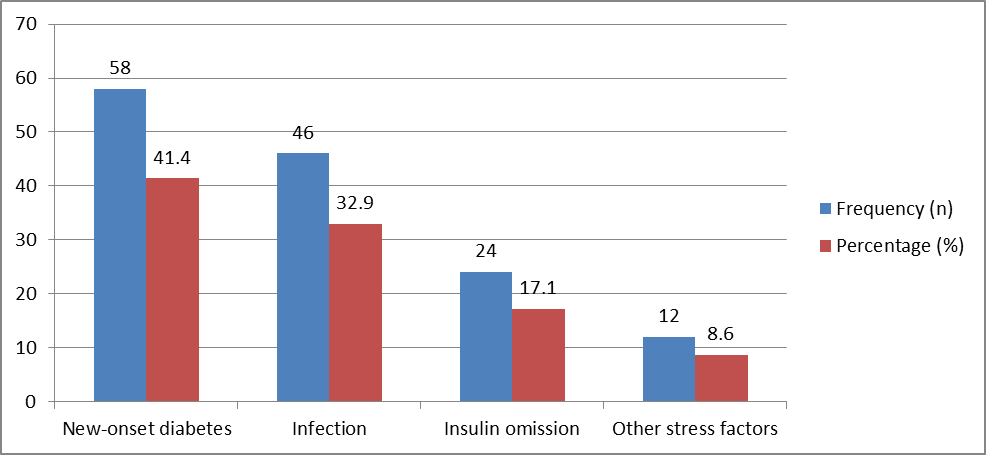
Figure 1: Precipitating Factors of DKA
Severity of DKA and Hospital Outcomes
DKA severity was assessed in categories and its relationship with outcomes was examined using ANOVA and post hoc test. This section examined the association between severity and duration of hospital stay, and mortality, with an escalation of outcomes as severity increases.
Table 3: Severity of DKA and Clinical Outcomes
|
Severity |
Frequency (%) |
Mean hospital stay (days) |
Mortality (%) |
|
Mild |
49 (35.0) |
4.2 ± 1.3 |
0 |
|
Moderate |
56 (40.0) |
6.8 ± 2.1 |
3.6 |
|
Severe |
35 (25.0) |
10.4 ± 3.5 |
17.1 |
Outcomes and Complications
Clinical outcomes and complications were evaluated using descriptive statistics and Mann–Whitney U test for non-parametric comparison of hospital stay between complicated and uncomplicated cases. This section also compared the incidence of major complications such as acute kidney injury, cerebral edema and hypokalemia.
Table 4: Outcomes and Complications
|
Outcome Variable |
Frequency (%) |
|
Full recovery |
118 (84.3) |
|
Recovery with complications |
11 (7.9) |
|
Mortality |
11 (7.9) |
|
Complication |
Frequency (%) |
|
Cerebral edema |
6 (4.3) |
|
Hypokalemia |
18 (12.9) |
|
Acute kidney injury |
9 (6.4) |
Association of Clinical Variables with Outcomes
We also examined the correlation between clinical factors and mortality using chi-square test and multivariate logistic regression. This helped to identify risk factors such as DKA severity, infection, and altered mental status that were associated with patient survival.
Table 5: Association of Clinical Variables with Outcomes
|
Variable |
Mortality (%) |
Survival (%) |
Test Value |
p-value |
|
Severe DKA |
17.1 |
82.9 |
χ² = 22.4 |
<0.001 |
|
Infection present |
13.0 |
87.0 |
χ² = 9.8 |
0.002 |
|
Altered consciousness |
19.6 |
80.4 |
χ² = 15.7 |
<0.001 |
Multivariate Analysis for Predictors of Mortality
Multivariate logistic regression was used to determine independent risk factors of death among children with DKA. The model used variables that were found to be significant on univariate analysis to adjust for confounding variables and calculate adjusted odds ratios.
Table 6: Multivariate Logistic Regression for Predictors of Mortality
|
Predictor |
Odds Ratio (OR) |
95% CI |
p-value |
|
Severe DKA |
4.8 |
1.9–11.9 |
0.001 |
|
Infection |
2.6 |
1.1–6.2 |
0.028 |
|
Altered consciousness |
3.9 |
1.5–9.8 |
0.004 |
|
Delayed presentation (>24h) |
5.2 |
2.0–13.3 |
<0.001 |
DISCUSSION :
Our study showed diabetic ketoacidosis (DKA) continues to pose a major challenge in the pediatric age group, with many patients presenting with moderate to severe disease [13,14]. Most children were aged 6-10 years and there was a slightly higher proportion of male patients. Symptoms like polyuria, polydipsia, vomiting and abdominal pain were typical of DKA. The high proportion of patients presenting with disturbed consciousness, especially in those with severe DKA, indicates a delay in presentation and the severity of DKA at presentation [15,16].
Infections were the most common precipitating event, followed by new onset of diabetes and insulin omission. This is an indicator of poor early detection, awareness and compliance with treatment in resource-poor settings [17,18]. The rate of recovery was high; but complications and deaths were mainly observed in individuals suffering from severe DKA. The strong correlation between the severity of DKA and unfavorable outcomes emphasizes the necessity of early identification and timely treatment. Additionally, infection and altered level of consciousness was found to be strongly associated with poor outcomes [19,20].
When compared to other literature, the incidence of DKA and the presence of severe symptoms in this study is higher than in high-income countries where early detection and established diabetes management programs are more prevalent. Similarly, the prominence of infection as the precipitating factor is more widely reported in the developing world, while insulin omission is a common precipitating factor in developed healthcare systems [21].
The presentation in this study is consistent with the global data on DKA, but the higher frequency of severe symptoms such as altered mental status is suggestive of a delay to seeking medical care. The death rate in this study was also higher than that reported in developed countries, where mortality rates of DKA in children is less than 1%. But the results are in line with other studies in similar socioeconomic contexts, where low access to health-care, delayed referral and monitoring of patients has been associated with adverse outcomes [22].
The link between the severity of DKA and a longer length of stay, complications and death has been previously reported and is consistent with the findings of this study [24]. Likewise, the role of infection and altered mental status as significant predictors of poor outcomes is consistent with other studies, suggesting that risk factors need to be aggressively managed in such patients [23].
Limitations
There were a few limitations to this study. As a single-center study, the results may be limited in their generalizability. This was a retrospective study, which may have led to missing data. Further, the study did not measure long-term follow-up and outcomes, which would help to understand the complications and recurrence of DKA. The impact of socioeconomic and educational factors, which may affect disease presentation and outcomes, were not examined.
Future Recommendations
Sweeping studies with multiple study centre would be best for future research representativeness. Longitudinal studies are recommended for obtaining more in-depth information, including follow-up. We also need to take into account the role of socioeconomic, educational, and access to health care on DKA risk and outcome. Education to support early diagnosis of diabetes, education of the parents and improved access to insulin may prevent DKA among children. Better health services and guidelines for treatment of DKA may further decrease the death rate in developing countries.
CONCLUSION :
DKA remains a common serious disease in children (especially in developing nations) with many presenting with moderate to severe DKA. Infection and late presentation were the main factors. The severity and infection in DKA and/or decreased level of consciousness at presentation were associated with adverse outcome. Early recognition, management and awareness of DKA needs to be enhanced to avoid complications and mortality in children.
REFERENCES:
1. Ogbera, A.O., Awobusuyi, J., Unachukwu, C. et al. Clinical features, predictive factors and outcome of hyperglycaemic emergencies in a developing country. BMC Endocr Disord 9, 9 (2009). https://doi.org/10.1186/1472-6823-9-9
2. Onyiriuka, A.N., Ifebi, E. Ketoacidosis at diagnosis of type 1 diabetes in children and adolescents: frequency and clinical characteristics. J Diabetes Metab Disord 12, 47 (2013). https://doi.org/10.1186/2251-6581-12-47
3. Atkilt HS, Turago MG, Tegegne BS. Clinical characteristics of diabetic ketoacidosis in children with newly diagnosed type 1 diabetes in Addis Ababa, Ethiopia: a cross-sectional study. PloS one. 2017 Jan 30;12(1):e0169666. https://doi.org/10.1371/journal.pone.0169666
4. Kipasika H, Majaliwa E, Kamala B, Mungai LJ. Clinical presentation and factors associated with diabetic ketoacidosis at the onset of type-1 diabetes mellitus in children and adolescent at Muhimbili National Hospital, Tanzania: a cross section study. Int J Diabetes Clin Res. 2020;7(3):126 doi10.23937/2377-3634/1410126
5. Passanisi, S., Salzano, G., Basile, P. et al. Prevalence and clinical features of severe diabetic ketoacidosis treated in pediatric intensive care unit: a 5-year monocentric experience. Ital J Pediatr 49, 58 (2023). HTTPS://DOI.ORG/10.1186/S13052-023-01448-1
6. Gebeyehu K, Tefera M, Melaku B, Yeshewas S. Assessment of clinical profiles, and treatment outcomes for children with diabetic ketoacidosis, in two hospitals selected from Addis Ababa, Ethiopia, 2020. The Ethiopian Journal of Health Development. 2022 Jun 28;36(2). HTTPS://DOI.ORG/10.20372/EJHD.V36I2.5180
7. Poovazhagi V. Risk factors for mortality in children with diabetic keto acidosis from developing countries. World journal of diabetes. 2014 Dec 15;5(6):932. doi: 10.4239/wjd.v5.i6.932
8. Jayashree M, Singhi S. Diabetic ketoacidosis predictors of outcome in a pediatric intensive care unit of a developing country. Pediatric critical care Medicine. 2004 Sep 1;5(5):427-33. DOI: 10.1097/01.PCC.0000137987.74235.5E
9. Al Thiabat H, Elbanna S, Quadier M, Dayyeh M, Abunnadi B, Obeidat H, Abu Shakhdam A, Elfarraj H, Almomani MA, Abu-Ekteish F. Clinical presentation and outcomes of diabetic ketoacidosis in pediatric and adolescent patients at a tertiary hospital in Jordan. Frontiers in Pediatrics. 2025 Jul 22;13:1635037. https://doi.org/10.3389/fped.2025.1635037
10. Razavi Z, Hamidi F. Diabetic ketoacidosis: demographic data, clinical profile and outcome in a tertiary care hospital. Iranian Journal of Pediatrics. 2017 Jun 1;27(27):e11518. doi:https://doi.org/10.5812/ijp.7649
11. Poon SW, Tung JY, Wong WH, Cheung PT, Fu AC, Pang GS, To SW, Wong LM, Wong WY, Chan SY, Yau HC. Diabetic ketoacidosis in children with new-onset type 1 diabetes mellitus: demographics, risk factors and outcome: an 11 year review in Hong Kong. Journal of Pediatric Endocrinology and Metabolism. 2022 Sep 27;35(9):1132-40. https://doi.org/10.1515/jpem-2022-0255
12. Eledrisi MS, Alkabbani H, Aboawon M, Ali A, Alabdulrazzak I, Elhaj M, Ahmed A, Alqahwachi H, Daghfal J, Beshyah SA, Malik RA. Clinical characteristics and outcomes of care in patients hospitalized with diabetic ketoacidosis. Diabetes research and clinical practice. 2022 Oct 1;192:110041. https://doi.org/10.1016/j.diabres.2022.110041
13. Große J, Hornstein H, Manuwald U, Kugler J, Glauche I, Rothe U. Incidence of diabetic ketoacidosis of new-onset type 1 diabetes in children and adolescents in different countries correlates with human development index (HDI): an updated systematic review, meta-analysis, and meta-regression. Hormone and Metabolic Research. 2018 Mar;50(03):209-22. DOI: 10.1055/s-0044-102090
14. Ashibogwu EM, Edeh GC, Ekwebene OC, Obiekwe SJ, Chiekezie CF, Iheakanwa O, Abalihe UO, Anisiobi PU. Prevalence, patterns of clinical presentation, and the outcome of treatment of diabetes mellitus among paediatric patients in a tertiary care facility. Int J Res Med Sci. 2024 Jan;12:50-6. https://dx.doi.org/10.18203/2320-6012.ijrms20233976
15. Musoma SN, Omar A, Mutai BC, Laigong P. Outcomes of children and adolescents admitted with diabetic ketoacidosis at Kenyatta National Hospital (KNH), Kenya. Journal of Diabetes Research. 2020;2020(1):8987403. https://doi.org/10.1155/2020/8987403
16. Lah Tomulić K, Matko L, Verbić A, Milardović A, Severinski S, Kolić I, Baraba Dekanić K, Šerifi S, Butorac Ahel I. Epidemiologic characteristics of children with diabetic ketoacidosis treated in a pediatric intensive care unit in a 10-year-period: single centre experience in Croatia. Medicina. 2022 May 5;58(5):638. https://doi.org/10.3390/medicina58050638
17. Abdul‐Rasoul M, Al‐Mahdi M, Al‐Qattan H, Al‐Tarkait N, Alkhouly M, Al‐Safi R, Al‐Shawaf F, Mahmoud H. Ketoacidosis at presentation of type 1 diabetes in children in Kuwait: frequency and clinical characteristics. Pediatric diabetes. 2010 Aug;11(5):351-6. https://doi.org/10.1111/j.1399-5448.2009.00600.x
18. Habib HS. Frequency and clinical characteristics of ketoacidosis at onset of childhood type 1 diabetes mellitus in Northwest Saudi Arabia. Saudi medical journal. 2005;26(12):1936-9. https://doi.org/10.15537/1658-3175.3238
19. Assefa, B., Zeleke, H., Murugan, R. et al. Incidence and predictors of diabetic ketoacidosis among children with diabetes in west and east Gojjam zone referral hospitals, northern Ethiopia, 2019. Ital J Pediatr 46, 164 (2020). https://doi.org/10.1186/s13052-020-00930-4
20. Huang, A., Chen, Q., Yang, W. et al. Clinical characteristics of 683 children and adolescents, aged 0–18 years, newly diagnosed with type 1 diabetes mellitus in Henan Province: a single-center study. BMC Pediatr 23, 39 (2023). https://doi.org/10.1186/s12887-023-03847-z
21. Aynalem, M.W., Nigusse, B., Legesse, Y. et al. Clinical profile of diabetic ketoacidosis and its severity in adults: evidence from ALERT Comprehensive Specialized Hospital. BMC Endocr Disord 26, 110 (2026). https://doi.org/10.1186/s12902-026-02224-y
22. Sokwalla, S., Shah, J., Chauhan, S. et al. Clinical presentation and outcomes of care in adults with diabetic ketoacidosis pre-COVID-19 and during-COVID-19 at a tertiary, referral hospital in Nairobi, Kenya. BMC Endocr Disord 24, 127 (2024). https://doi.org/10.1186/s12902-024-01610-8
23. Cherubini, V., Grimsmann, J.M., Åkesson, K. et al. Temporal trends in diabetic ketoacidosis at diagnosis of paediatric type 1 diabetes between 2006 and 2016: results from 13 countries in three continents. Diabetologia 63, 1530–1541 (2020). https://doi.org/10.1007/s00125-020-05152-1.