Breastfeeding Practices and Determinants of Child Growth in Punjab: A Hospital-Based Cross-Sectional Study
- Saria Seemab , Consultant pediatrician District headquarters Hospital Toba Tek Singh
- Ali Asghar , Pediatrician District headquarters Hospital Toba Tek Singh
- Farhan Javaid , Chief Consultant pediatrician District headquarters Hospital Toba Tek Singh
Article Information:
Abstract:
Optimal breastfeeding is a cornerstone of infant nutrition and survival, contributing significantly to healthy growth and protection against infectious diseases. However, adherence to exclusive breastfeeding recommendations remains suboptimal in many low- and middle-income countries, including Pakistan, where socio-cultural and healthcare-related factors influence infant feeding practices. Objective: To assess breastfeeding practices and identify determinants influencing infant feeding behaviors and child growth outcomes among mother–child pairs in a district-level hospital setting in Pakistan. Methods: A hospital-based cross-sectional study was conducted from January 2023 to December 2024 at the paediatric ward of District Headquarters (DHQ) Hospital, Toba Tek Singh, Pakistan. A total of 2,190 mother–child pairs were enrolled using a structured and pre-tested questionnaire capturing socio-demographic characteristics, maternal health factors, and infant feeding practices. Data were analyzed using RStudio. Descriptive statistics were computed, followed by binary logistic regression to identify determinants of breastfeeding practices. Survival analysis was applied to evaluate breastfeeding duration. A p-value of <0.05 was considered statistically significant. Results: Bottle feeding was found to be more prevalent than exclusive breastfeeding across most age groups and socio-demographic strata. Rural residence was significantly associated with higher odds of bottle feeding compared to urban settings. No substantial variation in feeding practices was observed with respect to maternal education, employment status, family system, or child gender. A higher proportion of hospital admissions was observed among bottle-fed children. The primary reported reasons for discontinuation or avoidance of breastfeeding included perceived insufficient milk supply, lactation difficulties, maternal psychological conditions, and caesarean delivery. Conclusion: Breastfeeding practices in this population remain suboptimal, with a concerning predominance of bottle feeding. Targeted interventions, including structured breastfeeding counseling, enhanced lactation support services, and community-based awareness programs—particularly in rural areas—are essential to improve exclusive breastfeeding rates and promote optimal child growth outcomes.
Keywords:
Article :
INTRODUCTION :
Breastfeeding is widely recognized as the optimal method of infant feeding due to its unique nutritional composition and its essential role in supporting healthy growth and development during early life. Breast milk provides all the necessary nutrients required by infants and offers protection against a wide range of common childhood illnesses. International guidelines recommend exclusive breastfeeding for the first six months of life, followed by the introduction of appropriate complementary foods while continuing breastfeeding up to two years of age or beyond (1,2).
In addition to its nutritional value, breastfeeding provides significant immunological protection. Breast milk contains antibodies and other protective factors that help safeguard infants against infections. It has been associated with a reduced risk of respiratory tract infections, otitis media, sudden infant death syndrome (SIDS), and gastrointestinal illnesses (3,4). Furthermore, evidence suggests that breastfeeding contributes to improved neurodevelopmental outcomes, including better cognitive, verbal, spatial, and social abilities (5).
Breastfeeding also offers important health benefits for mothers. It has been shown to reduce the risk of several maternal conditions, including breast cancer and cervical cancer (6). Moreover, breastfeeding is a convenient and cost-effective feeding method, as breast milk is readily available, hygienic, and naturally maintained at an appropriate temperature. This eliminates the need for formula preparation and reduces the financial burden on families.
Despite these well-established benefits and global recommendations, exclusive breastfeeding rates remain suboptimal in many low- and middle-income countries, including Pakistan. Breastfeeding practices are influenced by a complex interaction of maternal, socio-economic, cultural, and healthcare-related factors, resulting in considerable variation in breastfeeding initiation and continuation (7). In Pakistan, inadequate breastfeeding practices continue to contribute to poor nutritional status and suboptimal growth among children, emphasizing the need for context-specific evidence to guide public health interventions (8).
Hospital-based studies provide a valuable opportunity to examine breastfeeding practices and their associated factors within defined healthcare settings. Understanding local trends and barriers is essential for developing targeted strategies to improve breastfeeding rates and enhance child health outcomes. This study was conducted at the District Headquarters (DHQ) Hospital, Toba Tek Singh, Pakistan, to assess breastfeeding practices and identify factors influencing exclusive breastfeeding and child growth.
Materials and Methods:
Study Design and Setting
A hospital-based cross-sectional study was conducted over a two-year period from January 2023 to December 2024 in the pediatric ward of District Headquarters (DHQ) Hospital, Toba Tek Singh, Pakistan. The study aimed to evaluate breastfeeding practices and identify determinants influencing breastfeeding behavior and child growth among mothers attending the hospital during the study period. DHQ Hospital Toba Tek Singh serves as a major secondary-care referral center, catering to both urban and rural populations and providing a diverse study population (1).
Study Population and Sampling
The study population consisted of mother–child pairs presenting to the pediatric ward during the study period. A total of 2,190 participants were included, with data obtained from mothers regarding their children.
A non-probability consecutive sampling technique was used, whereby all eligible mother–child pairs meeting the inclusion criteria were recruited until the required sample size was achieved. This approach is commonly applied in hospital-based observational studies to ensure feasibility and inclusion of participants from varied socio-economic and residential backgrounds (2).
Both quantitative and qualitative data were collected to capture socio-demographic characteristics, maternal and child health indicators, and social factors influencing breastfeeding practices.
Data Collection Procedures
Data were collected using a pre-tested, structured questionnaire administered through face- to-face interviews with mothers. The questionnaire obtained information on maternal socio-demographic characteristics, including education level, residential status (urban or rural), and family structure.
Clinical and obstetric variables such as mode of delivery, maternal health conditions, and child health status were also recorded. In addition, detailed information on breastfeeding practices, including duration of exclusive breastfeeding and factors influencing feeding behavior, was collected.
Interviews were conducted by trained healthcare personnel to ensure consistency and reliability. Participation was voluntary, and informed consent was obtained from all respondents prior to enrollment. Confidentiality of participant information was maintained in accordance with ethical research standards (3).
Inclusion and Exclusion Criteria
Inclusion Criteria
• Mothers who were currently breastfeeding at the time of the survey
• Infants aged 0 to 24 months
• Mothers who provided informed consent and agreed to participate
Exclusion Criteria
• Children older than 24 months
• Mothers who declined participation or were unable to complete the interview
Data Management and Statistical Analysis
All collected data were checked for completeness and consistency prior to analysis. Data entry, coding, and statistical analyses were performed using RStudio (R statistical software).
Descriptive statistics were used to summarize study variables. Categorical variables were presented as
frequencies and percentages, while continuous variables were summarized using means with standard deviations or medians with interquartile ranges, as appropriate.
Binary logistic regression analysis was performed to identify factors associated with breastfeeding practices, particularly exclusive breastfeeding. Adjusted odds ratios (AORs) with 95 percent confidence intervals (CIs) were calculated to estimate the strength of associations.
Survival analysis techniques were applied to assess breastfeeding duration and time to discontinuation, allowing identification of factors influencing breastfeeding practices over time (4).
All statistical tests were two-sided, and a p-value of less than 0.05 was considered statistically significant.
Results and Discussion:
Age Distribution of Children Included in the Study
The figure presents the age distribution of children enrolled in the study conducted at DHQ Toba Tek Singh, Pakistan. Children were categorized into three age groups: 0–6 months, 6–12 months, and 12–24 months. The most significant proportion of participants belonged to the 12–24 months age group, followed closely by infants aged 0–6 months, while the 6–12 months group comprised the smallest number of children.
The relatively balanced distribution across age groups enhances the representativeness of the sample, allowing for a meaningful analysis of breastfeeding practices and their impact on child growth at various developmental stages. Adequate representation of infants in the 0–6 months category is significant, as this period is critical for exclusive breastfeeding, which is known to have important implications for early growth and health outcomes. Similarly, inclusion of older infants and young children (6–24 months) enables assessment of continued breastfeeding practices and complementary feeding patterns, which are key determinants of growth during later infancy and early childhood.
Overall, this age distribution supports the study's objective of examining trends in breastfeeding and factors affecting breastfeeding and children's growth in the local population.
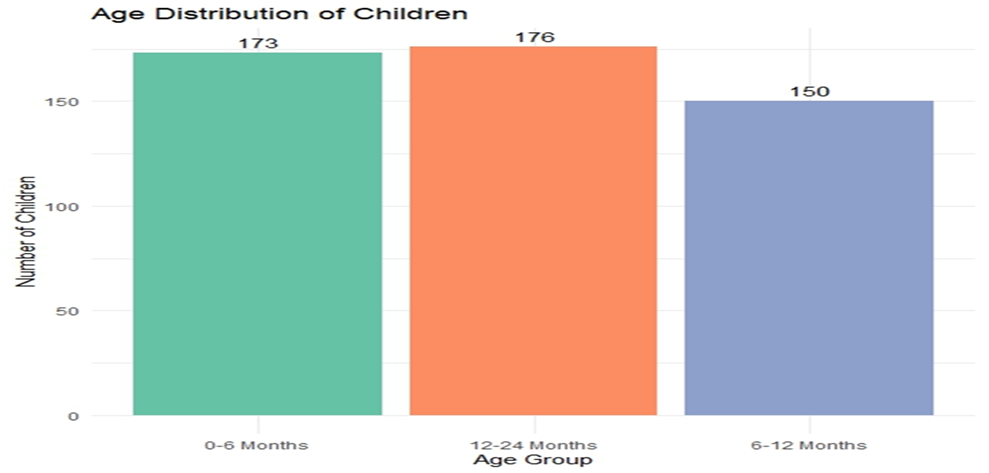 Figure 1. Age distribution of children enrolled in the study. The bar chart shows the number of children in three age groups: 0–6 months (n = 173), 6–12 months (n = 150), and 12–24 months (n = 176) at DHQ Toba Tek Singh, Pakistan.
Comparison of Infant Feeding Practices by Residential Area
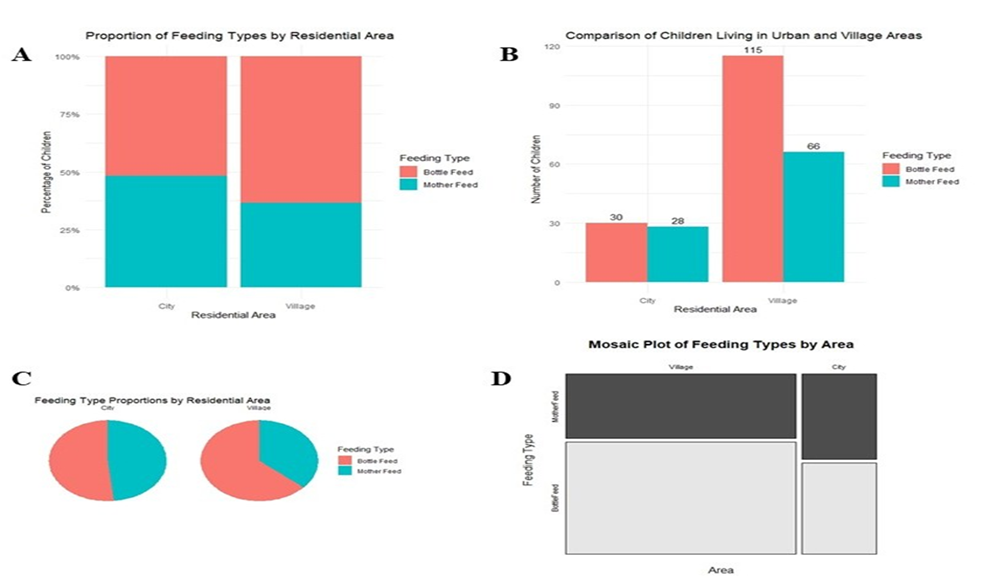
The set of figures collectively illustrates the distribution and proportion of infant feeding practices among children living in urban (city) and rural (village) areas of DHQ Toba Tek Singh, Pakistan. Feeding practices were categorized into two types: mother feeding (breastfeeding) and bottle feeding. The data are presented using stacked bar charts, grouped bar charts, pie charts, and a mosaic plot to provide a comprehensive comparison.
Overall, bottle feeding was more prevalent than mother feeding in both residential settings; however, this difference was more pronounced in rural areas. In urban areas, the proportion of mother-fed children was relatively higher and nearly comparable to that of bottle-fed children, indicating better breastfeeding practices in city settings. In contrast, rural areas showed a substantially higher number and proportion of bottle-fed children, with fewer children receiving mother feeding.
The grouped bar chart further highlights this disparity by showing that the absolute number of bottle-fed children in villages was markedly higher than that in cities, while mother feeding remained comparatively lower. The pie charts reinforce these findings by visually demonstrating a larger share of bottle feeding among rural children. The mosaic plot highlights both the prevalence of bottle feeding and the larger overall child population in rural areas, indicating that rural residence is associated with lower breastfeeding rates.
These findings suggest that residential location is an essential factor influencing infant feeding practices. Possible contributing factors include limited access to breastfeeding education and counseling, lower maternal literacy, cultural practices, socio-economic constraints, and reduced availability of maternal and child health services in rural areas.
The higher prevalence of bottle feeding in villages may negatively affect child growth and nutritional outcomes, increasing the risk of malnutrition and infectious diseases.
Targeted interventions focusing on breastfeeding promotion, especially in rural communities, are essential. Strengthening maternal education, improving healthcare outreach, and enforcing regulations on breast milk substitutes may help improve breastfeeding trends and contribute positively to children's growth and overall health.
Figure 2. Feeding practices among children by residential area at DHQ Toba Tek Singh, Pakistan. The figure presents multiple graphical representations comparing mother feeding (breastfeeding) and bottle feeding among children living in urban (city) and rural (village) areas. The stacked bar chart shows percentage distribution, the grouped bar chart displays absolute numbers, the pie charts illustrate proportional differences within each region, and the mosaic plot summarizes the relationship between residential area and feeding type.
Association of Infant Feeding Practices with Family System, Maternal Education, and Maternal Working Status (socio-economic status)
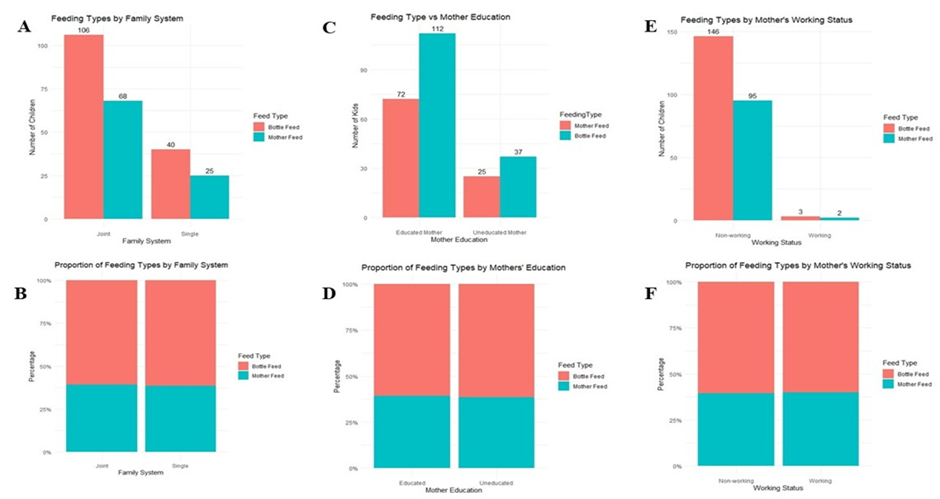
The presented figures examine the relationship between infant feeding practices and key socio-demographic factors, including family system, mother's education, and mother's working status, among children attending DHQ Toba Tek Singh, Pakistan. Feeding practices were categorized into two types: mother feeding (breastfeeding) and bottle feeding, and are illustrated using both absolute numbers and proportional distributions.
Regarding the family system, children living in joint families demonstrated higher absolute numbers of both bottle feeding and mother feeding compared to those from single (nuclear) families. However, bottle feeding was more prevalent than mother feeding in both family systems. The proportional distribution indicates only minor differences between joint and single families, suggesting that although joint families may provide additional caregiving support, this does not necessarily translate into higher breastfeeding rates. Cultural norms, shared decision-making, and the influence of elders in joint families may sometimes favor the early introduction of bottle feeding.
Analysis of maternal education revealed that educated mothers accounted for a larger proportion of children in the study and exhibited higher absolute numbers of both breastfeeding and bottle-feeding practices. Nevertheless, bottle feeding remained more common than mother feeding among both educated and uneducated mothers. The proportional analysis suggests only slight variation between the two groups, indicating that maternal education alone may not be sufficient to ensure optimal breastfeeding practices. This highlights the possible influence of other factors such as employment demands, misconceptions about breastfeeding adequacy, and aggressive marketing of breast milk substitutes.
The maternal working status revealed that the vast majority of mothers were non-working. Among non-working mothers, bottle feeding was still more common than mother feeding, while minimal numbers were observed among working mothers. Proportional analysis revealed minimal differences between working and non-working mothers, although the interpretation for working mothers is limited due to the small sample size. These findings suggest that factors beyond employment status—such as lack of breastfeeding counseling, social support, and healthcare guidance—may play a more significant role in determining feeding practices.
Overall, these results indicate that suboptimal breastfeeding practices persist across different family structures, education levels, and employment statuses. This underscores the need for comprehensive breastfeeding promotion strategies that extend beyond maternal education and employment considerations, focusing instead on community-wide awareness, family involvement, and strengthening breastfeeding support services at healthcare facilities.
Figure 3. Relationship between infant feeding practices and selected socio-demographic factors at DHQ Toba Tek Singh, Pakistan. The figure presents multiple bar charts illustrating the distribution and proportion of mothers who feed their children (breastfeeding) and those who use bottles (bottle feeding) according to family system (joint vs. single), mother's education (educated vs. uneducated), and mother's working status (working vs. working). Absolute numbers and percentage distributions are shown to highlight patterns and differences in feeding practices.
Infant Feeding Practices by Gender of the Child
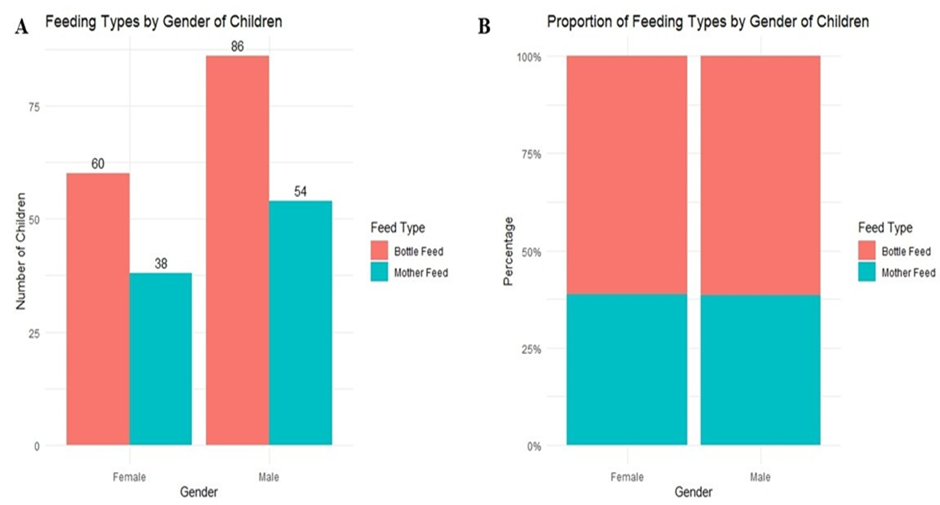
The figures illustrate the distribution and proportion of infant feeding practices among children attending DHQ Toba Tek Singh, Pakistan, according to their gender. Feeding practices were categorized into mother feeding (breastfeeding) and bottle feeding, and are presented using both absolute numbers and proportional comparisons.
In absolute terms, a higher number of male children received both bottle feeding and mother feeding compared to female children. Bottle feeding was more common than mother feeding in both genders, indicating a general preference or reliance on bottle feeding regardless of the child's gender. However, the difference between feeding types appears slightly more pronounced among male children.
The proportional analysis demonstrates that the relative distribution of feeding practices is remarkably similar between male and female children. In both groups, bottle feeding accounts for a larger proportion than mother feeding, with only minor differences in percentages. This suggests that gender-based discrimination in feeding practices is minimal in this study population, and infant feeding decisions are largely independent of the child's sex.
These findings indicate that while gender does not appear to influence breastfeeding practices in this setting significantly, the overall prevalence of bottle feeding remains high. This highlights the importance of universal breastfeeding promotion strategies that target all caregivers, rather than gender-specific interventions, to enhance breastfeeding rates and promote optimal child growth and health outcomes.
Figure 4. Feeding practices by gender of children at DHQ Toba Tek Singh, Pakistan. The figure shows the distribution and proportion of mother feeding (breastfeeding) and bottle feeding among male and female children. Absolute numbers are presented in the bar chart, while the stacked bar chart illustrates the percentage distribution of feeding types by gender.
Hospital Admissions and Reported Reasons for Discontinuation of Breastfeeding
The figures illustrate the relationship between infant feeding practices and child health outcomes, as well as the major maternal and infant-related factors contributing to the discontinuation or non-practice of breastfeeding among children attending DHQ Toba Tek Singh, Pakistan.
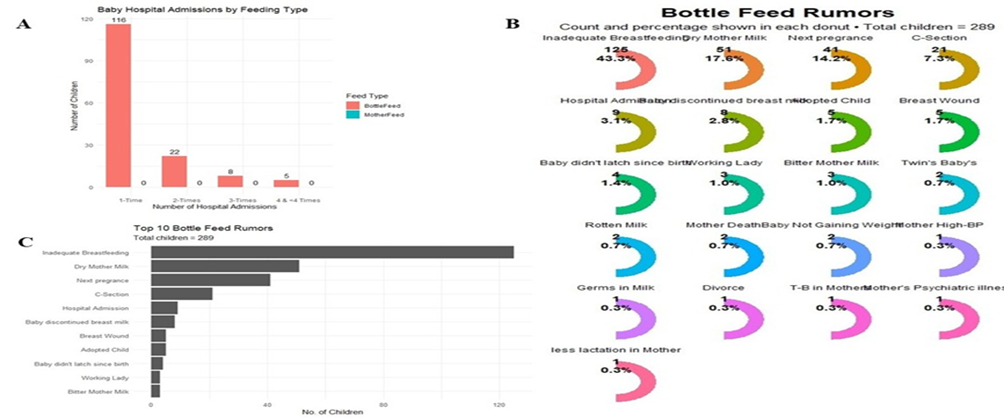
The analysis of hospital admissions by feeding type shows that hospital admissions were observed exclusively among bottle-fed children, with the highest number of admissions occurring after a single hospitalization episode, followed by repeated admissions. No hospital admissions were reported among exclusively mother-fed (breastfed) children. This finding highlights the protective role of breastfeeding against childhood illnesses that require hospital care, likely due to the immunological and nutritional benefits of breast milk. Increased hospitalization among bottle-fed children may reflect higher susceptibility to infections, gastrointestinal illnesses, and poor growth outcomes.
The second figure presents a detailed overview of the reported reasons for discontinuation or inability to practice breastfeeding. The most frequently reported factor was inadequate breast milk, followed by reduced lactation in the mother, maternal psychiatric illness, working mother status, and caesarean section delivery. Other notable reasons included repeated hospital admissions of the child, maternal medical conditions (such as hypertension, tuberculosis, or death), breast-related problems (wounds, pain, perceived bitter milk), and matters related to the infant, such as poor weight gain or failure to latch since birth. Social factors, including divorce, adoption, and subsequent pregnancy, were also reported but less frequently.
These findings underscore that breastfeeding practices are shaped by a complex interplay of biological, medical, psychological, and socio-economic factors. Many of the reported reasons are potentially preventable or manageable through timely breastfeeding counseling, lactation support, maternal mental health services, and workplace-friendly policies that support breastfeeding. Addressing these barriers through strengthened health education and postnatal support programs could significantly improve breastfeeding rates, contributing to better child growth and reduced morbidity.
Figure 5. Hospital admissions and reasons for discontinuation of breastfeeding among children at DHQ Toba Tek Singh, Pakistan.
The figure illustrates (A) the number of hospital admissions among children according to feeding type, showing admissions predominantly among bottle-fed children, and (B) the distribution of reported maternal, infant, social factors leading to discontinuation or non-practice of breastfeeding, presented as frequency counts.
CONCLUSION :
This hospital-based study provides important insights into breastfeeding practices and their associated determinants among children attending DHQ Toba Tek Singh, Pakistan. The findings demonstrate that bottle feeding is more prevalent than breastfeeding across all age groups, residential settings, socio-demographic categories, and gender groups. Despite inclusion of a broad pediatric age range, exclusive breastfeeding during the first six months of life was not consistently practiced, indicating suboptimal adherence to international feeding recommendations.
Residential location emerged as a key determinant of infant feeding practices, with significantly lower breastfeeding rates observed in rural areas compared to urban settings. Socio-demographic variables including family structure, maternal education, and maternal employment showed limited variation, suggesting that suboptimal breastfeeding is a widespread issue affecting multiple population groups. Importantly, child gender did not significantly influence feeding practices, indicating minimal gender-based disparity in this population.
The study also highlights the protective effect of breastfeeding, as hospital admissions were observed predominantly among bottle-fed children. Multiple maternal, infant-related, medical, and social factors contributed to breastfeeding discontinuation, with perceived insufficient milk supply being the most frequently reported reason. These findings reflect the multifactorial nature of breastfeeding behavior, influenced by biological, psychological, and health-system factors.
Overall, breastfeeding practices in this setting remain suboptimal. Strengthening breastfeeding promotion, lactation support services, and community-based interventions is essential to improve child growth outcomes and reduce preventable childhood morbidity.
Future Perspectives
Future interventions should prioritize strengthening breastfeeding counseling and lactation support at both hospital and community levels, particularly in rural areas where bottle feeding is more prevalent. Training healthcare providers to deliver standardized, evidence-based breastfeeding guidance during antenatal, postnatal, and pediatric visits may help address misconceptions regarding milk insufficiency and improve maternal confidence.
Community-based programs involving family members, especially in joint family systems, are essential to support breastfeeding initiation and continuation by addressing cultural beliefs and shared decision-making patterns. Integration of maternal mental health screening into postnatal care may also help reduce psychological barriers to breastfeeding.
At the policy level, strict enforcement of regulations on the marketing of breast milk substitutes, along with implementation of workplace-friendly breastfeeding policies, is crucial. Future research should adopt longitudinal study designs to better assess causal relationships between breastfeeding practices and child growth outcomes. Additionally, qualitative studies exploring maternal perceptions and healthcare experiences may provide deeper insight into barriers and facilitators of breastfeeding.
Collectively, these strategies can significantly improve breastfeeding practices and contribute to better maternal and child health outcomes in Pakistan and similar resource-limited settings.
Limitations of the Study
This study has several limitations. First, the cross-sectional design limits the ability to establish causal relationships between breastfeeding practices and child growth outcomes. Second, the study was conducted in a single hospital, which may limit generalizability to the wider population.
Third, consecutive sampling may introduce selection bias as participants were recruited only from hospital attendees. Fourth, data were based on maternal self-reporting, which may be affected by recall bias and social desirability bias.
Finally, the study did not include biochemical or anthropometric validation of nutritional status beyond reported information, which may limit objective assessment of child growth outcomes.
References :
1. Victora CG, Bahl R, Barros AJD, França GVA, Horton S, Krasevec J, et al. Breastfeeding in the 21st century: epidemiology, mechanisms, and lifelong effect. Lancet. 2016;387(10017):475-490. doi:10.1016/S0140-6736(15)01024-7
2. World Health Organization. Infant and young child feeding. WHO; 2021. Available from: https://www.who.int/news-room/fact-sheets/detail/infant-and-young-child-feeding
3. UNICEF. Breastfeeding: a mother’s gift for every child. UNICEF; 2018. Available from: https://www.unicef.org
4. Rollins NC, Bhandari N, Hajeebhoy N, Horton S, Lutter CK, Martines JC, et al. Why invest, and what it will take to improve breastfeeding practices? Lancet. 2016;387(10017):491-504. doi:10.1016/S0140-6736(15)01044-2
5. Horta BL, Victora CG. Short-term effects of breastfeeding: a systematic review on the benefits of breastfeeding on child health. WHO; 2013.
6. Kramer MS, Kakuma R. Optimal duration of exclusive breastfeeding. Cochrane Database Syst Rev. 2012;8:CD003517. doi:10.1002/14651858.CD003517.pub2
7. Chowdhury R, Sinha B, Sankar MJ, Taneja S, Bhandari N, Rollins N, et al. Breastfeeding and maternal health outcomes: a systematic review and meta-analysis. Acta Paediatr. 2015;104(S467):96-113. doi:10.1111/apa.13102
8. Black RE, Victora CG, Walker SP, Bhutta ZA, Christian P, de Onis M, et al. Maternal and child undernutrition and overweight in low-income and middle-income countries. Lancet. 2013;382(9890):427-451. doi:10.1016/S0140-6736(13)60937-X
9. Lamberti LM, Zakarija-Grković I, Fischer Walker CL, et al. Breastfeeding for reducing the risk of childhood infections. PLoS One. 2013;8(2):e58152. doi:10.1371/journal.pone.0058152
10. Anderson JW, Johnstone BM, Remley DT. Breast-feeding and cognitive development: a meta-analysis. Am J Clin Nutr. 1999;70(4):525-535. doi:10.1093/ajcn/70.4.525
11. Ogbo FA, Eastwood J, Page A, Arora A, McKenzie A, Jalaludin B, et al. Determinants of suboptimal breastfeeding practices in Nigeria and similar settings. Int Breastfeed J. 2017;12:12. doi:10.1186/s13006-017-0105-0
12. Senarath U, Dibley MJ, Agho KE. Factors associated with non-exclusive breastfeeding in South Asia. Int Breastfeed J. 2010;5:14. doi:10.1186/1746-4358-5-14
13. Victora CG, Bahl R, Barros AJD, et al. Global breastfeeding trends and inequalities. Lancet Glob Health. 2021;9(3):e225-e237. doi:10.1016/S2214-109X(20)30477-4
14. National Institute of Population Studies (NIPS) [Pakistan], ICF. Pakistan Demographic and Health Survey 2017-18. Islamabad, Pakistan; 2019.
15. Sinha B, Chowdhury R, Sankar MJ, Martines J, Taneja S, Bhandari N, et al. Interventions to improve breastfeeding outcomes. Cochrane Database Syst Rev. 2015;CD011512. doi:10.1002/14651858.CD011512.pub2