Evaluation of Healing by Placement of Alveogyl and Warm Saline Irrigation in the Management of Dry Socket: An Interventional Study
- Veeramuthu M , Department of Oral and Maxillofacial Surgery, Karpaga Vinayaga Institute of Dental Sciences, Chengalpattu, India
- Balaguhan Balasubramanian , Department of Oral and Maxillofacial Surgery, Karpaga Vinayaga Institute of Dental Sciences, Chengalpattu, India
- G R Karthikeyan , Department of Oral and Maxillofacial Surgery, Karpaga Vinayaga Institute of Dental Sciences, Chengalpattu, India
- Deepak velu , Department of Oral and Maxillofacial Surgery, Karpaga Vinayaga Institute of Dental Sciences, Chengalpattu, India
- Sakthisri V , Department of Oral and Maxillofacial Surgery, Karpaga Vinayaga Institute of Dental Sciences, Chengalpattu, India
- Mathanmohan Ayyathurai , Department of Oral and Maxillofacial Surgery, Karpaga Vinayaga Institute of Dental Sciences, Chengalpattu, India
Article Information:
Abstract:
Purpose: To prospectively evaluate the effectiveness of Alveogyl intra alveolar dressings for the management of dry socket and compare it with normal saline irrigation. Materials And Methods: From April 2025 to September 2025, all participants who were diagnosed with dry socket and the participants who have met our inclusion and exclusion criteria were included in our study. Patients with dry socket were randomly assigned to one of the two groups: Group A Patients treated with Alveogyl or Group B- Patients treated with warm saline. The two groups were compared in terms of pain relief and socket healing. Results: Chi Square test revealed a statistically significant difference (P< 0.005) in pain scores between day 1, 4 and 7 in patients treated with Alveogyl (P value- 0.000*) as well as in patients treated with warm saline (P value- 0.000*). Conclusion: Warm saline irrigation was found to be less effective than Alveogyl in the treatment of dry sockets. Trial registration: Clinical Trials Registry–India- CTRI/2025/04/085273
Keywords:
Article :
INTRODUCTION :
The most common complication that occurs after a dental extraction is dry socket. The first time the term ‘dry socket’ appeared in literature was in 1896, by Crawford. And it is defined as "post-operative pain in and around the dental alveolus, which increases in severity at some moment between the first and the third day after the dental extraction, accompanied by partial or total disintegration of the intra-alveolar clot, causing a foul smell" [1]. The cause of alveolar osteitis has yet to be firmly established. Multiple factors have been implicated in its etiology, including the level of experience of the surgeon, surgical trauma, smoking, use of oral contraceptives, perioperative corticosteroids, reduced regional blood supply and bacterial contamination. An increased incidence of alveolar osteitis occurs in the presence of pericoronitis, periapical infection, periodontitis, gingivitis and in patients with poor oral hygiene. The pathogenesis appears to result from failure of formation or fibrinolysis of the blood clot within the extraction socket following conversion of plasminogen into plasmin [2]. Age, gender, use of oral contraceptives, tobacco cigarette smoking, tooth location, bone and soft tissue damage from problematic extractions, poor oral hygiene, the amount of vasoconstrictor given along with local anaesthetics used, operative and postoperative management, and operator skill are few of the many denominators that have been linked [3].
The main reason of dry socket is thought to be local fibrinolytic activity [4]. The activation of the plasminogen pathway, which is caused by secondary activator chemicals released by bacteria or direct physiological activators after alveolar osteoid cells, results in fibrinolysis [5]. The condition at the extraction site is characterized by exposure of the underlying bone. Pain typically appears on the second or third day after the extraction and usually lasts either with or without treatment for about 10-15 days. And it is common for the pain to radiate to the ear and ipsilateral side of the head. There is usually no healthy post-extraction blood clot in the socket, which may be empty or contain fragments of a disintegrating blood clot [1].
There are many different ways to treat this excruciating disease, including inserting drugs like Alveogyl, zinc oxide eugenol, chlorhexidine, metronidazole, olive oil-black seed paste, and honey straight into the empty tooth socket, as well as cleaning and soaking it with enough regular saline [5, 6]. According to Fazakerley and Field [7], the main goal of dry socket care is to minimize pain prior to the start of normal healing. In most situations, local therapies by themselves are sufficient. Chlorhexidine, parahydroxybenzoic acid, tranexamic acid, polylactic acid, steroids, eugenol containing dressings and topical antibiotics, etc., have all been suggested as ways to help in preventing dry socket [8]. Systemic painkillers or antibiotics might be required in some cases. The use of intra-alveolar dressing materials is often advised in the literature, despite the widely held belief that dressings slow the healing of the extraction socket.
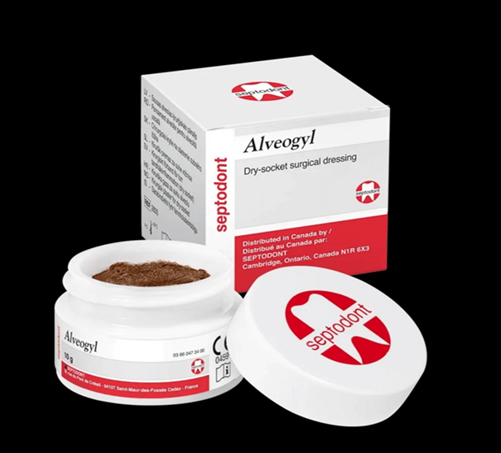
Fig 1: Alveogyl
Objectives
1. Evaluating pain score in dry socket treated with Alveogyl
2. Evaluating pain score in dry socket treated with warm saline
3. Comparison of pain scores in patients treated with Alveogyl and warm saline
Materials & Methods:
A double blinded randomized control trial comprising patients with dry socket were evaluated from April 2025 to September 2025 at the Karpaga Vinayaga Institute of Dental Sciences' Department of Oral and Maxillofacial Surgery. The ethical clearance of the study was obtained from the Institutional Ethics Committee (IEC NO: KIDS/IEC/2024/IV/030). The trial was registered under the Clinical Trials Registry–India- CTRI/2025/04/085273 dated on 21/04/25.
Requirements for Inclusion
Adults of both sexes over the age of 18 who had their teeth extracted and were clinically diagnosed with dry socket. The study included sockets with visible bone, a partial or complete loss of the blood clot at the tooth extraction site, and discomfort radiating from the socket to the same side of the face as the extraction.
Requirements for Exclusion
Patients over the age of 70 and under the age of 18. A patient with one or more bone disorders, such as osteoporosis. People who have previously taken bisphosphonates orally or intravenously. People who have previously received radiation to the head, neck, or jawbone [9]. Following tooth extraction, patients who reported with pain were examined to identify the cause of their complaint. On the basis of the following characteristics, the clinical diagnosis of dry socket was made. Pain that worsens between one and three days after extraction, in and around the extraction socket, with or without radiation. Alveolar clot loss, whether partial or complete, with or without halitosis.
Sample size
The sample size was calculated with G power software (version 3.1.2.9) based on the study conducted by Kesheni MP et al., 2020 and minimum sample size requires was 16 and it was rounded off to 20 (10 in each group)
Randomization
The Computer generated randomization was done and each group receive 10 sample with allocation concealment of 1:1 (Group A: 10 and Group B: 10)
For group A, dry socket was treated by placing Alveogyl (Manufactured by Septodont India Pvt. Limited) (Content: iodoform 15.8 g, eugenol B.P. 13.7 g, and butamben 25.7 g) (Figure 1)
In Group B participants, the socket was irrigated with warm saline (30 ml, at temperature of 20-25°C or 68-77°F, for a duration of 3 mins, thrice a day)
The randomization has been described in Figure 2.
Procedure
Method of Placing Alveogyl
With the aid of a sterile tool, a few Alveogyl fibers were inserted deeply into the socket, covering the entire denuded bone. Sterile gauze was then applied. After five minutes, the gauze was taken off, and a continuous interrupted suture was inserted. Group A patients were asked not to wash their mouth vigorously within 24 hours following the placement of the medicament.
The socket was irrigated with a warm, sterile saline solution. Curettage was avoided. Loose debris was removed, taking care not to dislodge any residual clot present in the socket, and irrigation was taught to the patients and was asked to repeat it thrice a day.
extension (Fig 2).
|
Excluded: · Patients over the age of 70 and under the age of 18. · A patient with one or more bone disorders, such as osteoporosis. · People who have previously taken bisphosphonates orally or intravenously. · People who have previously received radiation to the head, neck, or jawbone
|
|
Excluded: · Patients over the age of 70 and under the age of 18. · A patient with one or more bone disorders, such as osteoporosis. · People who have previously taken bisphosphonates orally or intravenously. · People who have previously received radiation to the head, neck, or jawbone · |
|
Allocated for intervention (n=10) Patients with dry socket treated with Alveologyl |
|
Randomised n=20 |
|
Lost to follow up n=0 |
|
Allocated for intervention (n=10) Patients with dry socket treated with Alveologyl |
|
Allocated for intervention (n=10) Patients with dry socket treated with normal saline |
|
Lost to follow up n=0 |
|
Analysed n=10 |
|
Analysed n=10 |
|
Allocated for intervention (n=10) Patients with dry socket treated with normal saline |
|
Excluded: · Patients over the age of 70 and under the age of 18. · A patient with one or more bone disorders, such as osteoporosis. · People who have previously taken bisphosphonates orally or intravenously. · People who have previously received radiation to the head, neck, or jawbone · |
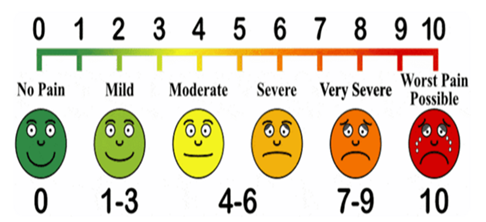
Fig 2: Flowchart
. 0-1 No pain
2. 2-3 Mild pain
3. 4-5 Moderate pain
4. 6-7 Moderately severe
5. 8-10 Severe
Fig 3: VAS pain scale
Outcome
Depending on how severe their pain was when they were diagnosed with dry socket, patients were urged to continue taking their oral analgesic prescription, which is a combination of 100 mg of aceclofenac and 500 mg of paracetamol twice a day. A visual analogue pain scale (Figure 3) was used to measure and compare the two groups' levels of pain reduction at the following consultation, which occurred seven days later. Until the surgical pain symptoms decreased and subsided, the intra-alveolar medicine was administered. After dressing, patients were evaluated 5, 30, and 60 minutes later. For 7 days, the patient was asked to record their daily pain on a visual analogue scale from 0 to 10, where 0 denoted no discomfort and 10 denoted severe pain. To determine whether there was a significant difference in pain scores, both the group participants were reviewed on a daily basis digitally (via video call using visual analogue scale for a duration of 3 minutes), where each participant was reviewed by two dental surgeons. One of the dental surgeons was questioning the participant and asking them to gently palpate the socket site extra orally, and the other surgeon noted the facial expression and gave pain scores accordingly. The pain scores of Day1, Day4 and Day7 were compared.
Patients were also requested to record if any negative drug side effects are noted, and are encouraged to contact us right away if they experience any issues. In the event that full relief was not obtained the first time, the treatment option was repeated a maximum of two to three times over two weeks if no adverse effects were observed. This was done to evaluate the full effect of the alveogyl drug. The number of repeated sessions for each medicine until all symptoms were completely relieved and the overall amount of time needed for full recovery were noted.
Statistical Analysis
Statistical analysis was performed using a personal computer in IBM corp. Statistical Package
Statistical analysis was performed using IBM corp. Statistical Package For social sciences (SPSS) software for windows; version 27.0 (Armonk, NY). Detailed descriptive & inferential statistics was calculated. Chi square test was performed to assess the difference in pain scores and Friedman’s test to compare pain in different time period between groups. P value of <0.05 was considered to be statistically significant.
Results:
This randomized controlled trial consists of two groups as follows:
Group A: Dry socket treatment with Alveogyl
Group B: Dry socket treatment with warm saline irrigation
|
|
DAY 1 |
DAY 4 |
DAY 7 |
|
NO PAIN |
0 |
0 |
10 |
|
MILD PAIN |
0 |
0 |
0 |
|
MODERATE PAIN |
0 |
3 |
0 |
|
MODERATELY SEVERE PAIN |
0 |
6 |
0 |
|
SEVERE PAIN |
10 |
1 |
0 |
Table 1: Frequency distribution of pain score of Group A participants
|
DAYS |
Chi- square value |
P value |
|
DAY1 vs DAY4 vs DAY 7 |
54.545 |
O.OOO* |
Table 2: Comparison of pain reduction between Day 1, Day 4 and Day 7
|
DAY 1 |
DAY 4 |
DAY 7 |
|
|
NO PAIN |
0 |
0 |
6 |
|
MILD PAIN |
0 |
0 |
4 |
|
MODERATE PAIN |
0 |
2 |
0 |
|
MODERATELY SEVERE PAIN |
2 |
8 |
0 |
|
SEVERE PAIN |
8 |
0 |
0 |
Table 3: Frequency distribution of pain score of Group B participants
|
DAYS |
Chi- square value |
P value |
|
DAY 1 vs DAY 4 vs DAY 7 |
50.400 |
O.OOO* |
● *Chi- square test, P< 0.005 significant
Table 4: Comparison of pain reduction between Day 1, Day 4 and Day 7
Demographic data
Total sample size - 20 (10 participants in each group)
Group A - 6 male participants and 4 female participants
Group B - 5 male participants and 5 female participants
When comparing table 1 and table 3, at the end of the week (day 7), all of the participants in group A reported no pain, whereas only 6 of the participants in group B reported no pain and the remaining 4 members reported mild pain. Table 2 and table 4 reveals that the P value is 0.000 and is statistically significant.
DISCUSSION :
One of the most frequent postoperative complications following tooth extraction is alveolar osteitis, often known as dry socket [1]. This disorder has also been referred to by other names, including fibrinolytic alveolitis, alveolitis sicca dolorosa, postoperative alveolitis, alveolalgia, septic socket, necrotic socket, localized osteomyelitis, and delayed extraction wound healing [11]. There are two primary schools of thought on the pathophysiology of dry socket (DS), also known as localized alveolar osteitis. The first approach is predicated on the idea that there isn't a blood clot at all, and a lot of work has been done to try and explain why clot formation fails. According to the second theory, a blood clot initially forms but is later lysed, leaving an empty socket in its place [12]. According to Birn’s fibrinolytic theory, after the extraction of a tooth, an inflammatory process begins that could affect the formation and retention of the clot (because of the impact of the kinase released during the process of inflammation) [1]. There are two main approaches proposed to prevent development of dry socket. The first is to improve oral hygiene and reduce plaque, food debris, and bacterial load around extraction sockets by the use of antiseptic mouthrinses
[13]. And according to the Bacterial Theory, Actinomyces viscosus and Streptococcus have been related to dry socket because they tend to retard alveolar post-extraction healing (fibrinolytic activity has been observed by Treponema denticola, a periodonto pathogenic microorganism) [1]. Staphylococcus have slow-acting fibrinolytic activity, which is different from the hemolytic streptococci's quick fibrin dissolving action [14]. In experimental dry socket models, a number of bacteria were found in the biologic material inside the alveolus, including Enterococcus, Streptococcus viridians, Streptococcus, Bacillus coryneform, Proteus vulgaris, Pseudomonas aeruginosa, Citrobacter freundii, and Escherichia coli [15]. As there is a sharp pain that persists and increases with suction or mastication and lasts several days, prompt management is necessary in order to alleviate the patients' pain and discomfort. The factors of risk associated with dry socket include female sex, traumatic extraction, smoking, poor oral hygiene, and infection around the tooth to be extracted [16].
Patients having a dry socket diagnosis were included in our investigation. The cause of dry socket was not clearly identified in either of the two groups, as all the participants have said to follow the post-extraction instructions. Therefore, patients were randomly assigned to the two groups. Group A patients in whom alveogyl dressing was done, reported a mild decrease in pain scores that was significant. Alveogyl is mainly intended to be used as a surgical dry socket dressing. And it is mainly composed of penghawar djambi, eugenol, sodium lauryl sulphate, calcium carbonate, mint flavour, and excipients. The fibres of the alveogyl promote haemostasis by compression and protect from superinfection with their barrier effect. Introduced into the socket, it easily adheres to the alveolus due to its fibrous consistency. Also, one of the ingredients of Alveogyl is eugenol, which is said to have sedative, antibacterial, and anodyne effects and tends to decrease pain. These properties possessed by the intra-alveolar medicament (Alveogyl) make it suitable for patients suffering from dry sockets, thereby reducing pain and enhancing healing. And in Group B patients, where only saline irrigation was done 2-3 times, it was found that the pain relief was significantly less as compared to Group A.
There are numerous additional treatment options for dry socket found in the literature, like the placement of zinc oxide eugenol (ZOE), a mixture of black seed oil and powder and honey other than the alveogyl. Additionally, dry socket can be effectively treated with platelet-rich fibrin (PRF). After the socket has quickly epithelized, the PRF is simple to perform and quickly influences pain levels. Although zinc oxide eugenol is easily available as a medicament for dressings, alveogyl contains butamben and iodoform, which increase the anaesthetic and antimicrobial activities, while ZOE has eugenol, which has sedative, anodyne, and antibacterial actions, where honey also tends to significantly reduce inflammation, discomfort, pain, and hyperaemia.
In our study, the alveogyl was closely sealed into the socket rather than left as an open dressing, which increased the onset of action of pain relief. Therefore, alveogyl was found to be effective. Future clinical trials should take into account all of the various treatment modalities in order to assess their efficacy in treating dry socket and alveolar osteitis. Our study has certain limitations, despite its merits, which include the patients' reporting of their pain levels and the frequent follow-up of patients in both groups. Patients may not have adhered to the temporary suspension of behaviours, such as smoking or using oral contraceptives, during the socket healing period and also the sample size of patients in each group was small.
Limitations:
Less follow up period. Smaller sample size. External factors like smoking, use of oral contraceptives were not included in this study. The results were based on subjective pain, therefore not completely reliable. We didn't compare with any other intra alveolar medication with normal saline.
CONCLUSION :
This case reports a rare and complex presentation of a neonate with a giant congenital melanocytic nevus in bathing-trunk distribution coexisting with a large pedunculated low-flow vascular malformation. Despite normal antenatal scans, the postnatal emergence and progressive enlargement of the mass required timely diagnostic evaluation and multidisciplinary care. Imaging with Doppler ultrasound and MRI played a pivotal role by confirming the superficial nature of the lesion and excluding deeper structural involvement, thereby enabling safe surgical excision. Early surgery prevented potential complications such as ulceration, infection, or haemorrhage and resulted in an excellent short-term outcome. Given the lifelong risk of melanoma and the psychosocial impact associated with GCMN, long-term dermatological and neurological follow-up is essential. This case underscores the need for vigilance in examining newborns, even after normal antenatal imaging, and highlights the importance of coordinated management in rare congenital presentations.
BIBLIOGRAPHY:
1. Balaji SM, Balaji PP: Textbook of Oral & Maxillofacial Surgery-E Book . Elsevier Health Sciences. Elsevier,New Delhi; 2018. 3rd Edition:
2. Soukaina T. Ryalat1, Mohammad H. Al-Shayyab1, Ahmed Marmash1, Faleh A. Sawair1, Zaid H. Baqain,Ameen S. Khraisat: The Effect of Alvogyl TM When Used As a Post Extraction Packing. . Jordan Journal of Pharmaceutical Sciences. 2011, 4:149-153.
3. M. Taberner- Vallverdu, M. Nazir, M. Sanchez-Garces, and C: Gay-Escoda, “Efficacy of different methods used for dry socket management: a systematic review,”. Medicina Oral, Patología´ıa Oral y Cirug´ıa Bucal, vol. 20, no. 5, pp. e633-e639. 2015, vol. 20: e633-e639.
4. I.R. Blum: Contemporary views on dry socket (alveolar osteitis): a clinical appraisal of standardization, aetiopathogenesis and management: a critical review. International Journal of Oral and MaxillofacialSurgery. 2002, vol. 31:309-317. 10.1054/ijom.2002.0263
5. J. Mamoun: Dry socket etiology, diagnosis, and clinical treatment techniques. Journal of the Korean Association of Oral and Maxillofacial Surgeons. 2018, vol. 44: p. 52. 10.5125/jkaoms.2018.44.2.52
6. B. Veale: Alveolar osteitis: a critical review of the aetiology and management. Oral Surgery. November 2014, vol. 8:68-77. 10.1111/ors.12130
7. Fazakerley M, Field EA: Dry socket: a painful post extraction complication. Dent Update. 1991.
8. Keshini MP, Shetty SK, Sundar S, Chandan SN, Manjula S.: Assessment of healing using alvogyl and platelet rich fibrin in patients with dry socket - An evaluative study. Ann Maxillofac Surg. 2020, 320-4.
9. Khan ZA, Prabhu N: A comparative study on alvogyl and a mixture of black seed oil and powder for alveolar osteitis: a randomized double-blind controlled clinical trial. International Journal of Clinical Practice. 2022, 10.1155/2022/7756226
10. Madhuchanda Borah1, Mukesh Patir2, Esma Antony3: Comparison Between Intrathecal Neostigmine And Fentanyl As Adjuvant To Hyperbaric Bupivacaine In Spinal Anaesthesia For Post-Operative Pain Relief. International Journal of Current Pharmaceutical Research. May 2024, Vol 16:12-17. 10.22159/ijcpr.2024v16i3.4071
11. Supe NB, Choudhary SH, Yamyar SM, Patil KS, Choudhary AK, Kadam VD: Efficacy of alvogyl (Combination of Iodoform+ Butylparaminobenzoate) and zinc oxide eugenol for dry socket. Ann Maxillofac Surg. 2018, 193-199. 10.4103/ams.ams_167_18
12. D W Nitzan: On the genesis of "dry socket". J Oral Maxillofac Surg . 1983, 706-10. 10.1016/0278-2391(83)90185-4
13. H. Birn.: Bacteria and Fibrinolytic Activity in “Dry Socket”. Acta Odontologica Scandinavica. 2009, 773-783.10.3109/00016357009028246
14. Daly BJ, Sharif MO, Jones K, Worthington HV, Beattie A: Local interventions for the management of alveolar osteitis (dry socket). Cochrane Database Syst Rev. 2022, 26:006968. 10.1002/14651858.CD006968.pub3
15. Cardoso CL, Rodrigues MT, Ferreira Júnior O, Garlet GP, de Carvalho PS: Clinical concepts of dry socket. J Oral Maxillofac Surg. 2010, 68:1922-32. 10.1016/j.joms.2009.09.085
16. Adekunle AA, Egbunah UP, Erinoso OA, Adeyemo WL: Effectiveness of warm saline mouth bath in preventing alveolar osteitis: A systematic review and meta-analysis. J Craniomaxillofac Surg. 2021, 49:980-988. 10.1016/j.jcms.2021.09.001