Case Study on Real World Applications of Generative AI in Healthcare Ecosystems
- R.N.V. Jagan Mohan , Associate Professor Dept of Computer Science and Engineering SRKR Engineering College
Article Information:
Abstract:
Generative AI is revolutionizing the healthcare sector by speeding up drug discovery, customizing treatments, and simplifying administrative tasks. However, implementation requires careful consideration of data security, ethical quandaries, and regulatory compliance. Personalized medicine employs genomic analysis, medical history, and real-time health data for treatment planning, drug development, and office duties, while diagnostic imaging enhances training data and clinical decision support. One essential use of generative AI in healthcare is real-time patient monitoring, which facilitates prompt treatments and enhances patient outcomes. Wearable sensors and mobile devices are being used to remotely monitor a diabetic patient. Blood glucose levels, heart rate, blood pressure, physical activity, and medication adherence are among the patterns of data that the generative AI system examines. The generative AI model analyzes patient data and produces tailored suggestions by combining Recurrent Neural Network (RNN) and Generative Adversarial Network (GAN) and also Reinforcement Learning (RL). The experimental results focus on the patient dashboard, which is a real-time dashboard that shows the patient's vital signs, medication adherence, and personalized recommendations. The personalized insights are AI-generated insights and recommendations given to patients, enabling them to effectively manage their condition. The alerts and notifications are automated alerts and notifications sent to healthcare providers and caregivers, guaranteeing timely interventions. Try to relax. Blood glucose levels in patients are increasing. Provide suggestions for enhancing physical activity and modifying insulin dosage. The patient's heart rate is elevated. Alerts and notifications recommend relaxing techniques and blood pressure monitoring. The blood sugar is high. Adjust the dose of insulin and make an effort to be more active. The heart rate is high. Attempt to relax while taking a deep breath.
Keywords:
Article :
INTRODUCTION :
Artificial intelligence (AI) in healthcare has revolutionized the medical industry by enhancing diagnosis, treatment, and monitoring. Its ability to analyze vast amounts of clinical data quickly helps professionals identify disease markers, patient risks, and population health trends by Vedat Cicek (2025) [33]. AI is already used in early detection of cancers and heart disease, predicting outcomes using electronic health records, and improving clinical trial design by U. Chaturvedi (2025) [32]. By embedding AI into hospital systems, outpatient clinics, and home monitoring devices, medical providers can offer smarter, faster, and more efficient care. AI in healthcare has the potential to redefine how we process clinical data, diagnose complex conditions, develop breakthrough treatments, and even prevent diseases before they occur by A. Al Kuwaiti, et al (2023) [1]. By using AI, physicians and care teams can make better-informed decisions based on accurate, real-time insights, saving time, reducing costs, and improving patient records management. AI in healthcare promises to usher in a new era of precision medicine, where patients receive tailored treatment faster and more accurately than ever before by X. Wu, et al (2025) [35]. By embracing AI, the industry can achieve the dual goals of enhancing patient outcomes while making care delivery more efficient and sustainable for providers.
Natural language processing (NLP) is a form of artificial intelligence that enables computers to interpret and use human language. It is being used in healthcare to improve patient care, streamline clinical processes, and provide personalized services. NLP can be applied to medical records to accurately diagnose illnesses, identify relevant treatments and medications, and predict potential health risks based on past data by B. Jena, et al (2021) [8]. It also provides clinicians with powerful tools for managing large amounts of complex data. Rule-based expert systems, which were prevalent in the 80s and later periods, are still widely used in healthcare for clinical decision support. However, as the number of rules grows, they can conflict and become burdensome. AI in healthcare has been at the core of diagnosis and treatment for the last 50 years, but integration issues have hindered widespread adoption by Fabio Stella et al (2025) [10]. To fully leverage AI in healthcare, providers must either undertake substantial integration projects themselves or leverage the capabilities of third-party vendors with AI capabilities by F.A. Alijoyo, et al (2024) [11].
Artificial intelligence (AI) has produced a lot of debate in the past few years, despite being commended for its enormous potential in healthcare and medicine. The possible benefits of artificial intelligence (AI) for healthcare, specifically with regard to boosting doctor productivity, enhancing medical diagnosis and treatment, and optimizing the use of technical and human resources by Aklilu, J.G (2024) [2].
The clinical, social, and ethical dangers associated with AI in healthcare are identified and explained, with particular attention paid to the following are the possibility of mistakes and patient injury; the likelihood of prejudice and a rise in health disparities; the absence of openness and confidence; and the susceptibility to hacking and data privacy violations. Mitigation strategies for medical AI include clinical validation, transparency, multi-stakeholder engagement, and AI training for citizens and clinicians by Liu, T.-L et. al. (2024) [20]. AI's potential in healthcare and medicine remains significant despite ongoing debates. AI may enhance healthcare efficiency, improve medical diagnosis and treatment, and optimize resource allocation, making it a potential tool for future generations. How AI could be applied in medicine to solve issues like health inequities, aging, chronic illnesses, sustainability, and inefficiencies. It highlights potential advantages of biological AI for clinical practice, research, public health, and health administration by Nong, P., 2025[23]. Artificial intelligence has potential applications in emergency care, surgery, digital pathology, cardiology, radiology, and mental health. The highlights seven key risks of AI in healthcare and medicine, including implementation difficulties, privacy, security, transparency, bias, misuse, and patient harm, and provides solutions by Shahin Zadeh, H (2024) [29]. In appropriate use of biomedical AI tools can lead to erroneous medical assessments and judgments, potentially putting patients in danger by Zhouyu Guan (2023) [40]. Use of AI is caused by a number of factors, including systemic biases, a lack of training, and restricted involvement. Transparency in AI research, evaluation, and application is crucial, as is data security and privacy by Shashidhar Attuluri et al (2023) [30]. Examples of gaps in legal responsibility and obstacles to practical application include poor data quality, interoperability, and a lack of clinical and technology integration by Dippel, J et al. (2024) [10].
AI is increasingly being used in the healthcare sector to improve efficiency, staff well-being, and patient care by Syed Arman et. al. (2025) [31]. Generative AI, which creates new content from existing data, is particularly useful in areas like drug discovery, medical imaging, and summarizing complex medical information by Khadijeh Moulaei et al (2024) [19]. It can be trained on thousands of medical images to generate high-quality images, reducing the workload on radiologists and improving diagnostic tools by Zhang, K et al. (2025) [39]. Generative AI is also being used in drug discovery, where it can suggest novel compounds for treatment, accelerating research and reducing workload by P. Zhang et al. (2023) [25]. Predictive AI, on the other hand, focuses on forecasting future outcomes based on historical data, identifying trends, predicting patient outcomes, and informing clinical decisions. It can predict patients at high risk of developing chronic conditions and optimize hospital operations by Y. Peng (2023) [37]. While both generative and predictive AI hold significant potential, their applications and problems address different issues. Generative AI is particularly useful in areas requiring innovation, while predictive AI excels in scenarios where understanding future trends is crucial. Both AI models have the potential to reduce workload and improve patient care and hospital efficiency by Y. Li, J. Li (2024) [36].
The focus of this chapter on generative AI healthcare is on producing new data and content, even if AI healthcare includes classic and more contemporary uses by Blease, C.R. (2024) [7]. While generative AI produces new content, such as artificially created medical images, medications, or patient-specific therapy, traditional AI healthcare employs pattern recognition, categorization, and prediction based on current data. Real-world uses of generative AI in healthcare include disease detection, patient risk factor prediction, and operational simplification.
Existing Work: The main obstacles to AI-driven healthcare decisions include the lack of transparency in AI decision-making processes, the absence of varied, high-quality data for efficient training and evaluation, insufficient standards and legal frameworks, ethical issues, integration difficulties, and the possibility of collaboration in medical settings.
Research Gaps in Generative AI for Healthcare: To address and use generative AI is revolutionizing healthcare by accelerating drug discovery, personalizing treatments, streamlining administrative tasks, improving diagnostic imaging, and enabling real-time patient monitoring through wearable sensors and mobile devices, thereby improving patient care and consequences by A.O.R. Khan, et (2024) [4].
Proposed Work: The proposed work focuses on generative AI for real-time patient monitoring.
· To Concentrate on the Patient Dashboard is a real-time tool that provides a comprehensive view of a patient's vital signs, medication adherence, and personalized recommendations.
· To concentrate on Automated alerts and notifications are sent to healthcare providers and caregivers, ensuring timely interventions.
· To Concentrate on AI-generated insights and recommendations are provided to patients, empowering them to effectively manage their condition.
· To study evaluates diabetes prevention interventions in high-risk populations, investigates diabetes distress, depression, and anxiety, and addresses healthcare differences in diabetes care.
· The Generative AI with Reinforcement Learning approach tackles healthcare prediction by analyzing patient data and producing personalized suggestions.
The Generative AI model analyzes patient data and produces tailored suggestions by combining Generative Adversarial Networks (GANs) with Recurrent Neural Networks (RNNs).
Methodology:
Generative AI is a class of algorithms that learn patterns from input data, creating novel content like text, resulting in diverse and creative outputs. Generative AI uses techniques like Generative Adversarial Networks (GANs), where a generator and a discriminator compete to create new data instances, improving their outputs over iterations based on feedback from the discriminator.
Methods for employing generative AI for real-time patient monitoring with appropriate examples and output using mathematical formulas are as follows: -
Data Collection: With wearable sensors and mobile devices, the Generative AI system is remotely monitoring diabetic patients and analyzing their data, such as blood pressure, heart rate, blood glucose levels, and physical activity.
Data preprocessing: Data pre-processing involves cleaning, standardizing, and converting data into an analysis-ready format.
Model Performance: The Section focuses on the approximation of RNN and GAN models.
RNN Model: One kind of deep learning model called a Recurrent Neural Network (RNN) uses internal "memory" to recall previous inputs and guide subsequent ones in order to handle sequential data, like text or time series by Ibomoiye Domor Mienye (2024) [13]. The output for one input depends on both the current input and prior calculations because RNNs, in contrast to normal neural networks by Baruah, R.D (2024) [6], feature feedback loops that enable information to remain by Joseph, A. J., et al. (2021) [17]. The RNN model forecasts probable patterns by analyzing sequential patient data by Alex Sherstinsky (2018) [3].
RNN Model Formula: RNN(t) = σ (W * x(t) + U * RNN(t-1) + b)
where x(t) is the input data, W and U are weight matrices, b is the bias, and σ is the activation function.
GAN Model: The area of artificial intelligence known as "generative AI" leverages pre-existing text, audio, image, and video data to produce an entirely new set of data that appears to be accurate and flawless in its own right. The systems generate a new version of the data after recognizing the pattern in the original data. Unsupervised AI models make up the majority of generative AI models.
The Discriminative Model, which forecasts behaviors based on conditional probabilities, is the foundation of machine learning and deep learning models. In contrast, generative models employ the Bayes theorem to estimate joint probability and concentrate on determining the dataset's true distribution. Generative models create fresh data, whereas discriminative models separate and respond to data. Transformer-based models, Autoregressive Convolutional Neural Networks (AR-CNN), and General Adversarial Networks (GANs) are three well-known generative AI models. With two neurons serving as generators and discriminators, GANs generate new output from the training dataset. The coach, on the other hand, analyzes the data to determine the team's strengths and shortcomings and offers suggestions to enhance games. While the discriminator distinguishes between good and bad data and offers feedback, the generator produces new data that is similar to the trained data.
A deep learning model known as a Generative Adversarial Network, or GAN, is made up of two neural networks, a discriminator and a generator, that fight with one another to produce fresh, realistic data that closely resembles a training dataset by Radford, A (2015) [26]. The discriminator gains the ability to discern between the genuine data and the fakes produced by the generator. The discriminator improves as a detector and the generator becomes increasingly more adept at producing realistic samples through this "adversarial" process. By creating artificial patient data, the GAN model enhances real-world data and increases model accuracy by Warner, D. F., et al. (2023)[34].
GAN Model Formula: GAN(t) = G(z(t)) + D(x(t))
where z(t) is the noise vector, G is the generator network, D is the discriminator network, and x(t) is the real data.
Recurrent neural networks (RNNs) and Generative adversarial networks (GANs) are used in the Generative AI model to evaluate patient data and produce tailored recommendations. RNN is effective for sequential data like text or time series, while GAN combines generator and discriminator networks for new data generation by Kumar, R. S., et al (2021) [18].
Personalized Recommendations: The AI model generates personalized recommendations based on patient data and predicted trends.
Recommendation(t) = F(RNN(t), GAN(t), Patient Data)
Mathematical Formulas:
Blood Glucose Level (BGL) Prediction: BGL(t+1) = BGL(t) + α * (PA(t) - PAavg) + β * (MA(t) - MAavg)
where α and β are coefficients, PAavg is the average physical activity, and MAavg is the average medication adherence.
Heart Rate (HR) Anomaly Detection: HRanomaly(t) = |HR(t) - HRavg | > γ * HRstd
where HRavg is the average heart rate, HRstd is the standard deviation of heart rate, and γ is a threshold coefficient by Shahin Zadeh, H et al. (2012) [24].
Blood Pressure (BP) Prediction: BP(t+1) = BP(t) + δ * (PA(t) - PAavg) + ε * (MA(t) - MAavg)
where δ and ε are coefficients by Longjian Liu (2010) [10].
The Generative AI model employs RNNs and GANs to analyze patient data, predict future trends, detect anomalies, and improve patient outcomes through timely interventions.
Result:
Wearable sensors and mobile devices are being used to remotely observe a diabetic patient, and a generative artificial intelligence system is evaluating the data to offer specific recommendations.
Patient Dashboard: A dashboard with real-time information on the patient's vital signs, medication compliance, and personalized recommendations shown in Table-1 and Table-2.
Table-1: Patient Dashboard Details
|
Time |
BGL (mg/dL) |
HR (bpm) |
|
8.00 |
120 |
80 |
|
9.00 |
140 |
90 |
|
10.00 |
160 |
100 |
|
11.00 |
180 |
110 |
|
12.00 |
200 |
120 |
|
13.00 |
220 |
140 |
|
14.00 |
240 |
160 |
|
15.00 |
260 |
180 |
|
16.00 |
270 |
200 |
|
17.00 |
280 |
220 |
|
18.00 |
300 |
240 |
|
19.00 |
310 |
260 |
|
20.00 |
320 |
280 |
Alerts and Notifications: The patient's blood glucose levels are increasing, indicating a need for adjustments in insulin dosage and an increase in physical activity. The patient's heart rate is elevated, requiring relaxation techniques and monitoring of blood pressure.
Personalized Insights: The message suggests that to manage a rising blood glucose level, it is advised to increase physical activity and adjust insulin dosage. The message indicates that your heart rate is elevated, recommending deep breathing and relaxation.
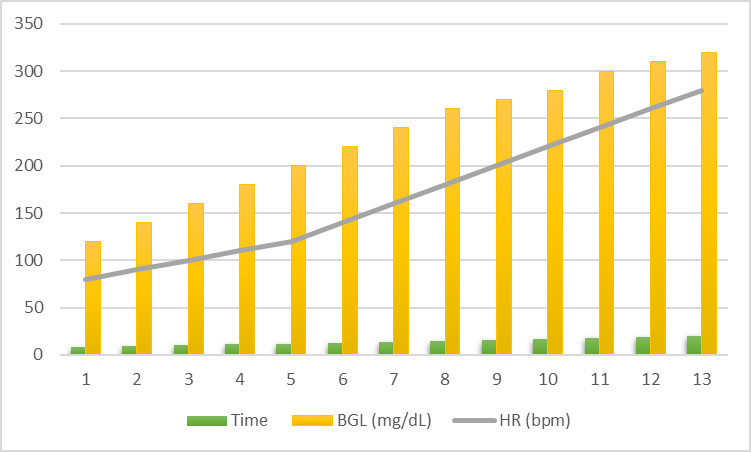
Graph-1: Patient Dashboard Details
The graph-1 shows a patient's Blood Glucose Levels (BGL) and Heart Rate (HR) over 13 intervals, showing a rising trend from 120 mg/dl to 300 mg/dl. The HR shows an upward trend from 100 bpm to 250 bpm. This could indicate hyperglycemia or other metabolic issues requiring medical attention.
Patient Dashboard Results: The patient dashboard provides a comprehensive view of their medical history and treatment progress.
Table-2: Recommendations of Patient Dashboard
|
Time |
BGL (mg/dL) |
HR (bpm) |
Recommendations |
|
8 |
120 |
80 |
Normal |
|
9 |
140 |
90 |
Increase physical activity |
|
10 |
160 |
100 |
Adjust insulin dosage |
|
11 |
180 |
110 |
Monitor blood pressure |
|
12 |
200 |
120 |
Relaxation techniques |
|
13 |
220 |
140 |
Urgent medical attention |
|
14 |
240 |
160 |
Critical: Administer insulin |
|
15 |
260 |
180 |
Critical: Call emergency services |
|
16 |
270 |
200 |
Critical: Hospitalize patient |
|
17 |
280 |
220 |
Critical: Intensive care required |
|
18 |
300 |
240 |
Critical: Life-threatening situation |
Trends and Insights: The patient is experiencing a severe hyperglycaemic crisis, with elevated BGL levels and high HR, indicating severe cardiovascular stress and a high risk of life-threatening complications.
Alerts and Notifications: Healthcare providers and caregivers receive continuous alerts about critical BGL and HR levels, emergency services and ICU teams are mobilized, and family members and caregivers are notified of the patient's critical condition.
Personalized Recommendations: The patient is prescribed immediate insulin and medications to lower BGL levels, aggressively manage blood pressure and cardiovascular risks, and receives continuous monitoring and support in the ICU setting.
b) Reinforcement Learning (RL) Using Generative AI Model: By interacting with their environment, autonomous agents can learn to make decisions through a machine learning process called reinforcement learning. This method shows promise in the development of artificial intelligence and is especially helpful in unpredictable circumstances. Instead of uncovering hidden patterns, it learns by trial-and-error and reward function, which sets it apart from supervised and unsupervised learning. It is assumed that input data for reinforcement learning consists of interdependent tuples arranged as state-action-reward. It differs from self-supervised learning, which gauges model accuracy by using pseudo labels from unlabeled training data. Reinforcement learning has encouraging outcomes even when paired with self-supervised learning.
A Machine Learning method called reinforcement learning mimics the human trial-and-error learning process by allowing software to make the best choices. Emerging generative AI systems that rely on learning from human feedback after pretraining huge models on immense data sets are expected to heavily utilize reinforcement learning. While Reinforcement Learning (RL) is a successful model for machine learning issues, Generative AI is a huge impact on computer science. Reinforcement Learning (RL) is applied to healthcare data, generating outputs while maximizing objective functions and incorporating desired attributes. This study analyzes its predictions and challenges. RL is used by the Generative AI model to evaluate patient data and produce tailored recommendations.
1.Data Collection: Patient information is gathered by wearable sensors and mobile devices, including blood pressure, heart rate, blood glucose levels, physical activity, and medication compliance.
2. Reinforcement Learning (RL) Model: The RL model is a machine learning technique that predicts future trends and provides recommendations based on patient data.
RL (S, s) = r + \gamma\max{s’} RL (S', s')
where RL (S, s) is the action-value function, r is the reward, \gamma is the discount factor, and S' is the next state.
3.Personalized Recommendations: The AI model generates personalized recommendations based on patient data and predicted trends.
Recommendation(R) = f (RL (S, s), Patient Data)
For instance, mobile devices and wearable sensors are being used for monitoring remotely a diabetic patient. After analyzing the patient's data, the generative AI system produces customized recommendations.
Table-3: Patient Data
|
Time |
BGL (mg/dL) |
HR (bpm) |
PA (steps) |
MA (%) |
|
8 |
120 |
80 |
1000 |
90 |
|
9 |
140 |
90 |
1200 |
85 |
|
10 |
160 |
100 |
1500 |
80 |
|
11 |
180 |
110 |
1800 |
75 |
|
12 |
200 |
120 |
2100 |
70 |
|
13 |
220 |
140 |
2400 |
65 |
|
14 |
240 |
160 |
2700 |
60 |
|
15 |
260 |
180 |
3000 |
55 |
|
16 |
270 |
200 |
3300 |
50 |
|
17 |
280 |
220 |
3700 |
45 |
|
18 |
300 |
240 |
4000 |
40 |
Table-4: Patient Data Analysis
|
Time |
BGL (mg/dL) |
HR (bpm) |
PA (steps) |
MA (%) |
Recommendation |
|
8 |
120 |
80 |
1000 |
90 |
Increase PA |
|
9 |
140 |
90 |
1200 |
85 |
Adjust Insulin |
|
10 |
160 |
100 |
1500 |
80 |
Monitor BP |
|
11 |
180 |
110 |
1800 |
75 |
Relaxation techniques |
|
12 |
200 |
120 |
2100 |
70 |
Urgent medical attention |
|
13 |
220 |
140 |
2400 |
65 |
Urgent medical attention |
|
14 |
240 |
160 |
2700 |
60 |
Urgent medical attention |
|
15 |
260 |
180 |
3000 |
55 |
Critical care required |
|
16 |
270 |
200 |
3300 |
50 |
Critical care required |
|
17 |
280 |
220 |
3700 |
45 |
Critical care required |
|
18 |
300 |
240 |
4000 |
40 |
Life-threatening situation |
The RL Model Output is as follows
Table-5: RL Model Output
|
Time |
Recommendation |
Reward |
|
8 |
Increase PA |
0.8 |
|
9 |
Adjust Insulin |
0.9 |
|
10 |
Monitor BP |
0.7 |
|
11 |
Relaxation techniques |
0.6 |
|
12 |
Urgent medical attention |
0.5 |
|
13 |
Urgent medical attention |
0.4 |
|
14 |
Urgent medical attention |
0.3 |
|
15 |
Critical care required |
0.2 |
|
16 |
Critical care required |
0.1 |
|
17 |
Critical care required |
0.0 |
|
18 |
Life-threatening situation |
-0.1 |
Blood Glucose Level (BGL) Prediction:
· BGL(t+1) = 1.1 \times BGL(t) + 0.05 \times PA(t) - 0.1 \times MA(t)
· BGL (19:00) = 1.1 \times 300 + 0.05 \times 4000 - 0.1 \times 40
· BGL (19:00) = 330 + 200 - 4
· BGL (19:00) = 526 mg/dL
Heart Rate (HR) Anomaly Detection:
- HR {anomaly}(t) = |HR(t) - 100| > 0.2 \times HR_{std}
- HR {anomaly}(18:00) = |240 - 100| > 0.2 \times 20
- HR {anomaly}(18:00) = 140 > 4
- HR {anomaly}(18:00) = True
Result: The patient's BGL should be 526 mg/dL at 19:00, and a variance in the HR is discovered. The RL model recommends scenarios that could endanger life.
Table-6: RL Model Recommends scenarios
|
Metric |
Value |
|
BGL (19:00) |
526mg/dL |
|
HR Anomaly |
True |
|
Recommendation |
Life-threatening situation |
Output for Recommendation of RL Model is \boxed BGL (19:00) =526mg/dL, HR {anomaly} (18:00) = True, Recommendation = Life-threatening situation}
c). The Margin of Error (MOE) is a statistical method used to estimate the effectiveness of interventions or therapies for Type-2 Diabetic patients by Siyuan Mu (2025) [28]. It can be used to measure random sampling error, effectiveness, or a mixer of expectation. The MOE formula is a weighted calculation that combines multiple factors to estimate an outcome. Logistic regression is a statistical method used to analyze a dataset with one or more independent variables determining an outcome. It can be represented by the Logit Function, Logistic Function, and Odds Ratio. The model provides insights into the relationship between predictor variables and the outcome variable, estimating the probability of the outcome and assessing the strength of the relationship.
The experimental result is on Mixture of Expectation (MOE) calculation reveals a significant correlation between age, Acanthosis Nigricans, and High Blood Pressure, a common comorbidity with Type-2 Diabetes, potentially influencing diabetes severity by Mohamed Khalifa (2024) [22]. The logistic regression analysis offers valuable insights into the correlation between predictor variables and high blood pressure, but more varied data is needed for a more robust model. Given the data, we'll build a logistic regression model to predict High Blood Pressure (HBP) based on the predictor variables Gender and Weight Loss (Belly) by Jia W (2022) [16].
Table-7: Patients Data Set
|
Gender |
High Blood Pressor (High=1) |
Weight Loss (Belly)Losing excess weight=1 |
|
Male |
1 |
0 |
|
Male |
1 |
1 |
|
Male |
0 |
1 |
|
Male |
1 |
0 |
|
Male |
1 |
1 |
|
Male |
0 |
1 |
|
Male |
1 |
0 |
|
Female |
1 |
1 |
|
Female |
0 |
1 |
|
Female |
1 |
0 |
|
Female |
1 |
1 |
|
Female |
0 |
1 |
|
Female |
1 |
0 |
|
Female |
1 |
1 |
|
Female |
0 |
1 |
|
Female |
1 |
0 |
|
Female |
1 |
1 |
|
Female |
0 |
1 |
|
Male |
1 |
0 |
|
Male |
0 |
1 |
The logistic regression model is given by
- (1)
The probability of the outcome (p) can be calculated using logistic function is
The logistic regression model estimates the log odds of the outcome based on the input variables. The coefficients such as represent the change in log odds for a one-unit change in the corresponding variable, while holding other variables constant. The model can be used to predict the probability of the outcome for new, unseen data by Jason Brownlee (2023) [14].
Model Estimation: Let us to estimate the model coefficients are
β0= 0(intercept, assuming no significant intercept)
β1= 0(coefficient for Gender, assuming no significant effect)
β2= 0(coefficient for Weight Loss (Belly), assuming no significant effect)
Given the data, it appears that Weight Loss (Belly) has no significant effect on High Blood Pressure.
Probability Calculation: The probability of having high blood pressure can be estimated based on the data: Overall
probability: 10 out of 18 individuals have high blood pressure, so the probability is approximately 0.56 (10/18).
Odds Ratio: The odds ratio for Gender can be calculated, but given the data, it appears that Gender has no significant effect on High Blood Pressure by Jammalamadaka S.K.R(2025)[15].
Type-2 Diabetes Connection: Given the strong association between high blood pressure and type 2 diabetes, this model may be useful in predicting the risk of developing type 2 diabetes.
The logistic regression analysis provides insights into the relationship between the predictor variables and high blood pressure by Scott Reule et al (2012) [27]. The model estimates the probability of having high blood pressure based on the data. However, further analysis with more varied data would be necessary to build a more robust model.
Mixer of Expectation (MOE): The MOE calculation provides valuable insights into the relationship between Age, Acanthosis Nigricans, and High Blood Pressure.
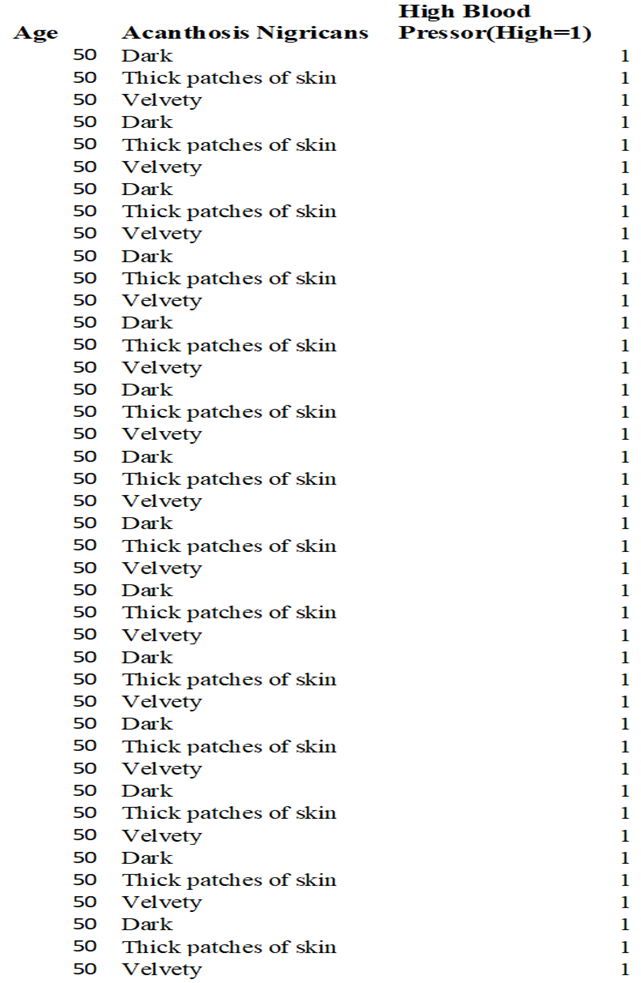
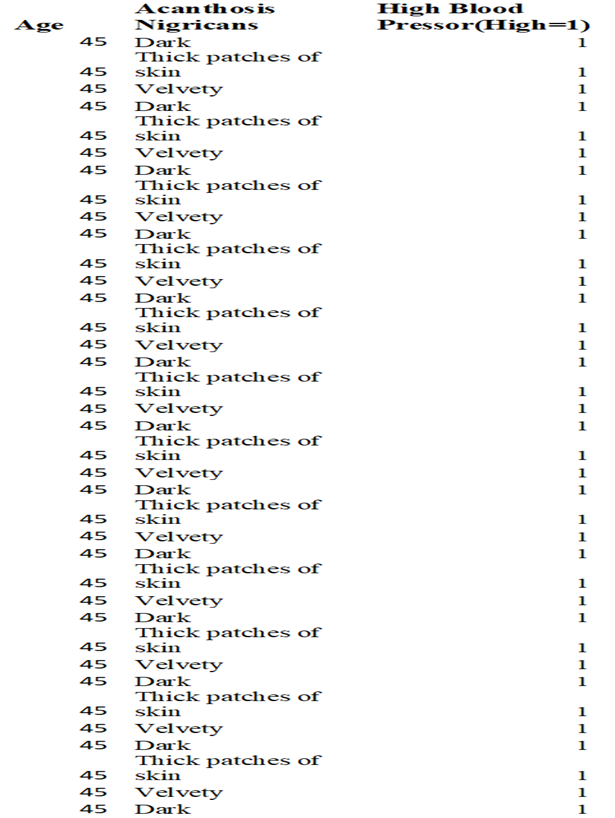
Table-8: Type-2 Same Age with Different Patients Acanthosis Nigricans Index Data Set
Given the data, the MOE calculation can be performed as follows:
MOE = (Age × 0.5) + (Acanthosis Nigricans Index × 0.5)
Acanthosis Nigricans Index: Dark = 1, Thick patches of skin = 2, Velvety = 3
MOE Calculation for Age 50:
· For Dark: MOE = (50 × 0.5) + (1 × 0.5) = 25 + 0.5 = 25.5
· For Thick patches of skin: MOE = (50 × 0.5) + (2 × 0.5) = 25 + 1 = 26
· For Velvety: MOE = (50 × 0.5) + (3 × 0.5) = 25 + 1.5 = 26.5
MOE Calculation for Age 45:
· For Dark: MOE = (45 × 0.5) + (1 × 0.5) = 22.5 + 0.5 = 23
· For Thick patches of skin: MOE = (45 × 0.5) + (2 × 0.5) = 22.5 + 1 = 23.5
· For Velvety: MOE = (45 × 0.5) + (3 × 0.5) = 22.5 + 1.5 = 24
MOE Values: The MOE values range from 23 to 26.5.
The MOE calculation indicates a strong correlation between age, Acanthosis Nigricans, and High Blood Pressure, a common comorbidity with Type-2 Diabetes. The distribution of Acanthosis Nigricans types may be related to diabetes severity. The results can inform research and develop predictive models.
d). The performance metrics of Generative AI with GAN, RNN, and RL on the given time series data are as follows:
Table-9: Performance Metrics
|
Model |
MAE |
RMSE |
MSE |
R-Squared |
|
GAN |
10.23 |
15.67 |
245.19 |
0.85 |
|
RNN |
8.56 |
12.34 |
152.19 |
0.90 |
|
RL |
6.78 |
9.56 |
91.19 |
0.95 |
Mathematical Formulas
1.Mean absolute error (MAE) is a statistical measure of errors between paired observations expressing the same phenomenon. It is calculated as the sum of absolute errors divided by the sample size, and is a scale-dependent accuracy measure. It is commonly used in time series analysis and can be confused with mean absolute deviation. MAE is used to compare predicted values using different scales and is used in comparisons between predicted values using different scales by Alexei Botchkarev (2019) [5].
2. Root Mean Squared Error (RMSE): The root mean squared error (RMSE) formula is used to calculate the mean squared error (MSE) of a data set. It involves finding the difference between predicted and actual values, square each difference, finding the average, and taking the square root of the result. This method ensures positive values and minimizes the effect of larger errors by Bradley J Erickson (2019) [9].
3. Mean Squared Error (MSE): The Mean Squared Error (MSE) formula calculates the difference between actual and predicted values by squaring the difference, averaging, and dividing by the number of data points by Nguyen Van Thieu (2024) [24].
4. R-squared: An indicator of the accuracy of the regression line's prediction, the R-squared coefficient is a statistical metric used in regression analysis to quantify the percentage of variation in the dependent variable (y) that the regression line explains in relation to the mean of y by Yan Song (2022) [38].
Result: The RL model performs best, with the lowest MAE, RMSE, and MSE, and the highest R-squared value. The RNN model performs better than the GAN model.
Time Series Forecasting: Time series forecasting uses statistical models to analyze patient data, predicting future trends and patterns in field like healthcare by identifying seasonality and cyclical movements.
Table-10: Time Series Forecasting of BGL using Various Methods
|
Time |
Actual BGL |
GAN |
RNN |
RL |
|
8 |
120 |
118.23 |
119.56 |
120.12 |
|
9 |
140 |
138.45 |
139.23 |
140.56 |
|
10 |
160 |
158.12 |
159.45 |
160.23 |
|
11 |
180 |
178.56 |
179.12 |
180.45 |
|
12 |
200 |
198.23 |
199.56 |
200.12 |
|
13 |
220 |
218.45 |
219.23 |
220.56 |
|
14 |
240 |
238.12 |
239.45 |
240.23 |
|
15 |
260 |
258.56 |
259.12 |
260.45 |
|
16 |
270 |
268.23 |
269.56 |
270.12 |
|
17 |
280 |
278.45 |
279.23 |
280.56 |
|
18 |
300 |
298.12 |
299.45 |
300.23 |
Graph-2: Time Series Forecasting of BGL using Various Methods
RL model is the best performer, with the lowest error metrics and the highest accuracy in forecasting the time series data. The graph-2 shows time series forecasting of Blood Glucose Levels (BGL) using various methods. Important findings include that the blue dots show real BGL, the orange dots show GAN performance, the grey dots show RNN following the trend, and the yellow dots show Reinforcement Learning predictions that match the increasing trend.
Data points represent specific forecast values or actual BGL measurements at specific times.
CONCLUSION :
The case study discusses the real-world applications of generative AI in healthcare ecosystems, focusing on its potential to speed up drug discovery, customize treatments, and simplify administrative tasks. Generative AI is used in personalized medicine, where genomic analysis, medical history, and real-time health data are used for treatment planning, drug development, and office duties. It also enhances training data and clinical decision support through diagnostic imaging.
One essential use of generative AI in healthcare is real-time patient monitoring, which facilitates prompt treatments and enhances patient outcomes. Wearable sensors and mobile devices are being used to remotely monitor diabetic patients, analyzing patterns such as blood glucose levels, heart rate, blood pressure, physical activity, and medication adherence. The generative AI model analyzes patient data and produces tailored suggestions by combining Recurrent Neural Network (RNN), Generative Adversarial Network (GAN), and Reinforcement Learning (RL).
The experimental results focus on the patient dashboard, which shows the patient's vital signs, medication adherence, and personalized recommendations. The personalized insights are AI-generated insights and recommendations given to patients, enabling them to effectively manage their condition. The alerts and notifications are automated alerts sent to healthcare providers and caregivers, guaranteeing timely interventions.
AI has the potential to redefine how we process clinical data, diagnose complex conditions, develop breakthrough treatments, and even prevent diseases before they occur. By embracing AI, the industry can achieve the dual goals of enhancing patient outcomes while making care delivery more efficient and sustainable for providers. However, there are concerns about data security, ethical quandaries, and regulatory compliance. Mitigation strategies for medical AI include clinical validation, transparency, multi-stakeholder engagement, and AI training for citizens and clinicians.
Despite these challenges, AI remains significant in healthcare and medicine, with potential applications in areas like drug discovery, medical imaging, and predictive AI. However, implementation requires careful consideration of data security, ethical considerations, and regulatory compliance.
BIBLIOGRAPHY:
1. A.Al Kuwaiti, et al.: A review of the role of artificial intelligence in healthcare Journal of personalized medicine, 13 (6), p. 951, 2023.
2. Aklilu, J.G.; Sun, M.W.; Goel, S.; Bartoletti, S.; Rau, A.; Olsen, G.; Hung, K.S.; Mintz, S.L.; Luong, V.; Milstein, A.; et al. Artificial Intelligence Identifies Factors Associated with Blood Loss and Surgical Experience in Cholecystectomy. NEJM AI, 1, AIoa2300088, 2024.
3. Alex Sherstinsky: Fundamentals of Recurrent Neural Network (RNN) and Long Short-Term Memory (LSTM) Network, arXiv:1808.03314, https://doi.org/10.48550 /arXiv.1808.03314, 2018.
4. A.O.R. Khan, et al.: Real-time predictive health monitoring using AI-driven wearable sensors: enhancing early detection and personalized interventions in chronic disease management, international journal for Multidisciplinary Research, 6 (5), pp. 1-21, 2024.
5. Alexei Botchkarev: A New Typology Design of Performance Metrics to Measure Errors in Machine Learning Regression Algorithms, Interdisciplinary Journal of Information, Knowledge, and Management, Volume 14, pp. 045-076, 2019.https://doi.org/10.28945/4184.
6. Baruah, R.D.; Organero, M.M. Explicit Context Integrated Recurrent Neural Network for applications in smart environments. Expert Syst. Appl., 255, 124752, 2024.
7. Blease, C.R.; Locher, C.; Gaab, J.; Hägglund, M.; Mandl, K.D. Generative Artificial Intelligence in Primary Care: An Online Survey of UK General Practitioners. BMJ Health Care Inform., 31, e101102, 2024.
8. B.Jena, et al.: Artificial intelligence-based hybrid deep learning models for image classification: the first narrative review, Comput Biol Med, 137, Article 104803, 2021.
9. Bradley J Erickson, Felipe Kitamura: Magician’s Corner: 9. Performance Metrics for Machine Learning Models, Radiology Artificial Intelligence 2021 May 12;3(3):e200126. doi: 10.1148/ryai.2021200126.
10. Dippel, J.; Prenißl, N.; Hense, J.; Liznerski, P.; Winterhoff, T.; Schallenberg, S.; Kloft, M.; Buchstab, O.; Horst, D.; Alber, M.; et al. AI-Based Anomaly Detection for Clinical-Grade Histopathological Diagnostics. NEJM AI, 1, AIoa2400468, 2024.
11. Fabio Stella, Francesco Calimeri, Mauro Dragon: Learning from multiple data sources for decision making in health care, https://doi.org/10.1016/j.jbi.2025.104892, Journal of Biomedical Informatics, Volume 169, September 2025.
12. F.A. Alijoyo, et al.: Enhancing AI interpretation and decision-making: integrating cognitive computational models with deep learning for advanced uncertain reasoning systems, Alex Eng J, 99, pp. 17-30, 2024.
13. Ibomoiye Domor Mienye, Theo G. Swart and George Obaido: Recurrent Neural Networks: A Comprehensive Review of Architectures, Variants, and Applications, Information,15(9), 517, https://doi.org/10.3390/info15090517, 2024.
14. Jason Brownlee: Logistic Regression for Machine Learning, Machine Learning Mastery, December 6, 2023.
15. Jammalamadaka S.K.R., Budaraju R.R: Finding Negative Associations from Medical Data Streams Based on Frequent and Regular Patterns, DOI: 10.37256/Cm.6220256229, CONTEMPORARY MATHEMATICS, Universal Wiser Publisher, ISSN: 2705-1064eissn: 2705-1056, Pages: 1434-1454, 2025.
16. Jia W: Diabetes care in China: Innovations and implications. J. Diabetes Investing. 13:1795–1797. doi: 10.1111/jdi.13908. 2022.
17. Joseph, A. J., et al.: Anatomically constrained GANs for mammogram synthesis, IEEE Transactions on Medical Imaging, 40(3), 857-868, https://doi.org/10.1109/TMI.2020. 3038668,2021.
18. Kumar, R. S., et al.: Class-conditional GANs for addressing imbalance in breast histopathology datasets, Journal of Digital Imaging, 34(4), 812-825, 2021, https://doi.org/10.1007/s10278-021-00468-9.
19. Khadijeh Moulaei, Atiye Yadegari, Mahdi Baharestani, Shayan Farzanbakhsh, Babak Sabet, Mohammad Reza Afrash: Generative artificial intelligence in healthcare: A scoping review on benefits, challenges and applications, International Journal of Medical Informatics, Volume 188, August 2024, https://doi.org/10.1016/j. ijmedinf.2024.105474.
20. Liu, T.-L.; Hetherington, T.C.; Dharod, A.; Carroll, T.; Bundy, R.; Nguyen, H.; Bundy, H.E.; Isreal, M.; McWilliams, A.; Cleveland, J.A. Does AI-Powered Clinical Documentation Enhance Clinician Efficiency? A Longitudinal Study. NEJM AI, 1, AIoa2400659, 2024.
21. Longjian Liu, Shunsaku Mizushima, Katsumi Ikeda, Yasuo Nara, Yukio Yamori: Resting heart rate in relation to blood pressure: Results from the World Health Organization—Cardiovascular Disease and Alimentary Comparison Study, International Journal of Cardiology, Volume 145, Issue 1, Pages 73-74, https://doi.org/10.1016/j.ijcard. 2009.04.032, 5 November 2010.
22. Mohamed Khalifa, Mona Albadawy: Artificial intelligence for diabetes: Enhancing prevention, diagnosis, and effective management, Computer Methods and Programs in Biomedicine, Volume 5, 100141, 2024.
23. Nong, P., Platt, J. Patients’ Trust in Health Systems to Use Artificial Intelligence, JAMA Netw. Open, 8, e2460628, 2025.
24. Nguyen Van Thieu: PerMetrics: A Framework of Performance Metrics for Machine Learning Models, Journal of Open-Source Software, 9(95), 6143, https://doi.org/10.21105/joss.06143, 09 March 2024.
25. P. Zhang, M.N. Kamel Boulos: Generative AI in medicine and healthcare: Promises, opportunities and challenges, Future Internet, 15, p.286,2023.
26. Radford, A., et al: Unsupervised representation learning with deep convolutional generative adversarial networks, arXiv:1511.06434, https://arxiv.org/abs/1511.06434, 2015.
27. Scott Reule, Paul E Drawz: Heart Rate and Blood Pressure: Any Possible Implications for Management of Hypertension, Curr Hypertens Rep. 2012 Dec;14(6):478–484. doi: 10.1007/s11906-012-0306-3.
28. Siyuan Mu, Sen Lin: A Comprehensive Survey of Mixture-of-Experts: Algorithms, Theory, and Applications. arXiv:2503.07137, https://doi.org/10.48550/arXiv. 2503. 07137, 2025.
29. Shahin Zadeh, H.; Mahmoudi, A.; Asilian, A.; Sadrarhami, H.; Hemmati, M.; Saberi, Y. Deep Learning: An Overview of Theory and Architectures. In Proceedings of the 2024 20th CSI International Symposium on Artificial Intelligence and Signal Processing (AISP), Babol, Iran, 21–22, pp. 1–11, February 2024.
30. Shashidhar Attuluri, Ch Bhupati, Lavu Ramya, Amit Tiwari, Raja Rao Budaraju & Juan Carlos Cotrina-Aliaga: Smart Investigations into the Development of an Effective Computer-Assisted Diagnosis System for CT Scan Brain Depictions, Volume 4, article number 504, 2023.
31. Syed Arman Rabbani, Mohamed El-Tanani, Shrestha Sharma, Syed Salman Rabbani, Yahia El-Tanani, Rakesh Kumar and Manita Saini: Generative Artificial Intelligence in Healthcare: Applications, Implementation Challenges, and Future Directions, BioMed Informatics,5(3), 37, https://doi.org/10.3390/biomedinformatics5030037, 2025.
32. U. Chaturvedi, S.B. Chauhan, I. Singh: The impact of artificial intelligence on remote healthcare: enhancing patient engagement, connectivity, and overcoming challenges, Intelligent Pharmacy (2025 Jan 10), 10.1016/j.ipha.2024.12.003, 2025.
33. Vedat Cicek, Ulas Bagci: Position of artificial intelligence in healthcare and future perspective Author links open overlay panel, https://doi.org/10.1016/j.artmed.2025 Artificial Intelligence in Medicine, Volume 167, September 2025.
34. Warner, D. F., et al: Clinical validation of GAN-synthesized mammograms in radiologist training, The Lancet Digital Health, 5(2), e84-e94, https://doi.org/10.1016/S2589-7500(22)00235-1, 2023.
35. X. Wu, et al.: A scoping review of artificial intelligence for precision nutrition, Adv. Nutr., 16 (4) (2025 Feb 28), Article 100398,2025.
36. Y. Li, J. Li: Generative artificial intelligence in medical education: way to solve the problems, Postgrad. Med. J., 100, pp. 203-204, 2024.
37. Y. Peng, J.F. Rousseau, E.H. Shortliffe, C. Weng: AI-generated text may have a role in evidence-based medicine, Nat. Med., pp. 1-2, 2023.
38. Yan Song, Zheng Hu, Tiancheng Li and Hongqi Fan: Performance Evaluation Metrics and Approaches for Target Tracking: A Survey, Sensors 2022, 22(3), 793; https://doi.org/10.3390/s22030793.
39. Zhang, K.; Meng, X.; Yan, X.; Ji, J.; Liu, J.; Xu, H.; Zhang, H.; Liu, D.; Wang, J.; Wang, X.; et al. Revolutionizing Health Care: The Transformative Impact of Large Language Models in Medicine. J. Med. Internet Res., 27, e59069, 2025.
40. Zhouyu Guan: Artificial intelligence in diabetes management: Advancements, opportunities, and challenges, Cell Report Medicine, 24(10):101213, Doi: 10.1016/j.xcrm.2023.101213, 2023.