Artificial Intelligence–Enabled Telehealth Platforms for Remote Patient Monitoring: Opportunities and Challenges.
- Jayashree S. Misal , Associate Professor, Dr G D Pol Foundation’s Institute of Nursing Education, Kharghar.
- Supriya A. Batwalkar. , Associate Professor, Dr.GD Pol Foundation’s Institute of Nursing Education, Khargha.
Article Information:
Abstract:
Background: Telehealth Remote patient monitoring (RPM) has become one of the key elements in modern healthcare, particularly due to the acceleration of the COVID-19 pandemic. The added value to telehealth platforms, such as artificial intelligence (AI), represents the best chance to improve patient care by providing continuous monitoring, early signs of clinical deterioration, and personalized treatment. This review explains how AI-based telehealth solutions are transforming the remote health care delivery industry, which are given priority applications in different fields (cardiology, diabetes management, mental health, dermatology, etc.) and their proven effectiveness. Machine learning and predictive analytics are examples of AI methods that enhance the accuracy of diagnoses, patient interaction, and efficiency during RPM [1][2]. The notable achievements are AI-driven wearables and mobile applications which have greatly changed the outcomes of chronic diseases (e.g. hypertension management) due to real time data analysis and coaching (Gazit et al., 2021). The review also explores the limitations of AI to remote care: the issue of data privacy and security, the problem of algorithmic bias, the problem of integration, the problem of regulation and ethics, and the necessity to train clinicians and instill trust in patients in AI-enhanced care. As we emphasize, AI-enabled RPM has immense potential of more proactive and preventative healthcare, but it is important to tackle these challenges to unlock the full potential of AI-enabled RPM. The opportunities and challenges are addressed equally and future directions, including federated learning, Internet of Medical Things (IoMT), and improved interoperability, are presented. It is intended to give an overall picture of the present and the future perspective of AI-based telehealth platforms in the context of RPM, using a user-friendly terminology and basing on recent research.
Keywords:
Article :
INTRODUCTION:
Remote patient monitoring (RPM) telehealth platforms allow gathering and transferring the health-related data of patients outside of the conventional clinical practice and providing care and interventions continuously and in a timely manner. Over recent years, RPM has experienced a strong momentum because of technological proliferation and the need to provide remote care in the COVID-19 times (Lai and Widmar, 2021). Telehealth, in a broad sense, includes real-time virtual consultation (telemedicine) and asynchronous health services and monitoring, both of which are intended to expand access to them and decrease the number of visits in person (Sharma, 2025). In this respect, artificial intelligence (AI) has become a disruptive empowerer of the telehealth system, and it can process the extensive amounts of data produced by the RPM devices and extract clinically relevant key outcomes (Sharma, 2025; Topol, 2019). AI methods, such as machine learning algorithms, natural language processing (NLP), and computer vision, can improve the accuracy of diagnoses and prediction in remote care, enabling the early identification of health declines and making it possible to respond to individuals (Yu and Kohane, 2019; Rossi and Rehman, 2025).
The need and opportunity of incorporating AI into telehealth RPM platforms is motivated by demand. Aging populations and high rates of chronic diseases (e.g. heart failure, diabetes, hypertension) places significant pressure on the healthcare system on the demand side, which has led to an urgent need to implement continuous monitoring solutions that can help avert hospitalizations [3][4]. The opportunity side is the spread of wearable sensors, connected medical equipment, and mobile health applications (the Internet of Medical Things) will offer an abundance of data to AI that can be used to create real-time insights (Damera et al., 2025; Tan et al., 2024). As an illustration, vital signs (heart rate, blood pressure, oxygen saturation, glucose levels, etc.) can be constantly monitored by smartwatches and biosensors, and the data can be analyzed by AI algorithms to identify insidious physiological changes that can be evidence of developing health problems (Chaturvedi et al., 2025). In fact, AI-based RPM transforms healthcare into a proactive rather than a reactive process: rather than waiting until patients show some symptoms, clinicians can be notified about some worrying trend or prediction made by AI analysis, thus allowing them to perform early interventions that enhance the outcomes (Sharma, 2025).
Although the fusion of AI with telehealth was promised, new challenges are also presented. The problem of data security, privacy of patient information, and the clarity of the algorithms becomes critical when the sensitive health information will be sent and processed remotely (Rossi et al., 2025; Char et al., 2018). Moreover, digital technologies are not equally accessible and comfortable to all patients, which brings up the issue of a digital divide in beneficiaries of AI-driven remote care (Lai and Widmar, 2021). This review offers a detailed analysis of the opportunities and challenges linked to AI-based telehealth platforms to RPM. We start by delving into the application of AI technologies in remote monitoring and the proof of their usefulness in a range of clinical settings. Next, we talk about the significant challenges of technical, ethical and practical nature that should be tackled. Lastly, we reflect on the future outlook and ways to solve the problem so that remote patient monitoring based on AI could be considered safe, effective, and fair.
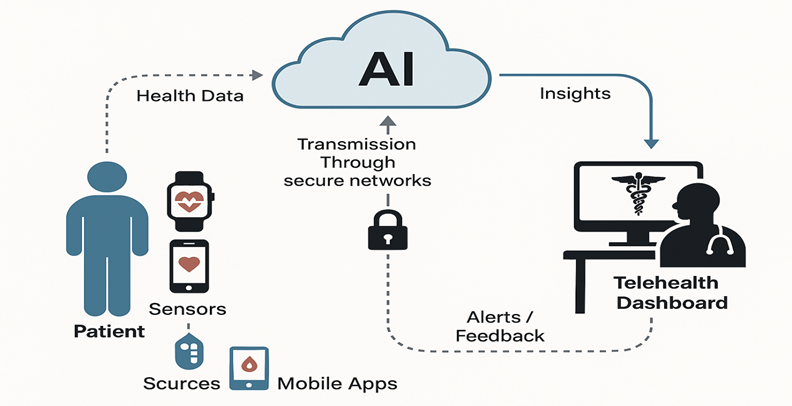
Figure 1: Conceptual architecture of an AI-enabled remote patient monitoring system. In this example architecture, patients use connected devices (wearables, sensors, mobile apps) to collect health data, which are transmitted through secure networks to cloud-based platforms. AI algorithms in the cloud analyze the incoming data streams in real time to detect anomalies or significant health trends. The insights are then shared with healthcare providers via telehealth dashboards, and alerts or feedback are sent back to patients. This closed-loop system enables continuous health surveillance, timely medical interventions, and improved patient engagement outside traditional clinical settings (Tsvetanov, 2024; Damera et al., 2025).
OPPORTUNITIES AND BENEFITS:
AI Applications in Remote Patient Monitoring:
AI-enabled RPM platforms have demonstrated numerous opportunities to enhance healthcare delivery. By leveraging AI’s capabilities in pattern recognition and predictive analytics, telehealth systems can monitor patients more effectively and improve clinical outcomes across a range of conditions. Key application areas and benefits are summarized in Table 1 and discussed below.
Table 1: Key applications of AI in remote patient monitoring across medical domains
|
Medical Domain |
AI-Based RPM Application |
Notable Outcome/Benefit |
|
Cardiology |
Wearable ECG and sensor devices with AI for arrhythmia and heart failure monitoring (e.g., smartwatches detecting atrial fibrillation) |
Early detection of cardiac events; reduced emergency hospitalizations through prompt intervention (Sharma, 2025; Topol, 2019) |
|
Diabetes Management |
Continuous glucose monitors linked to AI algorithms predicting glucose trends and insulin needs |
Improved glycemic control and fewer hyper/hypoglycemic episodes via real-time alerts and personalized insulin dosing recommendations (Sharma, 2025) |
|
Mental Health |
AI-driven teletherapy chatbots and mood monitoring (NLP analysis of patient speech/text via telehealth apps) |
Increased access to mental health support; early identification of depression or anxiety signs and timely referral for care (Chaturvedi et al., 2025) |
|
Dermatology |
Teledermatology platforms using AI image analysis of skin lesions uploaded by patients remotely |
High diagnostic accuracy in classifying skin lesions (benign vs. malignant) comparable to dermatologists; faster triage of cases for in-person follow-up (Chaturvedi et al., 2025) |
Table 1: Selected examples of how AI is applied in telehealth RPM and the benefits observed. These illustrate the breadth of AI’s impact, from physical health monitoring (cardiac arrhythmias, blood glucose levels) to mental health and specialist domains like dermatology.
Improved Clinical Outcomes and Early Detection
Remote patient monitoring (RPM) telehealth platforms allow gathering and transferring the health-related data of patients outside of the conventional clinical practice and providing care and interventions continuously and in a timely manner. Over recent years, RPM has experienced a strong momentum because of technological proliferation and the need to provide remote care in the COVID-19 times (Lai and Widmar, 2021). Telehealth, in a broad sense, includes real-time virtual consultation (telemedicine) and asynchronous health services and monitoring, both of which are intended to expand access to them and decrease the number of visits in person (Sharma, 2025). In this respect, artificial intelligence (AI) has become a disruptive empowerer of the telehealth system, and it can process the extensive amounts of data produced by the RPM devices and extract clinically relevant key outcomes (Sharma, 2025; Topol, 2019). AI methods, such as machine learning algorithms, natural language processing (NLP), and computer vision, can improve the accuracy of diagnoses and prediction in remote care, enabling the early identification of health declines and making it possible to respond to individuals (Yu and Kohane, 2019; Rossi and Rehman, 2025).
The need and opportunity of incorporating AI into telehealth RPM platforms is motivated by demand. Aging populations and high rates of chronic diseases (e.g. heart failure, diabetes, hypertension) places significant pressure on the healthcare system on the demand side, which has led to an urgent need to implement continuous monitoring solutions that can help avert hospitalizations [3][4]. The opportunity side is the spread of wearable sensors, connected medical equipment, and mobile health applications (the Internet of Medical Things) will offer an abundance of data to AI that can be used to create real-time insights (Damera et al., 2025; Tan et al., 2024). As an illustration, vital signs (heart rate, blood pressure, oxygen saturation, glucose levels, etc.) can be constantly monitored by smartwatches and biosensors, and the data can be analyzed by AI algorithms to identify insidious physiological changes that can be evidence of developing health problems (Chaturvedi et al., 2025). In fact, AI-based RPM transforms healthcare into a proactive rather than a reactive process: rather than waiting until patients show some symptoms, clinicians can be notified about some worrying trend or prediction made by AI analysis, thus allowing them to perform early interventions that enhance the outcomes (Sharma, 2025).
Although the fusion of AI with telehealth was promised, new challenges are also presented. The problem of data security, privacy of patient information, and the clarity of the algorithms becomes critical when the sensitive health information will be sent and processed remotely (Rossi et al., 2025; Char et al., 2018). Moreover, digital technologies are not equally accessible and comfortable to all patients, which brings up the issue of a digital divide in beneficiaries of AI-driven remote care (Lai and Widmar, 2021). This review offers a detailed analysis of the opportunities and challenges linked to AI-based telehealth platforms to RPM. We start by delving into the application of AI technologies in remote monitoring and the proof of their usefulness in a range of clinical settings. Next, we talk about the significant challenges of technical, ethical and practical nature that should be tackled. Lastly, we reflect on the future outlook and ways to solve the problem so that remote patient monitoring based on AI could be considered safe, effective, and fair.
Enhanced Patient Engagement and Accessibility
Telehealth working on AI also present possibilities to enhance patient interaction and access to care. Patients can be actively engaged with their care outside of the clinic by means of user-bots such as chatbots and mobile applications. Vital health assistants (chatbots) are AI-driven virtual assistants that can 24/7 respond to questions and/or give medication alerts and even mental health exercises (cognitive behavioral therapy) [5][6]. This continuous assistance can assist patients in following treatment procedures and supporting them outside of the hospital. As an example, AI coaching as a part of an RPM application can help motivate hypertensive patients to have healthy lifestyles and take medication, which leads to better outcomes as reported in such studies as Gazit et al. (2021). Telehealth engagement with patients can be of specific benefit to chronically ill persons who need regular monitoring and feedback. Also, AI-based telehealth solutions have the potential to access patients in rural or underserved locations, eliminating geographical barriers to access to healthcare (Sharma, 2025). Remote monitoring can be used to bring specialist consultation and regular check-ups closer, as traveling physically is unnecessary. It was witnessed throughout the pandemic, when the usage of telehealth surged, and even such patients as diabetes and COPD were able to get taken care of at home (Lai and Widmar, 2021). The AI also promotes accessibility by automating certain tasks - such as triage based on the risk score, which allows the providers to use their time wisely. Another advantage of engagement is personalization: AI algorithms have the ability to customize health education and alerts based on the situation of the specific patient (Amisha et al., 2019). Instead of generic advice, patients get the insight in the form of a warning to a diabetic patient that the glucose trend is growing and that some corrective measure will be taken (e.g., the app will issue a warning and provide a way to correct the situation). Ai-enhanced RPM fosters a closer therapeutic relationship even in the long distance because it promotes uninterrupted and personal communication between patients and providers (Chaturvedi et al., 2025). This not only enhances the clinical measures, but also confidence by patients and self-management skills.
Operational Efficiency and Cost Savings
Regarding the health system, remote monitoring with AI provides new possibilities of higher efficiency and cost reduction. The fact that the analysis of the RPM data will be automated implies that clinicians will receive only the necessary alerts instead of the whole alarm fatigue and switch the focus on the areas where it is most required (Rossi & Rehman, 2025). AI can address the routine vital signs trends and leave healthcare professionals to deal with complex cases. Cost-wise, different studies have shown that well-developed RPM programs have the potential to reduce health spending through avoidance of complications and hospitalization. In a systematic review, Tan et al. (2024) identified definite downward trends in the hospital readmission rates and length of stay related to the RPM interventions. The predictive capability of AI has its role: since early detection of high-risk situations allows intervention in outpatient care instead of expensive hospitalization. In addition, AI-based telehealth enables so-called hospital-at-home schemes, with some patients being treated at home, under the control of a hospital at the level of an inpatient treatment, reducing the cost of inpatient care significantly. Indicatively, home-based treatment of heart failure patients including daily monitoring and AI-controlled diuretic changes could prevent the emergencies due to fluid overload. According to economic studies, a high implementation of AI-enhanced RPM to chronic disease management would result in a significant amount saved by healthcare systems by not treating but preventing (Topol, 2019). Workflows also benefit: integration of AI into telehealth systems can make the documentation, schedule, and some forms of diagnostics (such as initial examination of a skin lesion or an ECG) automated, thereby decreasing the staff administrative load (Ahuja, 2019). The benefits are increasingly being realized by insurers and payers; many are starting to cover costs of RPM services and even promoting their use, anticipating eventual cost saving through better patient outcomes. The current trend of the growth of value-based care models fits the AI-enabled RPM quite well since it focuses on patient health and hospital avoidance.
Challenges of AI-Enabled Telehealth RPM
While the opportunities are compelling, there are significant challenges and barriers to the effective implementation of AI in remote patient monitoring. These challenges span technical issues, ethical and legal concerns, and human factors. Addressing them is crucial to ensure AI-driven telehealth is safe, equitable, and widely accepted.
Data Privacy and Security
RMSs gather constant flow of personal health information that is sensitive and posing severe privacy and security threats. Patients and providers should also believe that AI platforms are going to ensure confidential health information is kept. Transmission of data between home devices and the cloud platforms creates possible vulnerability to hacking or breach. Any breach of RPM data may reveal sensitive health information and put the privacy of patients at risk, which is against such laws as HIPAA. The priority must therefore be to ensure that the telehealth infrastructure has solid cybersecurity (Rossi & Rehman, 2025). This involves data in transit and data at rest encryption, secure user authentication and regular security auditing. Moreover, AI models in themselves can also be a problem with privacy; since big data can also be used to train algorithms and, when not managed correctly, can be used to reveal personally identifiable data. One of the solutions is suggested to be federated learning, where the AI models could be trained on the distributed data (which is kept locally), without centralizing the patient data (Rossi & Rehman, 2025). Nevertheless, the techniques are in maturity. The other point is the ownership and consent to data - patients must have clarity and understanding of how their data are going to be used by AI, they should consent to some features of analytics being used or not preferably. FDA and other authorities have started to provide recommendations on cybersecurity of medically networked devices and AI in recognition that the security breach of RPM devices may have direct detrimental effects on patients (e.g., when a device is hacked or data is distorted) (Yu and Kohane, 2019). To conclude, data privacy and security constitute a primary issue - it will not be easy to implement remote monitoring with AI without it because patients and providers will not want to trust it despite all the advantages.
Algorithmic Bias and Accuracy
The AI algorithms are immune to the quality of the data provided on which they are trained, and in healthcare, data may be biased or unrepresentative. When a predictive model provided in an AI-based telehealth platform is trained on a relatively limited range of people (e.g., middle-age adults in urban settings), then it is likely to fail in providing quality results in other patient groups (e.g., older patients or those living in rural settings). This type of algorithmic bias might result in care disparities with some groups being under-predicted or falsely identified (Char et al., 2018). As an example, a skin image analyzer AI may not work as well on darker skin tones assuming its training set was not diverse, which is a major issue with tele dermatology. To eliminate bias, it is crucial to curate training data attentively to define diversity and constant tracking of AI performance subpopulations (Yu and Kohane, 2019). Another problem in remote monitoring is variability and quality of data: data collected at home may be noisy or incomplete (e.g. the patient may sometimes abuse devices or avoid taking measurements). To prevent the high rate of mistakes, AI systems should be strong against such flaws. Maximum accuracy is essential since the diagnoses or monitoring errors can have extremely severe outcomes - the lack of an alert on a serious arrhythmia, or a false alarm leading to unjustified panic and visits to the hospital. The clinicians must be confident in the output of the AI; otherwise, with excessively high false positives or negatives, the clinicians will disregard the system, which will nullify its use. Some of the methods that can be used to enhance reliability include continuous retraining, external dataset validation, and the use of explainable AI. Explainable AI is especially essential in telehealth: clinicians (and patients) might want to know why the AI is raising an alarm about some pattern. Distrust can be reduced due to the absence of transparency (Rossi & Rehman, 2025). Overall, the problem of bias removal and the guarantee of the accuracy/clarity of the algorithms is a complex topic to which AI health developers need to focus their attention to ensure clinical credibility and fairness.
Integration with Clinical Workflow
To be more precise, AI-enabled RPM needs to become part and parcel of the current clinical processes and electronic health record (EHR) systems to be effective. This is a technical and organizational challenge of integration. At the technical level, there are often problems with interoperability: various telehealth devices and AI applications can generate data in different formats, and it is hard to unify data to provide it to a provider (Sharma, 2025). Standards such as HL7 FHIR are being developed to facilitate data exchange, yet a significant number of old systems and devices do not communicate effectively. Absence of integration could imply that clinicians may be required to access different dashboards to the RPM system, which may be inconveniencing to use and may cause alert fatigue without optimization. Rossi and Rehman (2025) refer to clinical workload as a reason to be concerned about AI applications - when such and such a tool delivers a large number of alerts or involves additional procedures; most busy healthcare professionals might not want to use it. Thus, the output of AI must be displayed in a convenient format (e.g., directly on the EHR record of the patient or through a single interface) and be ranked by urgency. Clinicians should also be provided with sufficient training so that they can be aware of the functionality and limitations of the AI tool (Sharma, 2025). A lot of providers do not have training on digital health and AI, and it may result in the usage of the technology in a wrong or inappropriate way. Some might be afraid of the fact that AI can replace their position or commit some mistakes they are not able to justify. The following considerations underscore the essence of integrating clinicians in the development and adoption of AI-RPM workflows. When physicians and nurses are involved in creating the form of alerts provision, and the way the AI will integrate with care procedures, they will become more trusting and willing to use the system (Ahuja, 2019). The other issue is reimbursement and liability: the providers may question, "Will I receive time on RPM alerts review? What happens when the AI fails to detect something important? Who is responsible? Well-defined policies and guidelines are yet to develop. To date, most healthcare systems have been handling such concerns by outlining the standard operating procedures of responding to AI-generated insights and keeping final clinical decision making by the human providers (Yu &Kohane, 2019). The key to sustainable use of telehealth AI platforms is to have a harmonious integration to make AI a help and not a hindrance.
Ethical and Regulatory Challenges
AI application in telehealth provokes a number of ethical and regulatory challenges. The autonomy and patient consent should be honored; patients need to be informed when AI is applied in their treatment and the decision-making process. It is possible that in some cases, an AI may suggest a change in treatment - it is ethically significant to make sure that there is a human-in-the-loop where the person will discuss and confirm the necessity of such changes (Char et al., 2018). Another issue is the possibility of over trusting AI: clinicians should be careful not to blindly follow AI suggestions, particularly when they were made contrary to clinical intuition, because algorithms are not always accurate. Authorities such as the FDA in the U.S have started developing avenues of approving AI-based medical devices and software. Nevertheless, the regulatory environment is yet to keep pace with the fast innovation. Numerous AI solutions in telehealth can be grey boxed (e.g. wellness apps vs. medical devices). Before AI tools are commonly used, it is essential to ensure their safety and efficacy by means of clinical validation (Rossi & Rehman, 2025). One of them is that AI algorithms may change (e.g. machine learning models which change with time ), making the traditional one-time approval model more complex. The regulators are thinking about such methods as adaptive or conditional approvals and post-market surveillance of AI. The question of accountability is also a big ethical issue: who is going to take responsibility in case an AI system cannot forecast a lethal arrhythmia or proposes a wrong change in medication, a clinician, the developer of the system, or the healthcare organization? In this, there should be clear guidelines to define responsibility and legal liability. Also, there is the question of fairness: AI-driven telehealth must not contribute to healthcare inequalities. However, according to it, biases in algorithms or lack of equal access to technology may result in unequal benefits. Ethicists and policymakers highlight the necessity of fairness checks in AI (Yu and Kohane, 2019) and programs to make sure that vulnerable populations (the elderly, low-income, those with limited internet) are not left behind in the process of healthcare digitization (Lai and Widmar, 2021). To conclude, it is a constant struggle to overcome ethical and regulatory challenges. It requires a multidisciplinary approach - the collaboration of engineers, clinicians, ethicists, and regulators to establish standards that promote patient safety, privacy, and rights and permit beneficial innovation to thrive.
Future Perspectives and Conclusion
Remote patient monitoring AI-enabled telehealth will continue to grow in number as we enter a more connected, data-driven paradigm of healthcare. In the future, this field may take several developments and trends:
Emerging Technologies: AI will be integrated with various technologies, including 5G telecommunications, sophisticated wearable biosensors, blockchain, and so forth, which will enhance the strength of remote monitoring (Chaturvedi et al., 2025). The ultra-fast 5G networks will allow transmitting high-density data (including live video or multi-sensors streams) to artificial intelligence engines to analyze them and minimize latency in vital monitoring (e.g., when an ICU patient is monitored at home). Some privacy issues in telehealth can be mitigated by using blockchain and other distributed ledger technology to improve the security of data and enable patients to control the sharing of their data (Chaturvedi et al., 2025). In the meantime, the IoMT is further projected to grow in terms of smarter and smaller devices, such as smart implants and ingestible sensors, all feeding information to AI models, which will be able to interpret and use it in a clinical setting.
Federated and Edge AI: Future RPM systems can employ federated learning and edge computing to avoid cases of privacy and enhance responsiveness. Federated learning enables AI models to be trained on data locally on either the devices of the patients (or the local servers in the hospital) without the raw data leaving the device, thereby maintaining privacy. Edge AI implies that data processing and anomaly detection may occur in a device or local hub (such as a home health gateway) and only a summary of them will be sent to the cloud. This decentralized strategy will help eliminate the need to be continually connected to the internet and can probably provide quicker alerts (Rossi & Rehman, 2025).
Better Algorithms and Explainability: Studies continue to be conducted to make medical Artificial Intelligence algorithms more transparent and explainable. Future telehealth AI can be accompanied by embedded explanation interfaces - such as an application may not only show that the risk of heart failure exacerbation is high, but it can also indicate where the data (weight gain, heart rate variability, etc.) came from. Clinician and patient trust may enhance such features. Besides, ongoing performance review and regular re-validation of AI models are likely to become the norm, potentially required by regulatory agencies, to maintain the accuracy of the algorithms over time and to keep abreast of emerging trends in population health or medical practice (Yu and Kohane, 2019).
Policies and Reimbursement: It is expected that the healthcare policies will change to embrace the remote monitoring and AI integration more. RPM services (that should be permanent, not temporary) will be given reimbursement codes; and insurance frameworks to appreciate the worth of preventive AI-directed care will be encouraged. More thorough systems of AI in healthcare are also anticipated to be published by regulatory bodies. Indicatively, instructions on how to ensure the validation of AI algorithms, how to make sure that the algorithms are not biased and that there are certain regulations on the reporting of any adverse events will ensure better guidelines of the road. On the global level, cooperations can result in international guidelines on digital health data interoperability and AI ethics in healthcare that could be used to align the practice.
CONCLUSION :
telehealth portals is an important innovation that can enhance healthcare outcomes, patient interaction, and efficiency of the system. The opportunities are demonstrated by a plethora of successful apps: not only the ones that help predict a heart failure attack in advance by several days, but also chatbots that provide mental health services to the people who otherwise may be left without. New technologies can also revolutionize healthcare and make it more proactive, continuous and personalized, in effect taking the aspects of hospital-level care into the home of the patient. To do so on a large scale, however, one will have to overcome the discussed challenges, namely, secure and substantial privacy guarantees, the absence of biases, seamless integration with healthcare processes, and the existence of coherent ethical and regulatory guidelines.
The stakeholders must adopt a patient-centered attitude toward AI in remote monitoring: the technology must enhance the experience of healthcare delivery without reducing the human factor or access inequity. According to Ahuja (2019), the role of the physician will be changed by AI rather than replaced because it can perform simpler analysis and data-crunching and leave clinicians alone with empathy, sophisticated choice-making, and patient connections. Soon, AI-based telehealth will probably transition to practice and leave pilot projects behind. Carefully going through the existing limitations and gleaning experience as the current research and real-life implementations, healthcare systems may utilize AI in telehealth to attain the dual aims of improved quality of care and increased access. This will open a new chapter of remote healthcare provision that will favor both the patients and the providers by integrating technology intelligence with human wisdom that would achieve improved health outcomes.
Conflict of Interest: The authors certify that they have no involvement in any organization or entity with any financial or non-financial interest in the subject matter or materials discussed in this paper.
Funding Source: There is no funding Source for this study.
REFERENCES:
1. Udit Chaturvedi, Shikha Baghel Chauhan, Indu Singh (2024). The impact of artificial intelligence on remote healthcare: Enhancing patient engagement, connectivity, and overcoming challenges Science Direct Intelligent Pharmacy journal https://journal.hep.com.cn/ip/EN/10.1016/j.ipha.2024.12.003 https://doi.org/10.1016/j.ipha.2024.12.003
2. Li, YH., Li, YL., Wei, MY. et al. Innovation and challenges of artificial intelligence technology in personalized healthcare. Sci Rep 14, 18994 (2024). https://doi.org/10.1038/s41598-024-70073-7
3. Adrien Laurent. AI in Remote Patient Monitoring: Technology & Applications. Intuition Labs.
4. https://intuitionlabs.ai/articles/ai-remote-patient-monitoring
5. Ahuja, A. S. (2019). The impact of artificial intelligence in medicine on the future role of the physician. PeerJ, 7, e7702. https://doi.org/10.7717/peerj.7702
6. Amisha, Malik, P., Pathania, M., & Rathaur, V. (2019). Overview of artificial intelligence in medicine. Journal of Family Medicine and Primary Care, 8(7), 2328–2331. https://doi.org/10.4103/jfmpc.jfmpc_440_19
7. Char, D. S., Shah, N. H., & Magnus, D. (2018). Implementing machine learning in health care—addressing ethical challenges. New England Journal of Medicine, 378(11), 981–983. https://doi.org/10.1056/NEJMp1714229
8. Chaturvedi, U., Chauhan, S. B., & Singh, I. (2025). The impact of artificial intelligence on remote healthcare: Enhancing patient engagement, connectivity, and overcoming challenges. Intelligent Pharmacy, 3(5), 323–329. https://doi.org/10.1016/j.ipha.2024.12.003
9. Damera, V. K., Cheripelli, R., Putta, N., Sirisha, G., &Kalavala, D. (2025). Enhancing remote patient monitoring with AI-driven IoMT and cloud computing technologies. Scientific Reports, 15, Article 24088. https://doi.org/10.1038/s41598-025-09727-z
10. Gazit, T., Gutman, M., & Beatty, A. L. (2021). Assessment of hypertension control among adults participating in a mobile technology blood pressure self-management program. JAMA Network Open, 4(10), e2127008. https://doi.org/10.1001/jamanetworkopen.2021.27008
11. Lai, J., & Widmar, N. O. (2021). Revisiting the digital divide in the COVID-19 era. Applied Economic Perspectives and Policy, 43(1), 458–479. https://doi.org/10.1002/aepp.13104
12. Miotto, R., Wang, F., Wang, S., Jiang, X., & Dudley, J. T. (2018). Deep learning for healthcare: Review, opportunities and challenges. Briefings in Bioinformatics, 19(6), 1236–1246. https://doi.org/10.1093/bib/bbx044
13. Rossi, M., & Rehman, S. (2025). Integrating artificial intelligence into telemedicine: Evidence, challenges, and future directions. Cureus, 17(8), e90829. https://doi.org/10.7759/cureus.90829
14. Sharma, P. (2025). Smart healthcare: The role of AI, robotics, and NLP in advancing telemedicine and remote patient monitoring. BMC Artificial Intelligence, 1, Article 14. https://doi.org/10.1186/s44398-025-00015-4.
15. Tan, S. Y., Sumner, J., Wang, Y., & Yip, A. W. (2024). A systematic review of the impacts of remote patient monitoring (RPM) interventions on safety, adherence, quality-of-life and cost-related outcomes. NPJ Digital Medicine, 7, Article 192. https://doi.org/10.1038/s41746-024-01182-w
16. Topol, E. J. (2019). High-performance medicine: The convergence of human and artificial intelligence. Nature Medicine, 25(1), 44–56. https://doi.org/10.1038/s41591-018-0300-7
17. Tsvetanov, F. (2024). Integrating AI technologies into remote monitoring patient systems. Engineering Proceedings, 70(1), 54. https://doi.org/10.3390/engproc2024070054
18. Yu, K. H., &Kohane, I. S. (2019). Framing the challenges of artificial intelligence in medicine. BMJ Quality & Safety, 28(3), 238–241. https://doi.org/10.1136/bmjqs-2018-008551.