Etiological Spectrum of Chronic Lower Gastrointestinal Bleeding on Colonoscopy in a Tertiary Care Hospital in Nowshera, Pakistan
- Abbass Masood , Senior registrar, Kabir Medical College, Peshawar
- Hamid ullah , Assistant Professor of Gastroenterology, Qazi Hussain Ahmed Medical complex, Nowshera
- Asfand yar khan , Assistant Professor of Gastroenterology, Qazi Hussain Ahmed Medical complex, Nowshera
- Ahmed Rahib , House officer, Department of Gastroenterology, Qazi Hussain Ahmed Medical complex, Nowshera
- Liaqat ali , Assistant Professor of Gastroenterology, DHQ Hospital, Mardan
- Haroon Ahmad , House officer, Department of Gastroenterology, Qazi Hussain Ahmed Medical complex, Nowshera
Article Information:
Abstract:
Background: Chronic lower gastrointestinal (GI) bleeding is a common clinical problem with a wide range of underlying etiologies that vary across regions. Limited data exist from Khyber Pakhtunkhwa (KP), Pakistan. Objective: To determine the etiological spectrum of chronic lower GI bleeding among patients presenting to a tertiary care hospital in Nowshera, Pakistan. Methods: A retrospective study of patients aged 1 year and older presenting with chronic lower GI bleeding (>6 weeks) who underwent lower GI endoscopy between January 2024 and December 2024 at Qazi Hussain Ahmed Medical Complex, Nowshera. Data were analyzed using SPSS 21. Results: A total of 239 patients were included; mean age was 36.03 ± 18.6 years, with 57.3% males. The most common etiologies were normal endoscopy (25.5%), hemorrhoids (22.6%), ulcerative colitis (15.1%), polyps (12.1%), solitary rectal ulcer syndrome (12.1%), malignancy (7.1%), infective colitis (5%), and ischemic colitis (0.4%). Conclusion: The etiological pattern observed differs from Western trends, with hemorrhoids, ulcerative colitis, solitary rectal ulcer syndrome, and polyps being more common, while diverticular disease was rarely observed. These findings emphasize the need for region-specific diagnostic and management strategies.
Keywords:
Article :
INTRODUCTION:
Chronic lower gastrointestinal (GI) bleeding is an important cause of outpatient visits and hospital admissions across the world. It is classically defined as recurrent or persistent bleeding from the GI tract distal to the ligament of Treitz lasting more than six weeks, typically presenting as hematochezia, intermittent rectal bleeding, or iron-deficiency anemia [1]. The etiological spectrum is broad and varies significantly based on age, comorbidities, geographic region, and population characteristics. Common causes reported internationally include hemorrhoids, colorectal polyps, colorectal cancer (CRC), angiodysplasia, inflammatory bowel disease (IBD), and diverticular disease [2–5].
Western literature highlights diverticular bleeding and angiodysplasia as major contributors, particularly among the elderly population [5]. However, studies from South Asia reveal distinctly different patterns. Research from Pakistan shows that hemorrhoids, solitary rectal ulcer syndrome (SRUS), infectious colitis, and ulcerative colitis (UC) are more frequently encountered, while diverticular disease and angiodysplasia remain uncommon [6–10]. The rising incidence of IBD in Pakistan, especially UC, has been observed consistently across multiple centers, attributed to urbanization, dietary changes, and improved diagnostic facilities [9,10]. An important emerging trend in the region is the increasing diagnosis of CRC in relatively younger age groups compared to Western populations, raising concern about late presentation, limited screening, and lack of public awareness [11].
Despite Pakistan’s diverse population, data from Khyber Pakhtunkhwa (KP) remain limited, particularly from district-level tertiary care hospitals such as Nowshera. This region has unique demographic, socioeconomic, and nutritional characteristics that may influence disease patterns. Understanding the local etiological spectrum of chronic lower GI bleeding is crucial for effective triage, appropriate use of endoscopy, and targeted treatment strategies in low-resource healthcare settings.
The present study aims to determine the etiological spectrum of chronic lower GI bleeding among patients aged 1 year and above presenting to a tertiary care hospital in Nowshera, Pakistan. This study adds important regional evidence to the existing national literature.
Methodology:
Study Design and Setting
This retrospective descriptive study was conducted in the Department of Gastroenterology, Qazi Hussain Ahmed Medical Complex (QHAMC), Nowshera—a major tertiary care center in Khyber Pakhtunkhwa, Pakistan.
Study Population
All patients aged 1 year and above presenting with chronic lower GI bleeding, defined as bleeding lasting more than six weeks, undergoing lower GI endoscopy from January 2024 to December 2024 were included.
Exclusion Criteria
• Evidence of upper GI bleeding
• Known coagulation disorders (e.g., hemophilia)
• Acute lower GI bleeding (<6 weeks)
Data Collection
Demographic variables (age, gender) and endoscopic findings were extracted from electronic medical records and endoscopy reports.
Data Analysis
Data were analyzed with SPSS v21. Categorical variables were presented as frequencies and percentages and continuous variables (age) were presented as mean ± standard deviation. Etiologies were categorized and their proportions calculated.
Results:
Demographic Characteristics
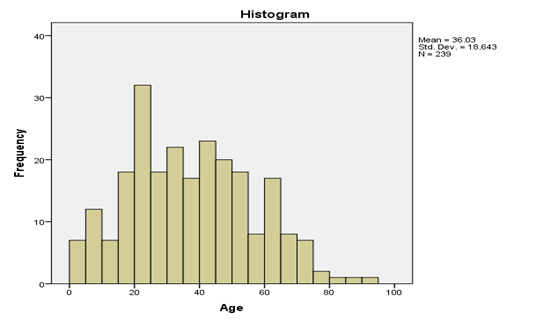
A total of 239 patients were included in the study. The mean age of the study population was 36.03 ± 18.64 years, with ages ranging from 1 to 92 years. There was a male predominance, with 57.3% (n = 137) males and 42.7% (n = 102) females.
Etiological Spectrum
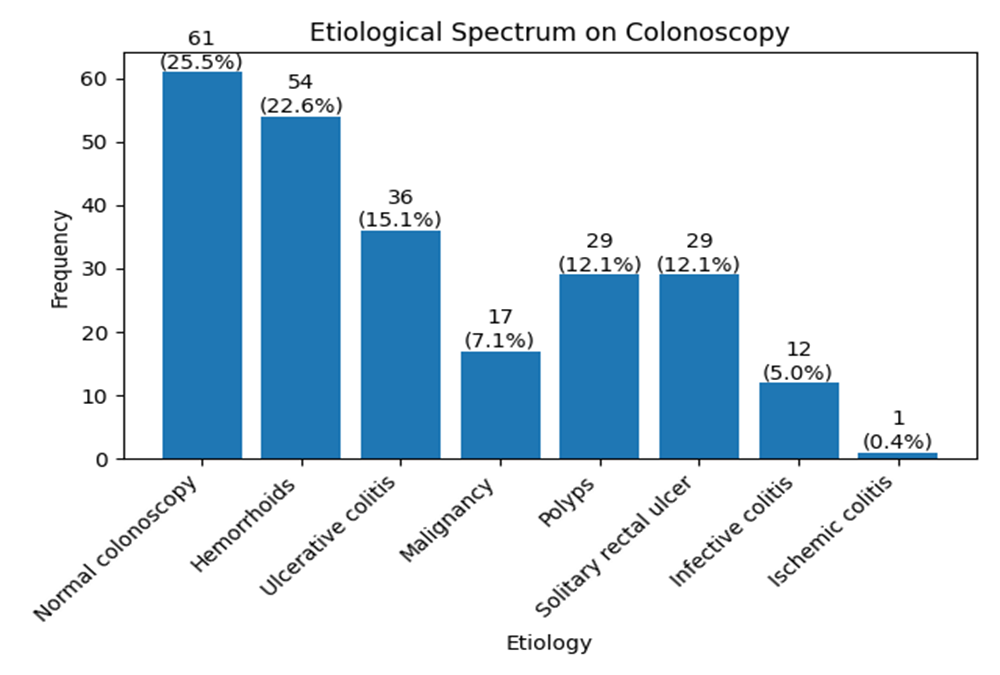
Colonoscopy findings revealed a diverse etiological spectrum. Normal colonoscopy was observed in 61 patients (25.5%), making it the most common finding. Among pathological causes, hemorrhoids were the most frequent, identified in 54 patients (22.6%), followed by ulcerative colitis in 36 patients (15.1%). Ischemic colitis was the least common etiology, identified in 1 patient (0.4%).
DISCUSSION :
This study highlights the etiological spectrum of chronic lower GI bleeding in a major tertiary care hospital in Nowshera, Pakistan, and demonstrates notable differences compared to Western populations. Hemorrhoids (22.6%) were the most common pathological cause, consistent with regional studies emphasizing hemorrhoidal disease as a leading cause of rectal bleeding in South Asia [6–8].
Ulcerative colitis constituted 15.1% of cases, supporting emerging evidence that IBD incidence is rising in Pakistan [9,10]. Unlike Western data, where diverticular disease and angiodysplasia are major contributors [4,5], these conditions were extremely rare in our population; no diverticular bleeding cases were recorded.
SRUS accounted for 12.1% of cases, which is relatively high compared to global reports but aligns well with Pakistani literature where SRUS is frequently underdiagnosed and often linked with chronic constipation and straining [8,10].
Colorectal malignancy was present in 7.1% of patients—an important finding given the increasing incidence of early-onset CRC in South Asian populations [11]. The young mean age of presentation (36 years) underscores the need for earlier screening strategies in Pakistan. A significant proportion (25.5%) had normal colonoscopy, similar to regional studies, likely reflecting minor anorectal pathology, self-limiting lesions, or intermittent bleeding with spontaneous resolution.
CONCLUSION:
Chronic lower GI bleeding in Nowshera shows a distinct etiological pattern compared to Western countries. Hemorrhoids, UC, SRUS, and polyps were the most frequent causes, whereas diverticular disease was rare. Early-onset colorectal cancer remains a growing concern. These findings highlight the need for improved endoscopic access, earlier CRC screening, and focused public health interventions in the region.
BIBLIOGRAPHY:
1. Strate LL, Gralnek IM. ACG Clinical Guideline: Management of Patients With Acute Lower Gastrointestinal Bleeding. Am J Gastroenterol. 2016 May;111(5):755.
2. Ghassemi KA, Jensen DM. Lower GI bleeding: epidemiology and management. Curr Gastroenterol Rep. 2013 Jul;15(7):333.
3. Peery AF, Crockett SD, Murphy CC, Lund JL, Dellon ES, Williams JL et al. Burden and Cost of Gastrointestinal, Liver, and Pancreatic Diseases in the United States: Update 2018. Gastroenterology. 2019 Jan;156(1):254-272.
4. Ullah HMK, Shafiq M, Ali QM, Ahmed S, Iftikhar A, Anwar Q. Colonoscopic Findings in Patients with Lower Gastrointestinal Symptoms at a Tertiary Care Hospital of South Punjab, Pakistan. J Pak Soc Intern Med. 2021; (2), 47-50.
5. Khan, D. S. Colonoscopy Findings In Patients Presenting With Bleeding Per Rectum. Journal of Medical Sciences,2017;25(3), 350–352.
6. Asaad HR, Faraj HIAG, Gharib DT, Shaikhani M,Hussein KFH, Ismaeil DA et al. Colonoscopic Findings in Patients with Rectal Bleeding Suspected to Have Internal Hemorrhoids: A Cohort Study. Barw Medical Journal.2024;2(2):26-29
7. Ali U, Anjum J, Ahmed S, Erum H. Demographic Profile and Extra Intestinal Manifestations of Ulcerative Colitis in Pakistani population. PJMHS;17(1):559-561.
8. Jafri, W., Yakoob, J., Jafri, N., Islam, M., Ali, Q. M. (2007). Irritable bowel syndrome and health seeking behaviour in different communities of Pakistan. Journal of Pakistan Medical Association, 57(6), 285-287
9. Zaman Z, Majid Z. Inflammatory bowel disease in Pakistan: Low prevalence or underdiagnosis? World J Gastrointest Pharmacol Ther. 2024 Nov 5;15(6):99226.
10. Ejaz Z, Khan SU, Rehman RU, Jibran MS. Solitary Rectal Ulcer Syndrome in Patients Presenting With Lower Gastrointestinal Bleeding: A Tertiary-Care Hospital Experience. Cureus. 2023;21;15(2).
11. Bhurgri Y, Khan T, Kayani N, Ahmad R, Usman A, Bhurgri A, Bashir I, Hasan SH, Zaidi S. Incidence and current trends of colorectal malignancies in an unscreened, low risk Pakistan population. Asian Pac J Cancer Prev. 2011;12(3):703-8.