ASSOCIATION BETWEEN HELICOBACTER PYLORI INFECTION AND IRON DEFICIENCY ANEMIA IN ADULTS: A CROSS-SECTIONAL ANALYSIS
- Hamid Ullah , Assistant Professor, Department of Gastroenterology, Qazi Hussain Ahmed Medical complex, Nowshera
- Abbas Masood , Senior registrar, Kabir medical college Peshawar
- Liaqat Ali , Assistant Professor, Department of Gastroenterology, Qazi Hussain Ahmed Medical complex, Nowshera
- Mohammad Naeem , Assistant Professor, Department of Gastroenterology, Mardan Medical Complex, Mardan
- Shakeel Ahmed , Assistant Professor, Department of Gastroenterology, DHQ Hospital Mardan
Article Information:
Abstract:
Background: Helicobacter pylori infection is highly prevalent worldwide and increasingly recognized as a contributor to extra-gastric disorders including iron deficiency anemia (IDA). Chronic gastritis caused by infection may impair iron absorption through hypochlorhydria, mucosal inflammation, and altered iron metabolism.Objective: To evaluate the association between H. pylori infection and iron deficiency anemia in adults and compare hematologic indices between infected and non-infected individuals. Methods: A cross-sectional study was conducted in 150 adults undergoing evaluation for dyspepsia or suspected anemia. Infection was diagnosed using stool antigen or urea breath test. Hemoglobin, ferritin, serum iron, total iron-binding capacity (TIBC), and transferrin saturation were measured. Statistical analysis was performed using SPSS v24, with p < 0.05 considered significant.Results: Mean age was 41.6 ± 12.4 years; 58% were H. pylori positive. IDA prevalence was significantly higher among infected individuals (64.4%) compared with non-infected individuals (28.6%) (p < 0.001). Mean hemoglobin was lower in infected patients (10.3 ± 1.3 vs 11.5 ± 1.1 g/dL; p < 0.001), as were ferritin levels (19.5 ± 6.8 vs 30.1 ± 7.4 ng/mL; p < 0.001). Multivariate regression showed infection independently predicted IDA (AOR 3.42; 95% CI 1.89–6.20).Conclusion: H. pylori infection is strongly associated with iron deficiency anemia and independently predicts its presence. Screening for infection should be considered in adults with unexplained anemia, especially in high-prevalence regions.
Keywords:
Article :
INTRODUCTION :
Helicobacter pylori is one of the most prevalent chronic bacterial infections globally, affecting more than half of the world’s population, with particularly high prevalence in developing countries due to socioeconomic and sanitation factors.¹ Traditionally associated with peptic ulcer disease and gastric carcinoma, H. pylori is now increasingly implicated in extra-gastric conditions including iron deficiency anemia (IDA).²Iron deficiency anemia remains the most common anemia worldwide, affecting nearly one-third of the global population and contributing significantly to impaired physical performance, reduced immunity, and decreased cognitive function.³ While nutritional deficiency and chronic blood loss remain classical etiologies, chronic infections such as H. pylori are increasingly recognized contributors.⁴Several biological mechanisms such as reduced gastric acid secretion impairing iron solubilization, bacterial sequestration of host iron, chronic inflammation with hepcidin-mediated iron restriction and microscopic gastrointestinal blood loss have been proposed linking H. pylori infection to iron deficiency. Evidence from observational studies and meta-analyses suggests infected individuals are more likely to have reduced ferritin levels and anemia, with improvement seen after eradication therapy.⁵The magnitude of association varies geographically due to dietary iron intake, genetic factors, and infection prevalence. South Asia has among the highest rates of both H. pylori infection and iron deficiency, making evaluation of this relationship clinically important.⁶
Aim: This study evaluated the association between H. pylori infection and iron deficiency anemia in adults presenting with gastrointestinal symptoms.
Methodology:
This cross-sectional study was conducted at the Department of Gastroenterology, Qazi Hussain Ahmed Medical Complex, Nowshera, over a period of six months from January 2025 to June 2025.
Study Population and Sampling Technique
Adult patients aged 18–65 years presenting to the Gastroenterology outpatient department (OPD) with laboratory evidence of iron deficiency anemia (IDA) were assessed for eligibility. A non-probability consecutive sampling technique was employed. Patients fulfilling the inclusion criteria and none of the exclusion criteria were tested for Helicobacter pylori infection. Only those with confirmed H. pylori infection were included in the final analysis.
Inclusion Criteria
• Age between 18 and 65 years
• Confirmed iron deficiency anemia based on laboratory parameters
• Positive Helicobacter pylori infection (stool antigen test and/or urea breath test)
Exclusion Criteria
Patients were excluded if they had:
• Chronic kidney disease
• Malignancy
• Pregnancy
• Inflammatory bowel disease
• Recent iron supplementation (within the last 4 weeks)
• Prior H. pylori eradication therapy within the past 6 months
• Prolonged proton pump inhibitor (PPI) use (>2 weeks)
Diagnostic Criteria
Helicobacter pylori Infection: Diagnosis was established using either a stool antigen test or a urea breath test.
Iron Deficiency Anemia: Iron deficiency anemia was defined using standard laboratory parameters, including hemoglobin level, serum ferritin, serum iron, and transferrin saturation.
Data Collection Procedure
After obtaining informed consent, demographic details (age, gender) and relevant clinical history were recorded. Laboratory investigations were reviewed, and eligible patients were tested for H. pylori. Data were recorded on a structured proforma.
Statistical Analysis
Statistical analysis was performed using SPSS version 24. Continuous variables, including hemoglobin, ferritin, serum iron, total iron-binding capacity, and transferrin saturation, were expressed as mean ± standard deviation and compared between H. pylori–positive and negative groups using the independent samples t-test.
Categorical variables, including the prevalence of iron deficiency anemia, were analyzed using the chi-square test. A multivariate logistic regression model was constructed to evaluate whether H. pylori infection independently predicted iron deficiency anemia after adjusting for potential confounders such as age, sex, dietary factors, and menstrual status.
Results were reported as adjusted odds ratios with 95% confidence intervals. A p-value < 0.05 was considered statistically significant for all analyses.
Data analysis and interpretation
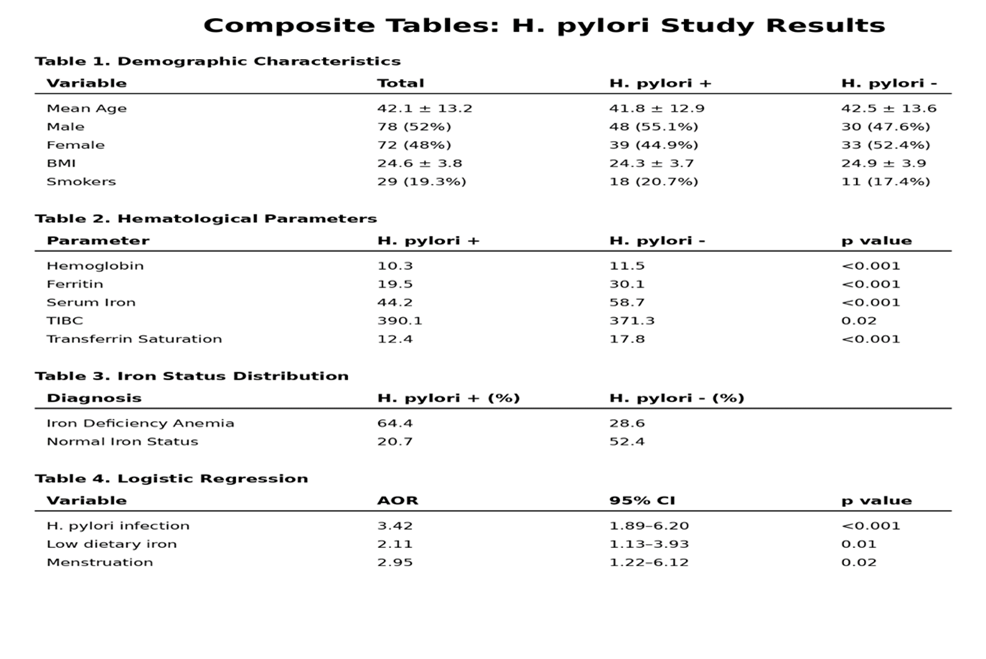
A total of 150 participants with a mean age of 41.6 ± 12.4 years were analyzed, of whom 87 (58%) tested positive for H. pylori infection.
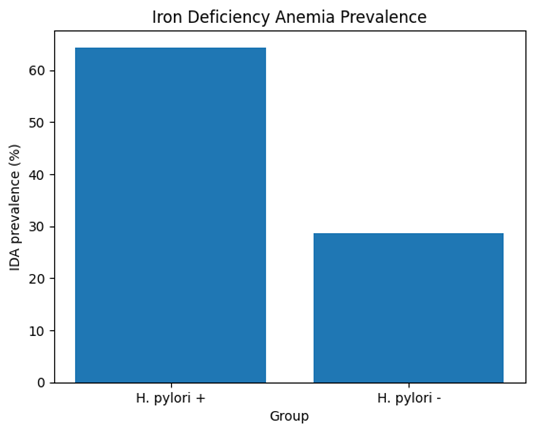
Baseline demographic characteristics, including age, gender distribution, body mass index, and smoking status, did not differ significantly between infected and non-infected groups (all p > 0.05), indicating comparable baseline characteristics. The prevalence of iron deficiency anemia (IDA) was significantly higher among H. pylori–positive individuals compared with negative individuals (64.4% vs 28.6%, p < 0.001).
Hematological and biochemical indices demonstrated significantly lower mean hemoglobin levels in infected patients (10.3 ± 1.3 vs 11.5 ± 1.1 g/dL; p < 0.001), along with markedly reduced ferritin (19.5 ± 6.8 vs 30.1 ± 7.4 ng/mL; p < 0.001), serum iron, and transferrin saturation, whereas total iron-binding capacity was significantly higher among infected individuals (390.1 ± 42.2 vs 371.3 ± 40.5 µg/L, p = 0.02).
Multivariate logistic regression analysis demonstrated that H. pylori infection remained an independent predictor of iron deficiency anemia after adjustment for age, gender, dietary iron intake, and menstrual status (adjusted odds ratio 3.42; 95% CI 1.89–6.20; p < 0.001). Low dietary iron intake and menstruation were also significant predictors, while age and female gender alone were not statistically significant.
Overall, these findings demonstrate a strong and independent association between H. pylori infection and biochemical evidence of iron deficiency.home.
Results:
DISCUSSION :
This study demonstrates a strong and statistically significant association between H. pylori infection and iron deficiency anemia. Infected individuals showed substantially lower hemoglobin, ferritin, and serum iron levels, indicating both absolute iron deficiency and impaired iron metabolism. The
adjusted odds ratio of 3.42 confirms infection as an independent predictor of IDA after controlling for confounders, strengthening causal plausibility.
These findings are consistent with international literature. A meta-analysis by Muhsen and Cohen reported significantly higher odds of IDA among infected individuals compared with controls.⁵ Similarly, Hershko et al. demonstrated that eradication therapy alone corrected otherwise unexplained iron deficiency in many patients.⁷
Studies from Europe and East Asia have reported comparable biochemical findings. Annibale et al. observed significantly reduced ferritin levels in infected patients, which improved after eradication.⁸ A Japanese cohort study likewise showed lower iron stores in infected adults independent of dietary intake.⁹
Regional data also support this association. South Asian populations have some of the highest reported prevalence rates of both H. pylori infection and iron deficiency.⁶ Studies from India and Pakistan have reported anemia prevalence ranging from 40–70% among infected individuals, closely mirroring the 64.4% prevalence observed in our infected cohort.¹⁰
The present study demonstrates a significant association between Helicobacter pylori infection and iron deficiency anemia. Infected individuals exhibited significantly lower hemoglobin, ferritin, serum iron, and transferrin saturation levels compared with non-infected individuals, indicating both absolute and functional iron deficiency. Furthermore, multivariate regression analysis confirmed that H. pylori infection remained an independent predictor of iron deficiency anemia even after adjusting for potential confounders such as age, sex, dietary factors, and menstrual status.
The biological relationship between H. pylori infection and iron deficiency is well supported by several pathophysiological mechanisms. Chronic gastritis caused by the infection may reduce gastric acid secretion, impairing the conversion of ferric iron to the more absorbable ferrous form and thereby limiting intestinal iron absorption. In addition, H. pylori–induced inflammation may increase cytokine production, which stimulates hepatic hepcidin synthesis, leading to decreased iron absorption and sequestration of iron within macrophages.4 The organism may also directly compete with the host for dietary iron, further contributing to depletion of iron stores.
The findings of this study are consistent with previous international studies that have reported reduced iron indices among infected individuals and improvement in hematologic parameters following eradication therapy. The relatively strong association observed in this study may reflect the high prevalence of H. pylori infection, iron-deficient dietary patterns, and delayed access to healthcare commonly seen in developing regions. These factors may amplify the clinical impact of the infection compared with populations in high-income countries. Collectively, these results support consideration of H. pylori screening in patients presenting with unexplained iron deficiency anemia, particularly in areas where the infection is highly prevalent.
LIMITATIONS
• Cross-sectional design prevents causal inference
• No histologic confirmation
• Diet assessed by self-report
• No long-term post-treatment follow-up
CONCLUSION:
This study provides strong evidence that H. pylori infection is independently associated with iron deficiency anemia in adults. The magnitude of association, biological plausibility, and consistency with international evidence suggest infection represents a reversible and treatable contributor to iron deficiency, particularly in high-prevalence regions.
BIBLIOGRAPHY:
1. Hooi JKY, Lai WY, Ng WK, Suen MMY, Underwood FE, Tanyingoh D et al. Global Prevalence of Helicobacter pylori Infection: Systematic Review and Meta-Analysis. Gastroenterology. 2017 Aug;153(2):420-429.
2. Malfertheiner P, Megraud F, O'Morain CA, Gisbert JP, Kuipers EJ, Axon AT et al. Management of Helicobacter pylori infection-the Maastricht V/Florence Consensus Report. Gut. 2017 Jan;66(1):6-30.
3. World Health Organization. Global prevalence of anemia 2011. Geneva: WHO; 2015.
4. Camaschella C. Iron-deficiency anemia. N Engl J Med. 2015;372:1832-1843.
5. Muhsen K, Cohen D. Helicobacter pylori infection and iron stores: systematic review and meta-analysis. Helicobacter. 2008;13:323-340.
6. Kharel S, Bist A, Shrestha S, Homagain S.Prevalence of Helicobacter pylori infection among healthy South Asians: systematic review and meta-analysis. JGH Open. 2020;4(6):1037-1046.
7. Hershko C, Ianculovich M, Souroujon M. A hematologist's view of unexplained iron deficiency anemia in males: impact of Helicobacter pylori eradication. Blood Cells Mol Dis. 2007;38(1):45-53.
8. Annibale B, Capurso G, Chistolini A, D’Ambra G, DiGiulio E, Monarca B, Delle Fave G. Gastrointestinal causes of refractory iron deficiency anemia in patients without gastrointestinal symptoms. Am J Med. 2001;111(6):439–445.
9. Rahat A, Kamani L. Frequency of iron deficiency anemia (IDA) among patients with Helicobacter pylori infection. Pak J Med Sci. 2021;37(3):776–781. doi:10.12669/pjms.37.3.3944
10. Kharel S, Bist A, Shrestha S, Homagain S. Helicobacter pylori healthy South Asians. JGH Open. 2020 Oct 12;4(6):1037-1046. doi: 10.1002/jgh3.12426. PMID: 33319035; PMCID: PMC7731813.