Scorpion bite contributing to failed spinal anesthesia- A Rare Case
- Hibba Asif , PG trainee Anesthesia, KRL hospital, Islamabad
- Muhammad Abdullah Shakeel , PG Trainee Anesthesia, KRL hospital, Islamabad
- Rida Amjad Qureshi , Senior Registrar Anesthesia, Medicsi Hospital, Islamabad
- Humaira Jadoon , Principle Medical Officer, Anesthesia, KRL hospital, Islamabad
Article Information:
Abstract:
We present a case of an elderly male who came for below-knee amputation (BKA) due to complicated synovial sarcoma. The patient had history of chronic obstructive pulmonary disease(COPD) and had undergone multiple cycles of chemotherapy and radiotherapy before surgical intervention was deemed necessary. Spinal anesthesia with a local anesthetic was planned due to his COPD. Despite two attempts by an experienced anesthesiologist, no sensory or motor block was achieved, even with confirmed cerebrospinal fluid backflow. Consequently, general anesthesia was administered.Upon further inquiry, the patient revealed a history of two previous scorpion bites. Based on relevant evidence-based studies and history given by the patient it was concluded that both are interlinked and scorpion venom may have contributed to the development of resistance to local anesthetics in the patient. Scorpion venom affects the sodium channel’s pumping mechanism, which plays a crucial role in the action of local anesthetics, leading to a possible resistance mechanism.
Keywords:
Article :
INTRODUCTION :
Failure to achieve local anesthesia can occur due to multiple factors including improper drug storage, incorrect technique, inadequate dosage and patient specific anatomical variations. However, in some cases, these common causes were ruled out, yet local anesthesia remained ineffective.(1)
Local anesthetic agents are the safest means of achieving adequate analgesia and anesthesia. Disposing the drug closer to the particular nerve or in the CSF helps block the sensations that may pose surgery impossible.(2) Voltage-gated sodium channels are responsible for propagation of nerve impulses and the local anesthetic agents block the sixth segment on alpha subunit of sodium channels. Scorpion venom is cardiotoxic, neurotoxic and nephrotoxic releasing enzymes like hyaluronidases, histamine and serotonin inciting an immunologic response.(3) Schylatoxin, charybotoxin, tityus toxin inhibit calcium dependent potassium channels and also causes opening of sodium channels at presynaptic nerve terminals.(4) A potential association between scorpion envenomation and failed spinal anesthesia has been documented though rarely reported. This case highlights a possible link between scorpion venom and local anesthetic resistance.
Case Report::
Patient background
Here we have a case of a 61 years old male, a diagnosed case of synovial sarcoma of right foot post-chemotherapy and post-radiotherapy over the last two years, who presented with wet gangrene of right foot
He was a known case of COPD and a chronic smoker for 30 pack years. His past anesthetic history included an uneventful excision biopsy of right foot surgery under spinal anesthesia in 2022 and an uneventful hernia repair under spinal anesthesia in 2016.
Due to non-salvageable limb and irresectable nature of tumor, a below knee amputation was planned by vascular team. His preoperative assessment showed that he had a productive cough, with exertional dyspnea and on examination coarse crackles were appreciable on both lung fields. His airway and spine examination was unremarkable. He was vitally stable. His lab investigations revealed that had a hemoglobin level of 11g/dl ,161000 platelets per microL of blood, a total leuckocyte count of 7700 cells/microL. The RFTs, LFTs and clotting profile were with in normal limits. Echocardiography showed an ejection fraction of 55%. ECG showed normal sinus rhythm. Chest X-ray revealed hyperinflated lungs, hilar lymphadenopathy, and a tubular heart.
The patient had no known drug or food allergies. He was on oral meropenem (1g BD for two days) and was advised to fast from midnight before surgery.
Based on his history, examination and Investigations, case was to be proceeded under subarachnoid block.
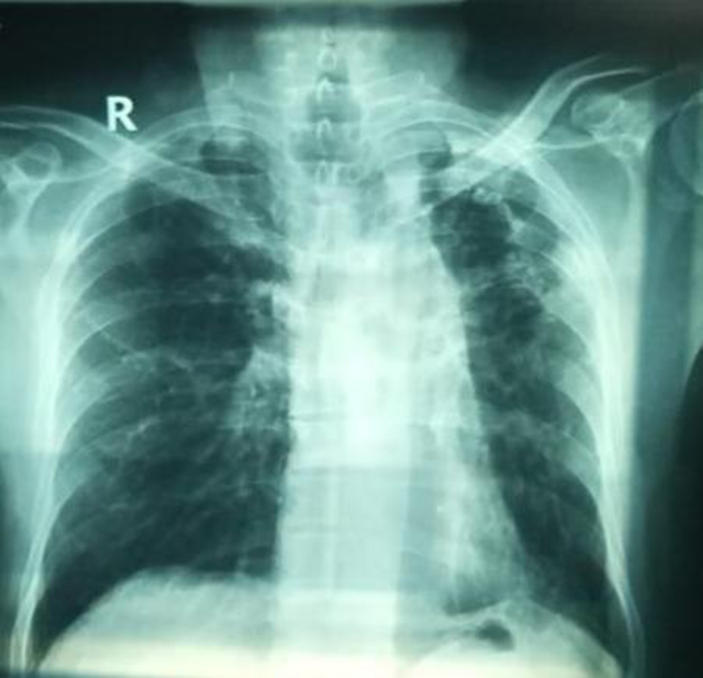
Fig : showing hyper inflated lungs, hilar lymphadenopathy and tubular heart.
Anesthetic Plan & Intraoperative Course
On the day of surgery, informed consent was obtained for both spinal anesthesia and general anesthesia . Standard ASA monitoring (ECG, blood pressure, pulse oximetry ) was initiated. He had a baseline BP of110/65 mmHg, HR of 70bpm and oxygen Saturation of 96% on room air.
Patient was put in a sitting position with the back exposed till mid third. After aseptic preparation, an L3-L4 subarachnoid block was attempted using 25G pencil point needle. After confirming free flow of CSF, 1.7 ml (8 mg) of 0.5% bupivacaine was injected intrathecally. The patient was immediately positioned supine. After 3 minutes, loss of temperature sensitivity was assessed using a spirit swab. No change in sensitivity was noted. Motor block was assessed using Bromage Score, which did not show a change from grade IV. He was positioned in Trendelenburg position but no block was established even after 20 minutes. A failed Spinal was established henceforth a second attempt was made at the same level by a consultant anesthetist. Despite confirmed CSF backflow, no anesthetic effect was achieved even after another 10 minutes. Given the failure of repeat spinal anesthesia, the team decided to proceed with a balanced general anesthesia.
General anesthesia protocol followed was:
• Preoxygenation: 100% O2 for 2 minutes
• Premedication: Ondansetron 4mg, midazolam 1mg, nalbuphine 2mg
• Induction: Propofol 60mg, atracurium 20mg
• Airway management: I-gel size, confirmed with end-tidal CO2
• Maintenance: Sevoflorane 2%
• Intraoperative analgesia: Paracetamol 1g, dexamethasone 4mg
The surgery proceeded uneventfully, and the patient was extubated successfully at the end of procedure. No sensory or motor block was observed even after extubation.
Postoperative Evaluation
On postoperative day one, the cause of failure was investigated. Further inquiry revealed that the patient had a previous history of scorpion envenomation in 2004 and a recent one eight months back in 2023. He had uneventful neuraxial anesthetics in 2016 and 2022, however he reported a painful dental extraction despite local block in 2005.
Given the well-documented association between scorpion venom and local anesthetic resistance, it was suspected that the previous envenomation contributed to the failed spinal anesthesia. This information was recorded for future anesthetic considerations.
DISCUSSION :
Giant congenital melanocytic nevi (GCMN) represent a rare and Spinal Anesthesia block is widely deemed as one of the most reliable and predictable regional block, however the risk of failure has always been acknowledged in the clinical setting. The failure rate of spinal anesthesia is reported to be between 1 to 17% averaging around 8% in a recent meta-analysis.(5) While common causes include improper drug storage, inadequate dosing, patient positioning, or technical failure, true resistance to local anesthetics is rare.(6) True resistance to local anesthetic agents is also quite difficult to identify and often skeptical.(7)
Voltage gate sodium channels are crucial for nerve impulse conduction, and local anesthetic act by inhibiting these channels. Local anaesthetic molecules, after crossing the phospholipid neuronal membrane, dissociate into ionized and un-ionized forms. The ionized form binds to open voltage-gated Na+ channels in a reversible and concentration-dependent manner. The binding site for local anaesthetics is situated in domain IV, loop S6 and becomes available only when the channel is in open state. The binding of the local anaesthetics to Na+ channels increases with the increase in the rate of nerve depolarisation. This bound drug stabilises the receptor in an inactivated state, thus hindering additional neuronal transmission. Scorpion venom contains the alpha toxin that binds extracellularly to S3–S4 loop in domain IV of the sodium channel, potentially altering its function. After the acute alteration of the Na-channels, the patient recovers. However, with time, antibody formation can take place. The presence of circulating antibodies may create a competitive antagonism at alpha subunit of sodium channels, leading to local anesthetic resistance later on.(7) Tripathi et al. compared 2 groups of 20 patients each with and without scorpion bite and concluded that the patients with scorpion bite showed a significant failure rate of spinal anesthesia when compared with the control group.(3) Though rare, cases of failed spinal anesthesia following scorpion bites have been reported in the literature. In such cases alternate strategies, such as adding adjuvants (e.g. fentanyl) to the local anesthetic, may help achieve an effective block. There are also case reports of successful spinal anesthesia after scorpion bites. Gautum et al. conducted a prospective study and concluded that time duration since the scorpion venom exposure exerts a crucial impact on the Spinal anesthesia in terms of sensory and motor block.(8) Panditrao et al. studied the effects of scorpion bites on the action of intrathecal bupivacaine and deduced a direct correlation of exposure to the scorpion venom and development of resistance to local anesthetics.(9) This pattern was also demonstrated by Trivedi et. al in multiple case series published in India as well where scorpion bites are prevalent.(10) Another case series presented by Pakhare et al, revealed that out of seven cases studied, five patients had a failed spinal block after a scorpion bite, one patient had a successful block after second attempt while one patient had a successful block after the first attempt.(11) Sandhya et al. deduced the possibility of a decrease in the antibody titre over a period of time leading to which caused a successful block in their patient after a duration of 2 years since her last scorpion bite. This showed that the time duration impacts the effectiveness of the local anesthetics after the scorpion bite.(12)
Our patient’s history also mirrored these findings. He had a history of local anesthetic failure in 2005 after a scorpion bite in 2004, that is within a span of 1 year. He subsequently had successful spinal anesthesia blocks in 2016 and 2022, twelve and eighteen years after the first bite respectively. This was followed by another spinal block failure in 2024 after the second exposure, eight months prior, to the scorpion venom in 2023.
Linking scorpion venom to failed spinal has not been reported before in our country and this was the first case that presented in our institution. It emphasizes the need for thorough history taking in patients from rural areas where scorpion envenomation is common.
CONCLUSION :
Scorpion venom may interfere with the mechanism of action of local anesthetics, leading to resistance which is time sensitive. Clinicians should consider scorpion envenomation as a possible cause of failed spinal anesthesia, particularly in patients from endemic areas. A detailed history is crucial for anticipating potential anesthetic challenges.
BIBLIOGRAPHY :
1. Chellam S, Dalal KS, Panse S. Scorpion Sting: A Reason for Failed Local Anesthetic Action. Res Innov Anesth. 2023 Dec 29;8(2):57–9. doi:10.5005/jp-journals-10049-2036
2. Panditrao M, Panditrao M, Khan MohdI, Yadav N. Does scorpion bite lead to development of resistance to the effect of local anaesthetics? Indian J Anaesth. 2012;56(6):575. doi:10.4103/0019-5049.104582
3. Tripathi S, Badlani B, Jain AK, Meravi J. EFFECT OF PREVIOUS SCORPION BITE ON THE EFFICACY OF INTRATHECALLY ADMINISTERED LEVOBUPIVACAINE IN SUBARACHNOID BLOCK. Asian J Pharm Clin Res. 2023 Feb 7;18–21. doi:10.22159/ajpcr.2023.v16i2.47289
4. Local Anesthesia Failure Cases with Scorpion Bite History in Third Molar Surgery- A Challenge. ARC J Anesthesiol. 2017;2(2). doi:10.20431/2455-9792.0202003
5. Zegeye ST, Admassie BM, Aligaz EM, Dires FT, Bayable SD. Incidence and predictors of failed spinal anesthesia: a systematic review and meta-analysis. Patient Saf Surg. 2025 Nov 27;20(1):1. doi:10.1186/s13037-025-00457-9
6. Fettes PDW, Jansson JR, Wildsmith JAW. Failed spinal anaesthesia: mechanisms, management, and prevention. Br J Anaesth. 2009 Jun;102(6):739–48. doi:10.1093/bja/aep096
7. Panditrao MM, Panditrao MM, Sunilkumar V, Panditrao AM. Can repeated scorpion bite lead to development of resistance to the effect of local anesthetics? Maybe it does! Case Rep Clin Med. 2013;02(02):179–82. doi:10.4236/crcm.2013.22049
8. Gautam A, Tripathi M, Gupta V, Gautam S, Rai S, Malviya D. Prospective Study Evaluating the Association between Time since Scorpion Bite and Spinal Anaesthesia Outcomes. J Clin Diagn Res. 2023. doi:10.7860/JCDR/2023/61751.18144
9. Panditrao M, Panditrao M, Sunilkumar V, Panditrao A. Effect of previous scorpion bite(s) on the action of intrathecal bupivacaine: A case control study. Indian J Anaesth. 2013;57(3):236. doi:10.4103/0019-5049.115593
10. Trivedi S, Bhardwaj H, Sahoo TK, Gupta S. Efficacy of Ropivacaine for Sub-Arachnoid Block in Patients with Recent History of Scorpion Sting: A case series. Sultan Qaboos Univ Med J. 2024 May;24(2):272–5. doi:10.18295/squmj.7.2023.046 PubMed PMID: 38828244; PubMed Central PMCID: PMC11139357.
11. Employees State Insurance Corporation (ESIC) Medical College and Hospital, Sanath Nagar, Hyderabad India, Pakhare VP, Nanda A, Employees State Insurance Corporation (ESIC) Medical College and Hospital, Sanath Nagar, Hyderabad India, Priyanka RDS, Employees State Insurance Corporation (ESIC) Medical College and Hospital, Sanath Nagar, Hyderabad India, et al. Scorpion Envenomation: The Cause of Inadequate Subarachnoid Block - A Case Series. J Anaesth Pain. 2023 May 31;4(2):38–41. doi:10.21776/ub.jap.2023.004.02.05
12. Successful Spinal Block in Obstetric Patient with Past History of Scorpion Sting and Failed Spinal Anesthesia. People’s J Sci Res [Internet]. 2022 Jan;15(1). Available from: https://pjsr.org/WebPages/ArchivesPages/Abstarct_Jan_2022/3.pdf