Effectiveness Of Retrograde Intrarenal Surgery (RIRS) Versus Percutaneous Nephrolithotomy (PCNL) In Terms Of Renal Stone Clearance
- Hafiz Abdul Hanan Atari , Department of Urology, Pakistan Kidney and Liver Institute (PKLI), Lahore.
- Shujah Muhammad , Department of Urology, Pakistan Kidney and Liver Institute (PKLI), Lahore.
- Nadeem Bin Nusrat , Department of Urology, Pakistan Kidney and Liver Institute (PKLI), Lahore.
- Nauman Zafar , Department of Urology, Pakistan Kidney and Liver Institute (PKLI), Lahore.
- Assad ur Rehman , Department of Urology, Pakistan Kidney and Liver Institute (PKLI), Lahore.
- Sarmad Bajwa , Department of Urology, Pakistan Kidney and Liver Institute (PKLI), Lahore.
Article Information:
Abstract:
Percutaneous nephrolithotomy (PCNL) is the standard treatment for renal calculi >2 cm due to its superior stone-free rates, despite higher morbidity. Retrograde intrarenal surgery (RIRS), enhanced by flexible ureteroscopy and modern laser systems, has emerged as a minimally invasive alternative for moderately large stones. Comparative data for stones measuring 20–30 mm remain limited.Objective: To compare the effectiveness and clinical outcomes of RIRS versus PCNL in the management of renal stones.Methods: This RCT was conducted at the Department of Urology, Pakistan Kidney and Liver Institute (PKLI), Lahore, over six months, following IRB review (IRB No. 00132025). A total of 82 adult patients (18–68 years) with single renal stones measuring 20–30 mm were enrolled and divided equally into RIRS and PCNL groups (n = 41 each). All procedures were performed by experienced urologists using standardized protocols. The primary endpoint was stone clearance, defined as no residual fragment >4 mm on non-contrast CT/ultrasound at three weeks. Secondary outcomes included operative time, need for secondary interventions, hospital stay, and perioperative complications. Statistical analysis was done using SPSS v26 with significance set at p < 0.05.Results: PCNL achieved higher single-session stone-free rates, while RIRS offered reduced invasiveness but an increased likelihood of secondary procedures.Conclusions: This study provided real-world comparative evidence to support optimal procedure selection for renal stones measuring 20–30 mm by balancing efficacy, morbidity, and procedural outcomes, establishing PCNL as the preferred method of approach for removal of renal stones measuring 20-30mm.
Keywords:
Article :
INTRODUCTION :
Nephrolithiasis, or kidney stone disease, is a recurring urologic disorder that is globally prevalent. In numerous populations, the lifetime prevalence estimates range from 10% to 13%. Urolithiasis' substantial public health burden was underscored by a recent population-based study conducted in Poland, which reported a lifetime prevalence of 12.85%.1 Data from the National Health and Nutrition Examination Survey (NHANES) in the United States indicate an estimated prevalence of 8–10%, with females experiencing notably significant increases in recent decades2,3. The global burden of urolithiasis is on the rise, which is partly attributable to the increasing prevalence of metabolic diseases, the promotion of dehydration by climate change, and lifestyle changes.4 Recurrence is a prevalent phenomenon; modern series frequently reference cumulative recurrence rates of 35% to 50% over the course of 5–10 years. 5,6
The pathophysiology of renal stone formation is multifactorial, with central contributors including the supersaturation of urinary solutes (e.g., calcium, oxalate, uric acid), urinary volume and flow, inhibitors of crystallization, dietary intake of relevant ions, and metabolic derangements (e.g., hyperparathyroidism, hyperoxaluria)7. Environmental factors, notably heat exposure and episodes of dehydration, also increase the risk, particularly in hotter climates. These climate-related risk factors, in conjunction with changes in dietary patterns (increased salt, animal protein, sugar, and reduced fluid intake), have likely contributed to the global increase in stone incidence 8.
Advancements in endourology have revolutionized the approach to renal calculi management. Historically, open surgery was the primary method; however, it has been largely replaced by minimally invasive techniques over the course of decades. Extracorporeal shockwave lithotripsy (SWL), retrograde intrarenal surgery (RIRS) via ureteroscopy and flexible endoscopes, percutaneous nephrolithotomy (PCNL), and in uncommon or complex cases, laparoscopic or open surgery are all part of the current therapeutic arsenal 10. Stone-related parameters (size, location, complexity, density), patient anatomy and comorbidities, and surgeon expertise are the primary determinants of the modality selection.
PCNL has long been regarded as the gold standard for renal stones that are larger than 20 mm (2 cm). High single-session stone-free rates (SFRs) of approximately 90–94% can be achieved in numerous series when patients are appropriately selected 11,12. However, PCNL is associated with a substantial morbidity risk, including hemorrhage necessitating transfusion, renal parenchymal trauma, adjacent organ injury, and postoperative pain or extended hospitalization. Major complications have been reported to occur in 5–8% of certain series 13,14.
Due to these morbidity concerns, there is a growing interest in extending the scope of RIRS to include the management of relatively sizable stones. Modern flexible ureteroscopes, digital optics, enhanced tip deflection, and high-power Holmium:YAG and Thulium fiber lasers enable the fragmentation of substantial calculi within the intrarenal collecting system. RIRS can access all calyces, fragment stones into dust or fine pieces, and avoid a percutaneous tract entirely in certain cases 15,16. Lower postoperative pain, negligible bleeding risk, a shortened hospital stay, and a faster recovery are among the benefits of RIRS. In addition, RIRS protects renal parenchyma that could otherwise be impacted by tract dilation in PCNL.
However, the comparative results between RIRS and PCNL for stones exceeding 2 cm are still inconsistent. However, some meta-analyses and systematic reviews indicate that PCNL has substantially higher SFRs than RIRS at the initial treatment stage, even though PCNL has higher complication or bleeding rates 17-19. For instance, a network meta-analysis revealed that both PCNL and mini-PCNL exhibited superior SFRs in comparison to RIRS, with RIRS rating lower on efficacy metrics 20. Another systematic review determined that PCNL continues to be more effective for large stones, despite the fact that RIRS had fewer hemorrhage complications 21. However, a few recent clinical studies and randomized controlled trials indicate that RIRS (with staged sessions) may achieve cumulative outcomes that are comparable to PCNL in certain patients, while simultaneously preserving a safer morbidity profile 22,23.
RIRS and SWL are primarily recommended for stones <20 mm or selected cases, while PCNL is presently recommended as the first-line therapy for renal stones >20 mm by the European Association of Urology (EAU) 24. A few authors suggest that patients with favorable anatomy or comorbidity risks for PCNL should be circumspect when extending RIRS indications beyond 2 cm [25]. Nevertheless, there is a dearth of high-quality local data in numerous regions and populations that specifically compare RIRS and PCNL for the 20–30 mm stone range.
Despite advancements in endourological techniques, the optimal management of renal stones measuring 20–30 mm remains uncertain. Although current guidelines recommend PCNL as first-line therapy for stones >20 mm, this is primarily based on higher single-session stone-free rates reported in selected populations. Emerging evidence suggests that RIRS may offer comparable outcomes in carefully selected patients, particularly when staged procedures are considered, while maintaining a more favorable morbidity profile. However, high-quality randomized evidence comparing these modalities in this specific stone size range, especially from resource-limited settings is limited.
Therefore, this randomized controlled trial was designed to compare the efficacy (stone-free rates) and safety profiles of PCNL and RIRS in patients with 20–30 mm renal stones. We hypothesized that PCNL would achieve higher single-session stone clearance, whereas RIRS would be associated with lower morbidity but a greater need for auxiliary procedures.
Methods::
This Randomized Controlled Trial was conducted at the Department of Urology, Pakistan Kidney and Liver Institute and Research Center (PKLI & RC), Lahore, over a six-month period from 13 February 2025 to 13 August 2025. The study was reviewed by the Institutional Review Board (IRB No. 0013-2025), and written informed consent was secured from all participants. A total of 82 adult patients with renal stones measuring 20–30 mm were enrolled using non-probability consecutive sampling and equally allocated into two groups: percutaneous nephrolithotomy (PCNL) and retrograde intrarenal surgery (RIRS) (41 patients each). Sample size was calculated using OpenEPI, based on previously published stone-free rates of 91.8% for PCNL and 66.6% for RIRS10, with 95% confidence and 80% power; the calculated sample size was 82.
Eligible patients were aged 18–68 years of either gender with renal calculi confirmed on imaging. Stone size was assessed using non-contrast CT KUB in accordance with EAU guidelines. Patients with uncontrolled diabetes or hypertension, active urinary tract infection or sepsis, morbid obesity (BMI >40 kg/m²), uncorrected coagulopathy, pregnancy, or inability to place a ureteral access sheath were excluded. All patients underwent standardized preoperative evaluation and surgical intervention under general anesthesia by experienced urologists. Data collected included demographic variables, stone characteristics, operative time, complications, and postoperative outcomes. Stone clearance was assessed at three weeks postoperatively, with stone-free status defined as no residual stone or clinically insignificant fragments ≤4 mm. Complications were graded using the Clavien–Dindo classification. Statistical analysis was performed using appropriate comparative tests, and a p-value <0.05 was considered statistically significant.
Statistical Analysis: IBM SPSS version 26 was employed to analyze the data. The mean ± standard deviation was used to summarize quantitative variables, including age, BMI, stone size, operative duration, and residual stone size. Frequencies and percentages were used to summarize categorical variables (need for secondary procedure, stone clearance efficacy, stone location, and gender). The chi-square test was employed to compare the primary outcome (stone-free rate in each cohort). Variations in secondary outcomes, such as operative time, were evaluated using an independent-samples t-test for means. Statistical significance was defined as a p-value of less than 0.05.
Results::
A total of 82 patients were included, with 41 patients each in the PCNL and RIRS groups. The mean age was 42.3 ± 12.5 years in the PCNL group, and overall gender distribution was comparable, with 41 males (21 PCNL, 20 RIRS) and 41 females. Mean body mass index was similar between groups (26.8 ± 3.7 kg/m² for PCNL vs 26.1 ± 3.9 kg/m² for RIRS). The mean longest stone diameter was approximately 25 mm in both groups. The renal pelvis was the most common stone location (≈46%), followed by lower calyx (≈25%) and upper/middle calyx or complex configurations, with no significant intergroup differences (all p > 0.05). Baseline demographic and stone characteristics were therefore comparable between the two cohorts.
Stone clearance at 3-week follow-up was significantly higher in the PCNL group. Stone-free status was achieved in 37 of 41 patients (90.2%) undergoing PCNL compared to 29 of 41 patients (70.7%) treated with RIRS (p ≈ 0.02). Residual fragments >4 mm were observed in 4 PCNL patients (9.8%) and 12 RIRS patients (29.3%), indicating a significantly higher residual stone burden following RIRS. Consequently, the need for secondary interventions was greater in the RIRS group. Four PCNL patients underwent additional treatment (three second-look PCNL procedures and one ESWL), whereas 12 RIRS patients required retreatment, including repeat RIRS in eight patients and conversion to PCNL in four cases. The overall retreatment rate was significantly higher for RIRS (29.3% vs 9.8%, p < 0.05).
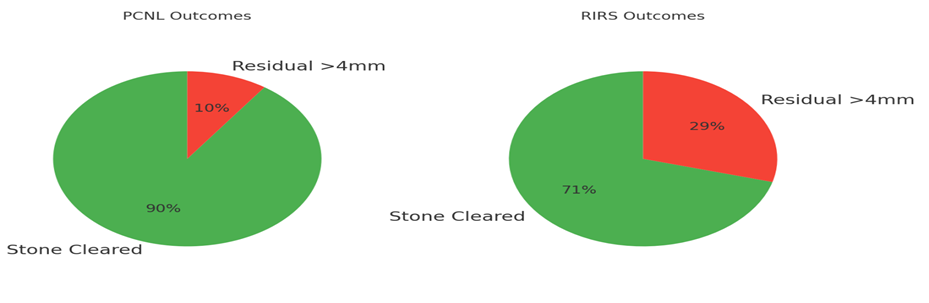
Figure 1: Comparison of stone clearance outcomes after one session of treatment. The pie charts illustrate the proportion of patients achieving complete stone clearance (green segment) versus those with residual stone >4 mm (red segment) in each group at 3 weeks post-procedure. PCNL achieved a higher stone-free rate (approximately 90%) compared to RIRS (~71%), indicating a greater likelihood of residual fragments after initial RIRS.
Mean operative time was comparable between the two techniques, with no statistically significant difference (56.3 ± 9.2 minutes for PCNL vs 59.8 ± 10.1 minutes for RIRS; p = 0.19). Although individual RIRS cases occasionally required prolonged laser fragmentation for larger stones, overall operative durations remained similar between groups.
Both procedures demonstrated acceptable safety profiles. Minor complications occurred in 5 PCNL patients (12.2%), including transient fever (n = 3) and small perinephric hematomas (n = 2), all managed conservatively. One PCNL patient (2.4%) required blood transfusion for a hemoglobin drop >3 g/dL, without the need for angioembolization. In the RIRS group, minor complications were observed in 6 patients (14.6%), most commonly postoperative fever and stent-related discomfort, managed with antipyretics and analgesics. One febrile urinary tract infection occurred in each group and responded to antibiotic therapy. No ureteral injuries, septic shock, thoracic complications, or mortality were observed. While not statistically significant, PCNL showed a tendency toward higher bleeding events, whereas RIRS demonstrated a trend toward higher febrile complications, consistent with known procedural profiles.
Overall, PCNL provided superior single-session stone clearance for renal stones measuring 20–30 mm, while RIRS was associated with a higher likelihood of staged procedures to achieve complete clearance, despite comparable operative times and similar complication rates.
Table 1: Comparison of surgical outcomes between PCNL and RIRS groups (n=41 each)
|
Outcome |
PCNL (Group A) |
RIRS (Group B) |
p-value |
|
Stone clearance achieved (SFR) |
37/41 (90.2%) |
29/41 (70.7%) |
0.02 * |
|
Mean operative time (minutes) |
56.3 ± 9.2 |
59.8 ± 10.1 |
0.19 |
|
Secondary procedure required |
4/41 (9.8%) |
12/41 (29.3%) |
0.03 * |
Secondary Procedures
Patients with residual stones were assessed for the need of ancillary procedures. Four patients in the PCNL group (9.8%) underwent additional treatment (redo-PCNL or ESWL), whereas 12 patients (29.3%) in the RIRS group required retreatment (redo-RIRS or conversion to PCNL). This difference was statistically significant (p = 0.03), indicating a higher retreatment burden in the RIRS group. (Figure 2, Table 2).
Figure 2. Secondary Procedure Requirement by Group
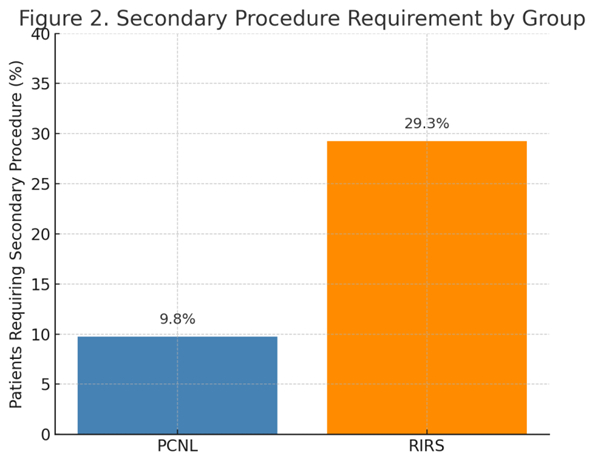
Frequency of secondary interventions due to residual stones >4 mm at 3-week follow-up. PCNL group had 9.8% (n=4) while RIRS group had 29.3% (n=12). (p < 0.05)
Table 2. Operative and Postoperative Outcomes Comparison
|
Variable |
PCNL (n=41) |
RIRS (n=41) |
p-value |
|
Stone-free rate (SFR) |
90.2% (37/41) |
70.7% (29/41) |
0.02* |
|
Mean operative time (min) |
56.3 ± 9.2 |
59.8 ± 10.1 |
0.19 |
|
Secondary procedure required |
9.8% (4/41) |
29.3% (12/41) |
0.03* |
|
Postoperative fever |
2.4% (1/41) |
4.8% (2/41) |
0.45 |
|
Blood transfusion required |
2.4% (1/41) |
0% (0/41) |
0.31 |
DISCUSSION :
This RCT evaluated the effectiveness of PCNL and RIRS in managing renal calculi measuring 20–30 mm. Our findings demonstrate a significantly higher single-session stone-free rate (SFR) in the PCNL group (90.2%) compared to the RIRS group (70.7%) (p < 0.05), despite comparable baseline characteristics and operative times. Additionally, secondary interventions were notably more frequent in the RIRS group (29.3% vs 9.8%). These results affirm the superior primary clearance efficacy of PCNL while highlighting the retreatment burden associated with RIRS.
The observed SFR in our PCNL group is consistent with international literature reporting success rates between 85–95% for stones >2 cm 1,2. De et al. confirmed PCNL's superior efficacy through a large meta-analysis (odds ratio 0.22 in favor of PCNL over
RIRS) 3. Akhtar et al. also reported comparable outcomes in a regional cohort, with mini-PCNL achieving 84.6% SFR versus 72.8% for RIRS4. Our data align closely with these benchmark.
The management of kidney stones with a diameter of 2–3 cm is still a topic of ongoing debate, as both PCNL and RIRS are minimally invasive options with distinct profiles. In a real-world clinical context, our study offers a direct comparison of these two approaches for renal stones measuring 20–30 mm. The results indicate that PCNL obtains a statistically significant higher single-session stone-free rate (SFR) than RIRS (90.2% vs 70.7%, p < 0.05), albeit at the expense of a more invasive technique and a higher perioperative burden. Although RIRS is less invasive, it is associated with a higher rate of secondary procedures and slightly more postoperative symptoms, which corroborates the trade-offs observed in previous studies.
Our findings are consistent with the findings of numerous studies that have demonstrated the superiority of PCNL for larger stones. PCNL-based investigations have consistently demonstrated one-session SFRs of 85–95% for stones greater than 2 cm in size 7,11,12. De et al. conducted a meta-analysis that determined that PCNL had substantially superior initial SFRs than RIRS for stones larger than 2 cm (odds ratio ~0.22 in favor of PCNL) 7. Akhtar et al. also discovered that mini-PCNL had a one-session SFR of 84.6%, while RIRS had an SFR of 72.8% for stones in the 2–3 cm range [9]. PCNL's advantage in terms of complete clearance, even in complex cases, was reaffirmed by Karakoç et al. in an updated review 10.
Nevertheless, cumulative SFRs may achieve equivalence with PCNL following multiple RIRS sessions. Even though RIRS had a higher retreatment rate, Barone et al. (2020) did not observe a statistically significant difference in final SFRs between the two when retreatments were accounted for 12. Our discovery that 29.3% of RIRS patients required a second procedure, in contrast to 9.8% in the PCNL group, is consistent with these findings. This implies that patients who are undergoing RIRS should be advised of the possibility of staged procedures, which can elevate both the cost and procedural burden.
RIRS appears to be the more conservative approach in terms of safety. Transfusion was only necessary in the PCNL group (2.4%) in our study, while minimal fever and stent discomfort were slightly more prevalent in the RIRS group. This pattern is corroborated by prior meta-analyses. Herrero et al. and Kang et al. observed that RIRS was associated with reduced renal trauma and transfusion rates, which is likely due to the avoidance of parenchymal puncture [6,8]. According to reports, the average hemoglobin decline in PCNL patients is 0.5–1.5 g/dL higher than that of RIRS. This suggests that RIRS is the safest choice for patients with bleeding diathesis or comorbidities11,12.
Another pertinent complication is postoperative infection. Transient bacteremia may result from the use of pressurized irrigation in RIRS, and intrarenal pressure elevations may elevate the risk of sepsis, particularly in infectious stones [7]. Our data indicated that both groups experienced the same rate of febrile UTIs (2.4%). However, the RIRS arm exhibited a trend toward more minor febrile episodes (13.6% vs 8.2%). Similar patterns were observed in local studies, including those conducted by Wahab et al. and Khan et al., in which RIRS had a higher incidence of stent-related complaints and fever, while PCNL had prolonged recovery periods and hospital stays 17,18.
In fact, the shortened hospitalization of RIRS is a significant advantage. Wahab et al. reported a mean hospital stay of 1.5 days for RIRS and 6.5 days for PCNL 17.. This trend was confirmed by qualitative observation, despite the fact that our study did not formally register the length of stay. RIRS is frequently administered on an outpatient or short-stay basis, which is advantageous for patients and working-age individuals who wish to reduce their idleness. In certain patients, RIRS is also advantageous due to the rapid return to activity and reduced analgesic requirement 8,12
Although the literature varies, the operational time in our study was statistically comparable (approximately 56–60 minutes). Some authors report that PCNL takes less time due to the rapid evacuation of fragments, while others, such as Barone et al., did not observe a significant difference 12. Operator experience and procedural standardization are likely the reasons for our comparable durations.
Implications of the Study
Our results confirm that PCNL is the most effective single-session treatment for renal stones measuring 20–30 mm, which is consistent with the current EAU guidelines that recommend PCNL as the first-line treatment for stones measuring over 20 mm [11,24]. Nevertheless, RIRS has been demonstrated to be a safe and practicable alternative in carefully selected patients. For example, patients who are elderly, anticoagulated, or have comorbidities may benefit from averting the percutaneous tract and bleeding risk associated with PCNL.. The trade-off is a slightly lower efficacy and a higher probability of staged treatment, which must be addressed during counseling with patients.
Improved scope designs, vacuum-assisted ureteroscopy, and thulium fiber lasers are among the technological advancements that continue to improve RIRS outcomes19,21. Similarly, mini- and super-mini-PCNL variants are intended to decrease the invasiveness of PCNL, which could potentially reduce the safety disparity 5,13. Comparative trials between these evolving methods are currently underway and are expected to further alter practice patterns.
Comparison to Recent Research
Our research closely aligns with recent regional data. Khan et al. (2025) discovered that SFR for 2–3.5 cm stones was 90% with PCNL and 80% with RIRS in a prospective Pakistani cohort. Retreatment rates were 10% with PCNL and 20% with RIRS 18. In the same vein, Wahab et al. (2025) reported that PCNL resulted in higher clearance and fewer repeat procedures, while RIRS resulted in shorter stays and less discomfort 17. International research, such as meta-analyses conducted by Kang et al. and Barone et al., has confirmed that no single modality is optimal in all circumstances; efficacy must be evaluated in relation to morbidity, cost, and patient preference6,12,21.
Limitations:
Limitations exist in this investigation. Although the primary outcome (SFR) is adequately powered, the sample size may interfere with the ability to detect differences in uncommon complications.. Additionally, we did not evaluate the composition of the stone, the severity of the discomfort, or the likelihood of a long-term recurrence. The surgeons who conducted all procedures were experienced, which reduced variability. However, the generalizability of the results may be restricted to similar tertiary settings.
CONCLUSION :
In comparison to retrograde intrarenal surgery, percutaneous nephrolithotomy obtais a higher single-session stone clearance rate for renal stones measuring 20–30 mm. Nevertheless, RIRS is a viable minimally invasive alternative in a limited number of patients and provides benefits in terms of postoperative recovery and morbidity. In order to balance efficacy with safety, patient preference, and institutional expertise, clinicians should adopt a patient-centered approach. The function of RIRS may continue to expand as technology advances, particularly in the areas of laser lithotripsy and scope design. The optimal application of these modalities will be further elucidated by ongoing randomized trials and extended follow-up studies.
Source of funding:
This research did not receive any specific grant from funding agencies in the public, commercial, or not-for-profit sectors.
BIBLIOGRAPHY:
1. Liu Y, Chen Y, Liao B, Luo D, Wang K, Li H, et al. Epidemiology of urolithiasis in Asia. Asian J Urol. 2018;5(4):205-14.
2. Wang K, Ge J, Han W, Wang D, Zhao Y, Shen Y, et al. Risk factors for kidney stone disease recurrence: a comprehensive meta-analysis. BMC Urol. 2022;22(1):62.
3. Fontenelle LF, Sarti TD. Kidney stones: treatment and prevention. Am Fam Physician. 2019;99(8):490-6.
4. Rule AD, Lieske JC, Pais VM. Management of kidney stones in 2020. JAMA. 2020;323(19):1961-2.
5. Wei C, Zhang Y, Pokhrel G, Liu X, Gan J, Yu X, et al. Research progress of percutaneous nephrolithotomy. Int Urol Nephrol. 2018;50(5):807-17.
6. Breda A, Angerri O. Retrograde intrarenal surgery for kidney stones larger than 2.5 cm. Curr Opin Urol. 2014;24(2):179-83.
7. De S, Autorino R, Kim FJ, Zargar H, Laydner H, Balsamo R, et al. Percutaneous nephrolithotomy versus retrograde intrarenal surgery: a systematic review and meta-analysis. Eur Urol. 2015;67(1):125-37.
8. Herrero MR, Doizi S, Keller EX, De Coninck V, Traxer O. Retrograde intrarenal surgery: an expanding role in treatment of urolithiasis. Asian J Urol. 2018;5(4):264-73.
9. Akhtar M, Khan MU, Usman HM, Raza QH, Aslam N, Ullah MS. RIRS and mini-PCNL in management of kidney stone: a comparative study. Biol Clin Sci Res J. 2022;2022(1):144.
10. Karakoç O, Karakeçi A, Ozan T, Fırdolaş F, Tektaş C, Özkarataş ŞE, et al. Comparison of retrograde intrarenal surgery and percutaneous nephrolithotomy for the treatment of renal stones greater than 2 cm. Turk J Urol. 2015;41(2):73-7.
11. Kang SK, Cho KS, Kang DH, Do Jung H, Kwon JK, Lee JY. Systematic review and meta-analysis to compare success rates of RIRS versus PCNL for renal stones >2 cm: an update. Medicine (Baltimore). 2017;96(49):e9119.
12. Barone B, Crocetto F, Vitale R, Di Domenico D, Caputo V, Romano F, et al. Retrograde intrarenal surgery versus percutaneous nephrolithotomy for renal stones >2 cm: a systematic review and meta-analysis. Minerva Urol Nefrol. 2020;72(4):441-50.
13. Gu Z, Yang Y, Ding R, Wang M, Pu J, Chen J. Comparison of RIRS and micro-percutaneous nephrolithotomy for kidney stones: a meta-analysis. Urol Int. 2021;105(1):64-70.
14. Cabrera JD, Manzo BO, Torres JE, Vicentini FC, Sánchez HM, Rojas EA, et al. Mini-percutaneous nephrolithotomy versus RIRS for the treatment of 10–20 mm lower-pole renal stones: a systematic review and meta-analysis. World J Urol. 2020;38(10):2621-8.
15. Jung HD, Chung DY, Kim DK, Lee MH, Lee SW, Paick S, et al. Comparison of ultra-mini percutaneous nephrolithotomy and RIRS for renal stones: a systematic review and meta-analysis from the Korean Endourological Society. J Clin Med. 2022;11(5):1529.
16. Uçer O, Erbatu O, Albaz AC, Temeltaş G, Gümüş B, Müezzinoğlu T. Comparison of the stone-free rate and effects on quality of life of percutaneous nephrolithotomy and RIRS for treatment of renal pelvis stone (2–4 cm): a prospective controlled study. Curr Urol. 2022;16(1):5-8.
17. Wahab AU, Khan I, Haq SU, Ullah G. Efficacy between percutaneous nephrolithotomy and retrograde intrarenal surgery for renal stones. Pak J Med Dent. 2025;14(4):in press.
18. Hayat Khan J, Malik S, Patujo YH, Siddique SHU, Moosa M, Khan MT, et al. Prospective comparative evaluation of stone clearance and complications in renal stones measuring 2 to 3.5 cm: PCNL versus RIRS. Cureus. 2025;17(9):e93302.
19. Kallidonis P, Tsaturyan A, Köhrmann KU, Liatsikos E. Minimally invasive surgical treatments for kidney stones: recent advances and future perspectives. Curr Opin Urol. 2020;30(2):130-8.
20. Qiu Y, Gao J, Huang Y, Zhang J, Wang W. Mini-percutaneous nephrolithotomy versus flexible ureteroscopy for renal stones in obese patients: a meta-analysis. Urolithiasis. 2024;52(1):55-63.
21. Kassem A, El-Shazly M, El-Hefnawy A, Mansour O, Saad H, Abdelmaksoud A. Retrograde intrarenal surgery versus percutaneous nephrolithotomy for 2–3 cm renal calculi: a prospective randomized controlled trial. Arab J Urol. 2025;23(2):145-52.
22. Şahin MF, Doğan C, Şeramet S, Topkaç E, Tuncer FB, Yazıcı CM. Comparison of the effects of multiple RIRS sessions and single-access conventional PCNL on early acute kidney injury. J Urol Surg. 2025;12(3):169-73.
23. Higazy A, El-Ghoneimy O, Khedr A, et al. Flexible mini-PCNL versus RIRS for renal stones: a prospective comparative study. World J Urol. 2025;43(5):1207-14.
24. De S, Autorino R, Kim FJ, Zargar H, Laydner H, Balsamo R, et al. Percutaneous nephrolithotomy versus retrograde intrarenal surgery: a systematic review and meta-analysis. Eur Urol. 2015;67(1):125-37.