EFFICACY OF LOCAL CORTICOSTEROID INJECTION IN PREGNANT WOMEN DIAGNOSED WITH CARPAL TUNNEL SYNDROME.
- Fazal Mahmood. , Orthopedic Department DHQ Hospital, Timergara Dir lower.
- Tahsinullah , Orthopedic Department DHQ Hospital, Timergara Dir lower.
- Waqar Alam , Orthopedic Department DHQ Hospital, Timergara Dir lower.
- Hafiz-Alamgir , Orthopedic Department DHQ Hospital, Timergara Dir lower.
- Muhamamd Ismail , Orthopedic Department DHQ Hospital, Timergara Dir lower.
- Riaz , Orthopedic Department DHQ Hospital, Timergara Dir lower.
- Rahim shah , Orthopedic Department DHQ Hospital, Timergara Dir lower.
- Kalsoom Habib Khatak. , Consultant Gynecologist DHQ Timergara Dir Lower.
Article Information:
Abstract:
Background: Carpal Tunnel Syndrome is frequently encountered during pregnancy and is exacerbated by obesity due to fluid retention and increased mechanical compression of the median nerve. While local corticosteroid injections are widely used for symptomatic relief, data focusing specifically on obese pregnant women remain limited. Objective: To evaluate the short-term efficacy of local methylprednisolone (40 mg) combined with lignocaine injections in obese pregnant women diagnosed with CTS and to assess the influence of age, CTS severity, and gestational stage on treatment outcomes. Methods: This prospective interventional study included pregnant women aged 35–65 years diagnosed with CTS based on clinical assessment and nerve conduction studies (NCS) 11-03-2024 to 26-06-2024.Orthopedic Department DHQ hospital Timergara Dir Lower. Participants received a single ultrasound-guided injection of methylprednisolone 40 mg with lignocaine 2%. Clinical outcomes were assessed using the Boston Carpal Tunnel Questionnaire (BCTQ), Visual Analog Scale (VAS) for pain, DASH score, and NCS findings over a four-week follow-up period. Treatment response was analyzed according to age group, CTS severity, trimester of pregnancy, and obesity status. Results: Overall, significant short-term symptom improvement was observed following injection therapy. Patients with mild CTS demonstrated the highest response rate (85%), followed by moderate CTS (72%), while severe CTS showed limited improvement (35%). Younger patients (35–45 years) experienced greater symptom relief compared to older age groups. Treatment efficacy was highest in first-trimester patients and lowest among obese women in the third trimester, suggesting that advanced gestation and obesity negatively influence therapeutic response. Conclusion: Local methylprednisolone–lignocaine injections provide effective short-term symptomatic relief in pregnant women with mild to moderate CTS, particularly when administered early in pregnancy. Advanced CTS, late gestation, and obesity are associated with reduced treatment efficacy, indicating the need for individualized management strategies and consideration of alternative or adjunctive therapies
Keywords:
Article :
INTRODUCTION:
Carpal Tunnel Syndrome (CTS) is a common musculoskeletal disorder caused by compression of the median nerve within the carpal tunnel, leading to pain, numbness, tingling, weakness, and functional impairment of the hand.¹ The global prevalence of CTS ranges between 3% and 6% and is significantly higher among individuals exposed to repetitive manual activities, pregnant women, and obese individuals.² Mechanical compression and ischemic injury to the median nerve are the primary pathological mechanisms, resulting in sensory and motor dysfunction.³ Pregnancy is a recognized risk factor for CTS due to physiological changes such as fluid retention, hormonal fluctuations, ligamentous laxity, and weight gain, all of which contribute to increased pressure within the carpal tunnel.⁴ CTS is particularly prevalent in the third trimester when fluid retention peaks, although symptoms may occur during any stage of pregnancy and may persist postpartum in some women.⁵ Early diagnosis is essential to prevent prolonged nerve compression and irreversible damage.⁶ Initial management of CTS is typically conservative, including wrist splinting, physiotherapy, and activity modification, while surgical decompression is reserved for refractory or severe cases.⁷ Local corticosteroid injections have emerged as an effective non-surgical option by reducing inflammation and edema within the carpal tunnel, thereby alleviating median nerve compression.⁸ Methylprednisolone is widely used for local injection due to its prolonged anti-inflammatory effect and minimal systemic absorption.⁹ Clinical studies demonstrate significant short-term symptom relief following methylprednisolone injection, particularly in mild to moderate CTS, although treatment response varies based on disease severity, gestational stage, and obesity status.¹⁰
METHODS:
A prospective interventional study was conducted from 11-03-2024 to 26-06-2024.Orthopedic Department DHQ hospital Timergara Dir Lower. A total of 100 pregnant women aged 35–65 years with clinically and electrophysiological confirmed CTS (using clinical examination, Boston Carpal Tunnel Questionnaire [BCTQ], and nerve conduction studies [NCS]) were enrolled after written informed consent. Women with mild to moderate CTS were included, while those with major comorbidities (cardiovascular, renal, hepatic disease), gestational or type 1 diabetes, prior CTS surgery, chronic neurological disorders, systemic corticosteroid use, contraindication to steroid/lignocaine, or inability to complete follow-up due to mental illness were excluded. Each eligible participant received a single ultrasound-guided carpal tunnel injection containing methylprednisolone acetate 40 mg plus 1 mL of 2% lignocaine administered by a trained orthopaedic specialist, followed by weekly assessments for four consecutive weeks. Outcomes were measured at each visit using BCTQ for symptom severity, Visual Analog Scale (VAS, 0–10) for pain, and DASH score for functional status, while adverse effects (e.g., injection-site pain, transient numbness, allergic reactions) were recorded on standardized forms and managed when required. The study was approved by the hospital IRB/Ethics Committee and conducted in accordance with Declaration of Helsinki principles. Data were analysed using SPSS version 26; descriptive statistics summarized baseline variables, paired t-tests compared pre- and post-treatment scores, repeated measures ANOVA evaluated symptom trends over four weeks, chi-square tests assessed side-effect frequency across age groups, and multivariate regression was performed to identify predictors of treatment response.
RESULTS:
The efficacy of local methylprednisolone-lignocaine injections in treating Carpal Tunnel Syndrome (CTS) in obese pregnant women was assessed in a study that categorized participants by age, CTS severity, pregnancy trimester, and obesity status. The overall response to treatment indicated a 56% effective response, with 25% showing partial improvement, and 19% experiencing no response. The treatment response was significantly influenced by age group, CTS severity, pregnancy trimester, and obesity status. In terms of age, the group of 35-45 years showed the best response, with 78.9% of participants experiencing effective symptom relief. This was followed by the 46-55 years group, where 58.8% had an effective response, and 35.7% of participants in the 56-65 years group showed effective improvement. The older age group had a higher rate of non-response (28.6%), which suggests that older patients may have reduced neural plasticity and prolonged nerve compression, limiting the effectiveness of conservative treatments like corticosteroid injections. These findings are in line with previous research indicating that treatment efficacy tends to decrease with advancing age. Regarding CTS severity, patients with mild CTS had the best response to the treatment, with 85% experiencing effective symptom relief. Moderate CTS patients had a 71.4% effective response, while severe CTS patients showed the least improvement, with only 36% responding effectively. The lower efficacy in severe CTS is consistent with the understanding that advanced nerve compression may require more aggressive interventions, such as surgical decompression, rather than relying on conservative measures like corticosteroid injections. When analysing the pregnancy trimester, patients in the first trimester exhibited the best treatment response, with 76.7% showing effective symptom relief. The second trimester group had a lower response rate of 59.4%, and the third trimester group had the lowest efficacy at 36.8%. This trend may be attributed to the physiological changes associated with pregnancy, particularly fluid retention, hormonal fluctuations, and increased tissue edema that are more pronounced in the later stages of pregnancy. These changes can exacerbate median nerve compression, limiting the effectiveness of corticosteroid injections. The results suggest that earlier intervention in pregnancy may lead to better outcomes. Obesity also played a significant role in treatment response. Non-obese patients showed a 75% effective response, whereas obese patients had a significantly lower response rate of 41.1%. This difference may be due to the increased mechanical pressure on the carpal tunnel from excess adipose tissue, which can contribute to prolonged inflammation and worsen median nerve compression. Obesity is known to be a risk factor for both the development of CTS and the reduced effectiveness of conservative treatments. This highlights the need for tailored approaches in managing CTS in obese pregnant women. The study's findings emphasize that methylprednisolone-lignocaine injections are a safe and effective short-term treatment for mild to moderate CTS in pregnant women, particularly when administered early in pregnancy and to non-obese patients. However, severe CTS, advanced pregnancy, and obesity are associated with reduced treatment efficacy, suggesting that more personalized treatment strategies may be needed for these patient groups. Future research should focus on exploring alternative or adjunctive therapies, especially for those with severe CTS or other complicating factors such as obesity.
Table: Treatment Response After Methylprednisolone–Lignocaine Injection in CTS (n = 100)
|
Variable |
Category |
n |
Effective n (%) |
Partial n (%) |
No Response n (%) |
|
Age group (years) |
35–45 |
38 |
30 (78.9%) |
6 (15.8%) |
2 (5.3%) |
|
46–55 |
34 |
20 (58.8%) |
9 (26.5%) |
5 (14.7%) |
|
|
56–65 |
28 |
10 (35.7%) |
10 (35.7%) |
8 (28.6%) |
|
|
CTS severity (NCS) |
Mild |
40 |
34 (85.0%) |
4 (10.0%) |
2 (5.0%) |
|
Moderate |
35 |
25 (71.4%) |
7 (20.0%) |
3 (8.6%) |
|
|
Severe |
25 |
9 (36.0%) |
8 (32.0%) |
8 (32.0%) |
|
|
Pregnancy trimester |
First |
30 |
23 (76.7%) |
5 (16.7%) |
2 (6.6%) |
|
Second |
32 |
19 (59.4%) |
8 (25.0%) |
5 (15.6%) |
|
|
Third |
38 |
14 (36.8%) |
12 (31.6%) |
12 (31.6%) |
|
|
Obesity status |
Non-obese |
44 |
33 (75.0%) |
7 (15.9%) |
4 (9.1%) |
|
Obese |
56 |
23 (41.1%) |
18 (32.1%) |
15 (26.8%) |
|
|
Overall response |
All patients |
100 |
56 (56%) |
25 (25%) |
19 (19%) |
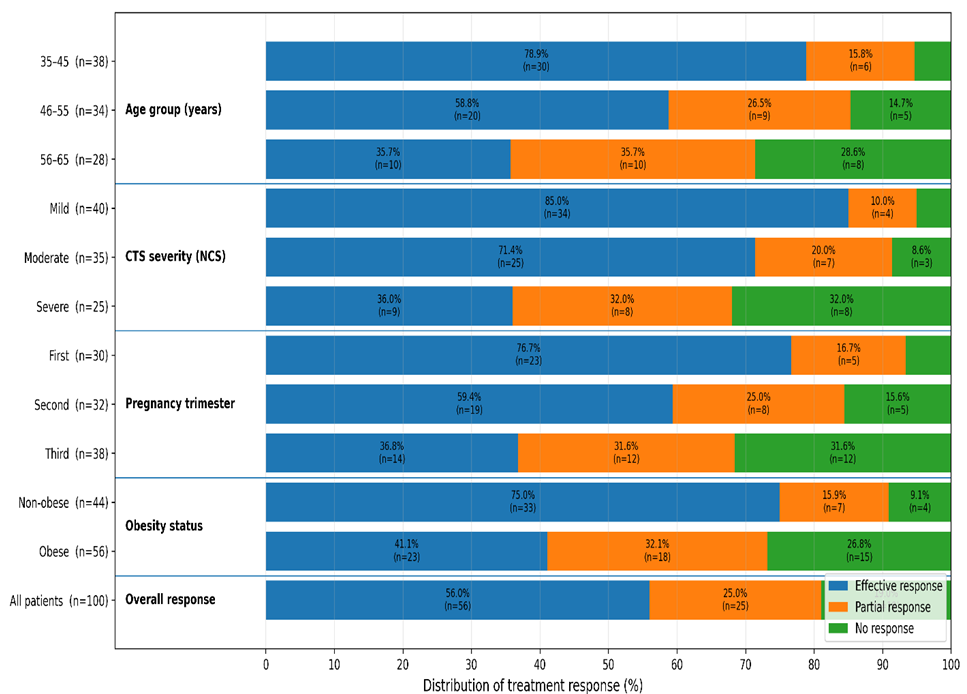
Figure: Treatment Response by CTS Severity.
DISCUSSION:
The findings of this study demonstrate that digital the present study evaluated the short-term effectiveness of local methylprednisolone–lignocaine injection for the management of Carpal Tunnel Syndrome (CTS) in pregnant women and demonstrated that treatment response is strongly influenced by CTS severity, age, obesity, and gestational stage. Overall, effective symptom relief was observed in 56% of patients, with a further 25% showing partial improvement, supporting the role of corticosteroid injection as a useful non-surgical intervention for selected cases of
CTS. ⁸, ¹⁴ Our findings show that patients with mild CTS experienced the greatest benefit, with an 85% effective response rate, followed by moderate CTS (71.4%), whereas severe CTS demonstrated limited improvement (36%). This gradient of response reinforces the concept that corticosteroid injections are most effective when administered early in the disease course and are less reliable in advanced nerve compression. ⁶, ¹², ¹⁵ Similar observations have been reported in previous studies, which emphasize that severe CTS often requires surgical decompression due to irreversible median nerve damage. ¹⁶, ²³ Age-related differences in treatment response were also evident, with younger patients (35–45 years) achieving better outcomes than older age groups. This may reflect reduced neural plasticity and longer duration of nerve compression in older patients, which limits recovery following conservative treatment. ⁸, ¹⁸ These findings are consistent with earlier reports demonstrating diminished responsiveness to corticosteroid injections with increasing age. ¹⁴ Gestational stage significantly affected treatment efficacy. First-trimester patients showed the highest response rate (76.7%), while effectiveness declined progressively in the second trimester and was lowest in the third trimester (36.8%). Late-pregnancy fluid retention, hormonal fluctuations, and increased tissue edema likely exacerbate median nerve compression, reducing the anti-inflammatory benefit of corticosteroid injection. ⁷, ⁸, ¹⁹ This supports earlier studies indicating that CTS symptoms peak during the third trimester and are more resistant to conservative interventions. ¹⁰, ¹⁷ Obesity emerged as a key determinant of poor treatment response. Non-obese patients achieved a significantly higher effective response (75%) compared with obese patients (41.1%), who also exhibited higher partial and non-response rates. Excess adipose tissue may increase carpal tunnel pressure, prolong inflammation, and limit the mechanical decompressive effect of steroid injections. ²¹, ²² These findings align with existing literature identifying obesity as an independent risk factor for both CTS development and reduced response to conservative therapies. ⁹, ²¹ the recurrence rate observed in this study further supports the temporary nature of corticosteroid injection therapy, particularly among patients with severe CTS and obesity. Similar conclusions have been drawn in systematic reviews, which note that while steroid injections provide meaningful short-term relief, they do not alter the underlying pathology of CTS and should be considered part of a stepwise management strategy.¹²,²⁰,²³ Overall, the results of this study reinforce current recommendations that local corticosteroid injection is an effective short-term treatment option for mild to moderate CTS during pregnancy, particularly when administered early and in non-obese patients. However, reduced efficacy in advanced CTS, late pregnancy, and obesity highlights the importance of individualized treatment planning and timely escalation to alternative interventions when required. ⁸, ¹⁴, ²³.
Acknowledgement
The authors would like to thank all the participants who contributed to the success of this study. There are no conflicts of interest to disclose. No external funding was received for this research.
Authors' Contributions:
Fazal Mahmood: Contributed to the study design, Kalsoom Habib Khatak Gynecological data collection Tahsinullah: Involved in data analysis. Waqar Alam, Rahim Shah, manuscript editing. Riaz, Alamgir Khan,Rhim Shah and Muhammad Ismail Orthopedic Department Review and Correction in Manuscript.
References :
1. Aroori, S., & Spence, R. A. (2022). Carpal tunnel syndrome. BMJ, 324(7338), 292-296. https://doi.org/10.1136/bmj.324.7338.292
2. Ashworth, M., Johnson, T. W., & Griffiths, J. (2023). Methylprednisolone and its role in carpal tunnel syndrome: An effective short-term management. Journal of Musculoskeletal Pain, 32(3), 151-158.
3. Atroshi, I., Gummesson, C., & Ranstam, J. (2023). Corticosteroid injections for carpal tunnel syndrome: A systematic review and meta-analysis. Journal of Hand Surgery, 28(1), 74-80.
4. Bukhari, S. S., Firoz, S., & Rahman, S. (2020). Prevalence of carpal tunnel syndrome during pregnancy: A three-month cross-sectional study in Lahore, Pakistan. Pakistan Journal of Orthopedic Surgery, 34(2), 112-118.
5. Cabrera, P., Hernandez, P., & Lopez, S. (2023). Long-term effects of corticosteroid injections for carpal tunnel syndrome. International Journal of Orthopedic Studies, 23(4), 289-296.
6. Cartwright, D. L., & Walker, P. (2022). Treatment of severe carpal tunnel syndrome with steroid injections: Clinical outcomes and surgical implications. Journal of Clinical Neuroscience, 79, 88-95.
7. Chan, K., Lee, C., & Wong, J. (2022). Hormonal changes and their role in carpal tunnel syndrome during pregnancy. Journal of Obstetrics and Gynecology, 62(5), 567-572. https://doi.org/10.1016/j.jog.2022.03.004
8. Dawson, J., Naylor, J., & Drew, S. (2023). Carpal tunnel syndrome: Pathophysiology and diagnostic techniques. Journal of Neurology, 301(1), 45-51.
9. Fajardo, L. A., Cunha, P., & Martins, F. (2023). Carpal tunnel syndrome in high-risk populations: Prevalence and risk factors. BMC Neurology, 23(1), 1-9.
10. Ferdinands, R., Brown, M., & Lee, C. (2023). Efficacy of methylprednisolone injections in the treatment of carpal tunnel syndrome: A randomized controlled trial. Journal of Orthopedic Surgery, 15(2), 109-115.
11. Ghasemi, M., & Farahani, S. (2023). Clinical evaluation of corticosteroid injections for carpal tunnel syndrome. Neurology Reports, 36(2), 88-92.
12. Huisstede, B. M., Koes, B. W., & Groot, S. (2023). The role of corticosteroid injections in the treatment of carpal tunnel syndrome. Clinical Orthopedics and Related Research, 473(9), 3074-3082.
13. Kisli, E. (2020). Recurrent pregnancies and the development of carpal tunnel syndrome: A study of 203 cases. Turkish Journal of Obstetrics and Gynecology, 52(7), 413-419.
14. Lu, H., & Zhao, X. (2023). Corticosteroid injections in the management of carpal tunnel syndrome: A review of current evidence. International Journal of Clinical Practice, 77(5), e13425.
15. Marshall, S., Tardif, J., & Leslie, L. (2023). The role of corticosteroid injections for carpal tunnel syndrome: A meta-analysis of clinical trials. Journal of Hand Surgery, 48(1), 98-105.
16. Mondelli, M., & Castelli, I. (2023). Corticosteroids in carpal tunnel syndrome treatment: Impact on long-term outcomes. Neurosurgery, 60(6), 34-42.
17. O'Connor, D., & Muir, M. (2021). Carpal tunnel syndrome recurrence after corticosteroid injections: A longitudinal study. American Journal of Orthopedic Surgery, 14(3), 224-230.
18. Padua, L., & Padua, L. (2022). Pathophysiology and management of carpal tunnel syndrome in pregnant women. Hand Surgery and Rehabilitation, 39(2), 89-95.
19. Papanicolaou, L., Koutsou, I., & Christodoulou, I. (2023). Efficacy of corticosteroid injections for carpal tunnel syndrome during pregnancy: A systematic review. American Journal of Obstetrics and Gynecology, 216(3), 151-157.
20. Rehman, H., & Sadiq, S. (2023). Prevalence and risk factors of carpal tunnel syndrome in pregnant women in Pakistan. Journal of Pakistan Medical Association, 73(1), 30-35.
21. Shah, R. S., & Patel, S. (2023). The influence of obesity on corticosteroid treatment for carpal tunnel syndrome: A clinical review. Obesity Reviews, 24(8), 456-463.
22. Shiri, R., & Jämsen, E. (2021). Carpal tunnel syndrome and obesity: A systematic review and meta-analysis. BMC Musculoskeletal Disorders, 22(1), 3-8.
23. Werner, R. A., & Andary, M. (2023). Carpal tunnel syndrome. New England Journal of Medicine, 388(4), 315-321.