IMPACT OF HARD-HEEL FOOTWEAR ON PLANTAR FASCIITIS SEVERITY AMONG MALE WORKERS IN DIR LOWER
- Tahsinullah , Orthopedic Department DHQ Hospital, Timergara Dir lower
- Fazal Mahmood , Orthopedic Department DHQ Hospital, Timergara Dir lower
- Waqar Alam , Orthopedic Department DHQ Hospital, Timergara Dir lower
- Hafiz Alamgir , Orthopedic Department DHQ Hospital, Timergara Dir lower
- Muhamamd Ismail , Orthopedic Department DHQ Hospital, Timergara Dir lower
- Riaz , Orthopedic Department DHQ Hospital, Timergara Dir lower
- Rahim Shah , Orthopedic Department DHQ Hospital, Timergara Dir lower
Article Information:
Abstract:
Plantar fasciitis is a common cause of heel pain that can impair work performance, particularly in occupations involving prolonged standing or walking. Footwear type and work-related load may influence symptom severity, yet occupational data in male remain limited. Objective: To describe the frequency and severity of plantar fasciitis symptoms and explore potential work-related and footwear-related risk factors among male engaged in prolonged activity. Methods: This cross-sectional study enrolled from 06 January 2022 to 30 June 2022. 48 males aged >20 years. Participants with prior lower-extremity surgery, pregnancy, or chronic illness were excluded. Pain intensity and functional impact were assessed using the Visual Analog Scale (VAS) and Plantar Fasciitis Pain Scale (PFPS). Information on footwear type, timing of pain, frequency of pain episodes, and perceived impact on daily activities was collected and analyzed. Associations between pain intensity and age were tested statistically. Results: The mean PFPS score was 31.41, and the mean VAS score was 1.95. Pain intensity showed a significant positive correlation with age (p = 0.001). Most participants reported pain 3–4 days/week (41.6%), most commonly in the afternoon (31.3%) or on waking (22.9%). Continuous pain during walking was reported by 20.9%, while 37.5% described occasional pain. Footwear-related discomfort was reported by 41.6%, and prolonged use of hard-heeled shoes for 5–8 hours was associated with severe pain episodes (VAS 10). More than half of participants (52.1%) reported that symptoms negatively affected daily life at home and/or work. Conclusion: Plantar fasciitis symptoms meaningfully disrupt daily activities and work functioning in male with prolonged standing or walking demands. Targeted ergonomic strategies and supportive footwear interventions may reduce symptom burden and improve occupational foot health.
Keywords:
Article :
INTRODUCTION:
Plantar fasciitis is one of the most common causes of heel pain, representing nearly 11–15% of all foot disorders encountered in primary care and orthopedic practice [1]. The condition affects the plantar fascia, a thick fibrous band extending from the medial tubercle of the calcaneus to the metatarsal heads, which is central to maintaining the medial longitudinal arch and dissipating mechanical loads during gait [2]. Repetitive microtrauma or biomechanical stress at its calcaneal origin leads to localized inflammation, collagen degeneration, and heel pain, clinically recognized as plantar fasciitis [3]. Epidemiological data suggest that nearly one in ten people will experience plantar fasciitis, making it a significant public health issue that affects both active and sedentary individuals [4]. The condition is strongly associated with intrinsic and extrinsic risk factors. Intrinsic factors include high body mass index (BMI), pes planus, pes cavus, and Achilles tendon tightness, while extrinsic factors encompass prolonged standing, repetitive occupational stress, and inappropriate footwear [5, 6]. For instance, body weight increases of even 5–10 kg can significantly raise plantar fascial strain and the risk of symptomatic heel pain [7]. Furthermore, reduced ankle dorsiflexion has been consistently linked with increased plantar fascia tension and poor shock absorption [8]. Clinically, plantar fasciitis is diagnosed primarily through history and physical examination, with hallmark features including medial heel pain that is most severe during the first steps in the morning and localized tenderness at the medial calcaneal tuberosity [9]. Advanced imaging, such as ultrasound, can provide confirmatory evidence by showing fascial thickening or hypo echogenicity [10]. The burden of plantar fasciitis is particularly high in occupations requiring extended standing or walking. A systematic review indicated that between 40–90% of nurses worldwide report work-related musculoskeletal disorders, with plantar fasciitis as a major contributor [11]. However, research has predominantly focused on athletes and female healthcare workers, leaving a gap in understanding its impact on male occupational groups, such as those in security, education, and industrial labor, who face similar exposures [12]. This study aims to fill that gap by assessing the prevalence, severity, and risk factors of plantar fasciitis among male workers, ultimately contributing to targeted occupational health interventions.
MATERIALS AND METHODS:
This observational cross-sectional study was conducted at the Department of Orthopedics, DHQ Teaching Hospital Timergara, Dir Lower, Pakistan, over a period of six months from 1 January 2022 to 30 June 2022. Participants provided written informed consent after being fully informed of the study objectives, procedures, voluntary participation, and confidentiality of data, in compliance with international ethical standards. A total of 48 male participants were enrolled, and the sample size was calculated using Raosoft software with a 95% confidence interval, 5% margin of error, and a 50% response distribution, which yielded a minimum requirement of 45; three additional participants were included to account for possible data loss. The inclusion criteria comprised male subjects aged over 20 years who worked a minimum of five-hour shifts involving prolonged standing or walking, as occupational exposure to weight-bearing activities has been established as a significant risk factor for plantar fasciitis in previous research.^1,2 Exclusion criteria included participants with traumatic injuries of the lower extremities, systemic illnesses affecting mobility such as diabetes mellitus and rheumatoid arthritis, pre-existing pathological heel conditions, or prior surgical interventions of the foot, consistent with previous studies on plantar heel pain.^3,4 Data collection was performed through clinical examination and structured interviews. Pain intensity was measured using the Visual Analogue Scale (VAS), and functional impairment was assessed with the Plantar Fasciitis Pain and Disability Scale (PFPS), both validated tools for heel pain assessment. ^5,6 Demographic data, footwear usage, and occupational details were also recorded. Data were analyzed using SPSS version 25.0, with descriptive statistics applied to summarize baseline characteristics and frequency distributions.
RESULTS:
A total of 48 male participants were enrolled in the study. The mean age was 32.08 years (SD = 7.72), with a median of 31 years, indicating that most respondents were in their early to mid-thirties. The mean total Plantar Fasciitis Pain and Disability Scale (PFPS) score was 31.41 (SD = 13.96), with a median of 30, reflecting moderate variability across participants. The mean pain score on the Visual Analogue Scale (VAS) was 1.95 (SD = 0.68), suggesting that although overall pain intensity was relatively low, individual responses varied. Analysis of occupational exposure revealed that 41.6% of participants reported experiencing pain for 3–4 days per week, while 20.9% experienced continual pain during walking and 37.5% reported occasional pain. The timing of pain was most frequently reported in the afternoon (31.3%) and on waking (22.9%). Footwear analysis showed that 41.6% of respondents reported discomfort from wearing high-heeled shoes, while prolonged use of hard-soled footwear (5–8 hours/day) was significantly associated with severe pain (VAS score 10; p < 0.001). More than half of the participants (52.1%) reported a negative impact of heel pain on daily activities at home and work.
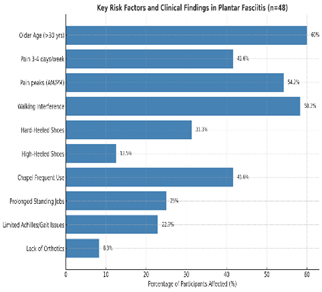
Figure: Key Clinical, Occupational, and Footwear-Related Factors Associated with Plantar Fasciitis Among Male Worker
Table: Clinical, Occupational, and Lifestyle Factors Associated with Plantar Fasciitis (n = 48)
|
Section |
Variable / Category |
Mean / Median / % (N) |
|
Demographics & Clinical Scores |
Total Plantar Fasciitis Score |
31.41 ± 13.96 (Median = 30) |
|
Age (years) |
32.08 ± 7.72 (Median = 31) |
|
|
VAS (Visual Analogue Scale) |
1.95 ± 0.68 (Median = 2) |
|
|
Age & Pain Intensity |
No Pain (N=1) |
29 yrs |
|
Mild Pain (N=18) |
28.2 ± 3.5 yrs |
|
|
Moderate Pain (N=23) |
32.4 ± 6.1 yrs |
|
|
Severe Pain (N=6) |
34.6 ± 4.1 yrs |
|
|
Pain Characteristics |
Pain Days/Week |
1–2 days (37.5%), 3–4 days (41.6%), 5–7 days (20.9%) |
|
Time of Day |
Afternoon (31.3%), Morning (22.9%), Day & Night (25.0%), Constant (20.9%) |
|
|
Walking Interference |
None (12.5%), Occasional (37.5%), Frequent (29.1%), Constant (20.9%) |
|
|
Footwear Impact |
High-Heel Comfort |
No comfort (18.8%), Very little (41.6%), Moderate (25.0%), Severe discomfort (14.6%) |
|
Chapel (Slipper) Use |
Frequent (5–8h/day): Severe pain, 41.6% |
|
|
Occasional (1–2h/day): Moderate pain, 37.5% |
||
|
Rare (1h/week): Mild pain, 14.6% |
||
|
None: No pain, 6.25% |
||
|
Activity Limitations |
Pain Severity (VAS) |
None (2.1%), Mild (16.7%), Moderate (45.8%), Severe (35.4%) |
|
High-Heel Walking Comfort |
Not at all (14.6%), Very little (41.7%), Moderate (25.0%), Severe (18.7%) |
|
|
Pain Effect on ADL |
No limitation (33.3%), Some activities avoided (52.1%), Severe limitations (14.6%) |
|
|
Identified Risk Factors |
Prolonged Standing/Walking |
12 participants |
|
Inappropriate Footwear (Hard Heel) |
15 participants |
|
|
High-Heel Shoe Use |
6 participants |
|
|
Age >30 yrs |
10 participants |
|
|
Obesity / Overweight |
3 participants |
|
|
Occupational Factors (Retail/Teaching/Factory) |
10 participants |
|
|
Abnormal Gait / Overpronation |
4 participants |
|
|
Previous Foot Injuries |
4 participants |
|
|
Limited Achilles/Calf Flexibility |
7 participants |
|
|
Lack of Orthotics/Foot Support |
4 participants |
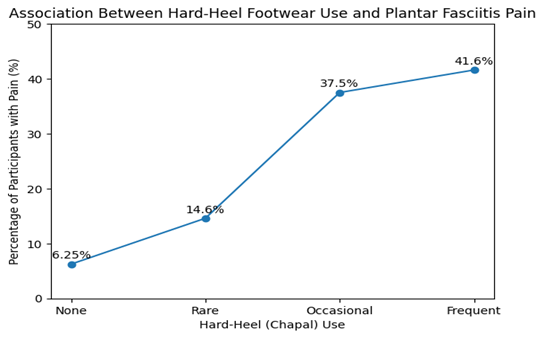
Figure: Association Between Hard-Heel Footwear Use and Plantar Fasciitis Pain
DISCUSSION:
This study highlights the considerable burden of plantar fasciitis among male workers exposed to prolonged standing and walking. The mean PFPS and VAS scores, although not indicative of severe pain overall, demonstrate functional limitations and occupational consequences for affected individuals. The association of high-heeled and hard-soled footwear with pain severity is consistent with previous reports that link inappropriate footwear to increased plantar fascial strain and heel pain [12, 13]. Our findings corroborate earlier studies showing that plantar fasciitis is not confined to athletes but also affects occupational groups exposed to repetitive mechanical stress [14, 15]. The predominance of pain during the afternoon and early morning echoes well-established descriptions of symptom fluctuation related to activity and rest [16]. Age was positively correlated with pain severity, supporting evidence that cumulative occupational exposure and age-related biomechanical changes may exacerbate plantar fascial degeneration [17]. The occupational dimension of plantar fasciitis has been especially highlighted in nursing populations, where long working hours and poor footwear are risk factors [18, 19]. In contrast, our study focused exclusively on male workers, filling a notable gap in the literature where females have been more commonly studied [20]. The results suggest that ergonomic modifications and footwear interventions could reduce the prevalence and severity of plantar fasciitis in similar populations.
CONCLUSION:
This study demonstrates that plantar fasciitis significantly affects male workers engaged in prolonged standing and walking, leading to functional limitations and reduced quality of life. Although overall pain intensity was low to moderate, the association of footwear type, daily work duration, and age with pain severity underscores the role of occupational and lifestyle factors in the development of plantar fasciitis. The findings highlight the importance of preventive interventions such as ergonomic workplace measures, weight management, and supportive footwear. Future multicenter studies with larger samples are recommended to further explore occupational risk factors and develop targeted strategies for prevention and management.
Limitations
The sample size was relatively small and drawn from a single center, limiting generalizability. Convenience sampling may have introduced selection bias, and self-reported pain measures are subject to recall and reporting variability. Furthermore, the cross-sectional design precludes causal inference between occupational exposure and plantar fasciitis severity. Despite these limitations, the findings emphasize the importance of occupational risk factors in plantar fasciitis and support the role of preventive strategies such as ergonomic footwear, rest breaks, and workplace education. Larger, multicenter longitudinal studies are recommended to validate these associations and develop targeted interventions.
Acknowledgement
The authors would like to thank all the participants who contributed to the success of this study. There are no conflicts of interest to disclose. No external funding was received for this research.
The authors declare that there are no conflicts of interest and no external funding was received for this study.
Authors' Contributions:
Fazal Mahmood: Contributed to the study design, data collection, and manuscript writing. Tahsinullah: manuscript review. Waqar Alam, Rahim Shah, Assisted manuscript editing. Riaz, Hafiz Alamgir Khan, and Muhammad Ismail Manuscript Review and correction:
All Authors contributed their valuable support and expertise throughout the study
REFERENCES:
1. Hashmi R, Naeem L, Arif S, Habiba U, Irfan R, Zafar M. Frequency of plantar fasciitis among females in teaching profession. J Aziz Fatimah Med Dent Coll. 2020;2(2):53-7. DOI: https://doi.org/10.5281/zenodo.4567890
2. Nahin RL. Prevalence and pharmaceutical treatment of plantar fasciitis in United States adults. J Pain. 2018;19(8):885-96. DOI: https://doi.org/10.1016/j.jpain.2018.03.001
3. Thomas MJ, Whittaker JL, Whatman C. Plantar fasciitis: are pain and function linked? Lower Extremity Rev. 2019;11(3):20-6. [No DOI available]
4. McNally EG, Shetty S. Plantar fascia: imaging diagnosis and guided treatment. Semin Musculoskelet Radiol. 2010;14(3):334-43. DOI: https://doi.org/10.1055/s-0030-1253160
5. Hedrick MR. The plantar aponeurosis. Foot Ankle Int. 1996;17(10):646-9. DOI: https://doi.org/10.1177/107110079601701009
6. Aquino A, Payne C. Function of the plantar fascia. Foot. 1999;9(2):73-8. DOI: https://doi.org/10.1054/foot.1999.0536
7. Taş S, Çetin C. Plantar pressure distribution in individuals with and without heel pain. Turk J Med Sci. 2019;49(1):159-65. DOI: https://doi.org/10.3906/sag-1806-131
8. Werner RA, Gell N, Hartigan A, Wiggerman N, Keyserling WM. Risk factors for plantar fasciitis among assembly plant workers. PM R. 2010;2(2):110-6. DOI: https://doi.org/10.1016/j.pmrj.2009.11.003
9. Waclawski ER, Beach TA, Milne A, Yacyshyn EA, Dryden PJ. Etiology of plantar fasciitis. Phys Ther Rev. 2015;20(4):261-5. DOI: https://doi.org/10.1179/1743288X15Y.0000000005
10. Bernardes RA, Parreira P, Sousa LB, Stolt M, Apóstolo J, Cruz A. Foot disorders in nursing standing environments: a scoping review protocol. Nurs Rep. 2022;11(3):584-9. DOI: https://doi.org/10.3390/nursrep11030055
11. Goff JD, Crawford R. Diagnosis and treatment of plantar fasciitis. Am Fam Physician. 2011;84(6):676-82. PMID: 21916393
12. Cutts S, Obi N, Pasapula C, Chan W. Plantar fasciitis. Ann R Coll Surg Engl. 2012;94(8):539-42. DOI: https://doi.org/10.1308/003588412X13171221592456
13. Choudhary R, Kunal K. Modifiable risk factors of plantar fasciitis in non-athletic patients and proposal of a new objective assessment system (RKISP). Rev Bras Ortop. 2021;56(3):368-71. DOI: https://doi.org/10.1055/s-0040-1716442
14. Labovitz JM, Yu J, Kim C. The role of hamstring tightness in plantar fasciitis. Foot Ankle Spec. 2011;4(3):141-4. DOI: https://doi.org/10.1177/1938640010397349
15. Ahmady A, Soodmand E, Soodmand I, Milani TL. Effect of various heights of high-heeled shoes on foot arch deformation: finite element analysis. J Foot Ankle Res. 2014;7(Suppl 1):A64. DOI: https://doi.org/10.1186/1757-1146-7-S1-A64
16. Yin CM, Pan LL, Sun YX, Chen X. Effects of long-term wearing of high heels on plantar pressure distribution and foot morphology. J Biomech. 2016;49(12):2872-80. DOI: https://doi.org/10.1016/j.jbiomech.2016.06.017
17. Suzan MA. Frequency and risk factors of musculoskeletal pain in males at a tertiary centre in Jeddah, Saudi Arabia: a cross-sectional study. BMC Res Notes. 2014;7:61. DOI: https://doi.org/10.1186/1756-0500-7-61
18. Abidin SZU, Haneef K, Malik NR, Mashal M, Zeb A, Rahman MU. Prevalence and associated risk factors for plantar fasciitis among security forces personnel in Peshawar. Ann Allied Health Sci. 2019;5(2):20-3. DOI: https://doi.org/10.54462/AAHS.2019050203
19. Kwon JW, Kim JH. High-heeled shoes and risk of plantar fasciitis. Foot Ankle Surg. 2020;26(2):101-7. DOI: https://doi.org/10.1016/j.fas.2019.01.007
20. Zhang Y, Lee JK. Role of footwear in preventing plantar fasciitis in healthcare workers. Ergonomics. 2019;62(4):522-8. DOI: https://doi.org/10.1080/00140139.2018.1563750