“A Study on the Influence of Flexible Work Arrangements on Employees’ Work-Life Balance and Job Satisfaction.”
- Ms. Neha Mishra , School of Commerce & Management Shri Venkateshwara University, Gajraula, Uttar Pradesh
- Akash Bhardwaj , 1School of Commerce & Management Shri Venkateshwara University, Gajraula, Uttar Pradesh
Article Information:
Abstract:
In light of increasing employee expectations and the realities of the workplace in the aftermath of the pandemic, flexible work arrangements have emerged as a key component of contemporary organizational practices. Worker happiness and work-life balance are the foci of this research into the effects of flexible work schedules. Seventy individuals with experience with flexible work arrangements from different companies were surveyed to gather primary data for a quantitative study. Regression analysis and descriptive statistics were employed for data analysis following data collection via a structured questionnaire including Likert-scale items. Employees' work-life balance is significantly and positively affected by flexible work arrangements, according to the research. The results demonstrate that a large portion of the variation in employees' ability to juggle work and personal responsibilities is attributable to flexibility, suggesting that having control over one's schedule and physical location reduces stress and improves overall health. In addition, the study shows that flexible work arrangements are significantly associated with higher levels of job satisfaction. When given more options for how and when they get their work done, employees report higher levels of job satisfaction, as well as higher levels of motivation, engagement, and positive attitudes toward their jobs. Results show that both null hypotheses are false, lending credence to the idea that flexible work arrangements significantly impact WLF and job satisfaction. Although there are numerous organizational aspects that might impact employee outcomes, one successful strategy for human resources that supports long-term success is flexibility. The results throw light on real-world challenges faced by businesses in their pursuit of more flexible work arrangements that boost employee happiness, satisfaction, and retention.
Keywords:
Article :
INTRODUCTION :
Flexible work arrangements (FWAs) are organizational techniques that enable employees to modify their work hours, schedules, or locations to fulfill personal responsibilities while still meeting professional and corporate goals. In the contemporary post-pandemic work environment, the transition to optional benefits has rendered flexible work arrangements an expectation. Remote work and digital technologies have established flexibility as a new standard, essential to modern human resource strategy. (Ananda, 2024)
Flexible Work Arrangements are transforming the traditional work paradigm. These include flexible hours, allowing employees to choose their start and end times within certain restrictions; compressed workweeks, enabling full-time employees to work fewer days while completing their total hours; part-time positions; job-sharing; and remote or hybrid work arrangements. Collectively, these options allow employees the autonomy to determine their working hours, methods, and locations, but the corporation retains accountability for performance.(Shanker, 2022)
There are three primary categories of FWAs. Scheduling flexibility alters the daily or weekly commencement and conclusion times, incorporating adaptable start and end times or shift exchanges to accommodate personal obligations. The variability of working hours affects total hours worked; part-time employment or job-sharing assists individuals seeking reduced workloads without exiting the workforce. Location flexibility enables employees to engage in off-site work via remote arrangements, satellite offices, or a hybrid of on-site and off-site work. (Nandani & Doshi, 2022)
Flexible Work Arrangements (FWAs) offer benefits to both employees and businesses. The employees experience enhanced work-life balance, diminished stress, and elevated job satisfaction. FWAs are especially beneficial for the inclusion and sustained engagement of marginalized populations, including caregivers, individuals with disabilities, and women. Flexible Work Arrangements enhance employee engagement, productivity, and retention, while diminishing absenteeism, turnover, and operational costs for organizations. They can also recruit a committed, diverse, and innovative workforce that improves long-term success. (Wheatley, 2017)
Employee work-life balance pertains to the ability to manage time and energy between professional obligations and personal domains such as family, health, relationships, and leisure activities. This aims to mitigate fatigue and improve overall well-being and job satisfaction. The demarcation between professional and personal life is ambiguous, rendering the need for balance in hybrid, technology-driven settings increasingly critical. (Marecki, 2024)
Work-life balance denotes a state of harmony between professional responsibilities and personal pursuits, ensuring that neither aspect dominates the other. It does not require the same time commitment; rather, it necessitates a balanced approach that alleviates stress and role conflict. Online technology, continuous connectivity, and remote work necessitate careful time management, role clarification, and organizational support to maintain equilibrium. (Veenalatha, 2019)
Maintaining a healthy equilibrium is essential for all individuals. Employees with balance exhibit greater productivity, engagement, and elevated morale. Employees with a balanced lifestyle experience less stress and burnout, resulting in fewer absences, enhanced health, and increased mental and physical well-being, which fosters greater commitment and overall performance, hence enhancing retention.
Flexible work options are intrinsically linked to work-life balance. Flexible working hours, remote or hybrid work arrangements, and part-time employment will immediately facilitate a balance, enabling employees to harmonize their personal and familial responsibilities. They reduce commuting time, offer control over scheduling, and accommodate personal demands, so alleviating stress and improving well-being. A well-balanced workforce enables individuals to effectively meet their professional and personal obligations, hence promoting sustainable performance and sustainability. (Prakash.j, 2021)
Job satisfaction refers to the degree of enjoyment employees experience with their work, encompassing their emotional responses and mental attitudes towards daily tasks and the entire office environment. It is intimately connected to prior concepts such as flexible employment and work-life equilibrium, as supporting policies enhance overall satisfaction and commitment. (Dziuba et al., 2020)
Job satisfaction is a favorable disposition resulting from an individual's assessment of their employment. It may be broad or particular on factors like as compensation, oversight, professional advancement, interpersonal relationships, and working conditions. The three elements of satisfaction are interconnected and encompass cognitive appraisal (logical assessments), emotional reactions (akin to affective responses), and behavioral inclination (motivation, conduct, and intention to remain or depart). (Hatfield, 2024)
Intrinsic motivators drive sources of intrinsic motivation toward job satisfaction—such as enjoyment of the work, autonomy, skill use, achievement, and purpose—which are crucial for sustained engagement in employment. Extrinsic elements encompass external incentives and circumstances, such as salary, perks, job stability, promotional prospects, and the physical work environment. The same influencing elements in both groups include effective communication, appreciation, supportive supervisors, fairness, and positive workplace relationships. (Hasan et al., 2024)
The advantages of job happiness are substantial for both people and enterprises. Content employees typically exhibit elevated productivity, motivation, engagement, and organizational dedication, alongside reduced stress and burnout. This enhances mental well-being, diminishes absenteeism, and decreases turnover intentions. From an organizational standpoint, elevated job satisfaction cultivates employee loyalty, promotes innovation and discretionary effort, and enhances overall performance. Thus, enhancing job happiness is a strategic need for firms aiming for sustainable growth and a stable, high-performing staff. (Iqbal et al., 2017), (Reeves, 2025)
Objectives
· “To examine the impact of flexible work arrangements on employees’ work–life balance.
· To analyze the influence of flexible work arrangements on employees’ job satisfaction.
Hypotheses
· Null Hypothesis (H₀₁): Flexible work arrangements have no significant impact on employees’ work–life balance.
· Alternative Hypothesis (H₁₁): Flexible work arrangements have a significant impact on employees’ work–life balance.
· Null Hypothesis (H₀₂): Flexible work arrangements have no significant influence on employees’ job satisfaction.
· Alternative Hypothesis (H₁₂): Flexible work arrangements have a significant influence on employees’ job satisfaction.
Variable
Table:1 Independent and Dependent Variables
|
Variable Type |
Variable Name |
|
Independent Variable (IDV) |
Flexible Work Arrangements |
|
Dependent Variable (DV 1) |
Work–Life Balance |
|
Dependent Variable (DV 2) |
Job Satisfaction |
Literature review
(T S et al., 2026) The relationship between work and personal life significantly influences employees' overall job satisfaction. It allows employees to oversee professional obligations without jeopardizing personal well-being. Employees that benefit from supporting work–life balance initiatives, flexible schedules, manageable workloads, and organizational backing typically report elevated levels of job satisfaction. An inadequate work–life balance frequently results in stress, burnout, and diminished morale, establishing it as a crucial factor influencing job satisfaction within organizational contexts. The research investigates the influence of work–life balance on job satisfaction among banking personnel. The relationship between work-life balance and job satisfaction was analyzed for flexible working arrangements, organizational work-life balance activities, employee turnover intentions, work pressure, and prolonged working hours. A total of 207 replies were obtained by a snowball sampling method. The correlation analysis was employed to ascertain the correlations among the study variables. The results demonstrated that work–life balance exerts a minimal influence on job satisfaction among employees in private sector banks in Kerala.
(Fatimah et al., 2026) This study aimed to assess the impact of Work-Life Balance, Flexible Work Arrangements, and Career Planning on employee Job Satisfaction at Baznas Bazis DKI Jakarta Province. This study employed a quantitative methodology and survey methodologies for data collection. The research sample comprised 50 active employees from Baznas Bazis DKI Jakarta Province. Data were collected using surveys employing a Likert scale, and the analysis was conducted using multiple linear regression, alongside classical assumption tests, t-tests, F-tests, and coefficient of determination assessments. The study's findings demonstrate that both Work-Life Balance and Flexible Work Arrangements positively and significantly influence employee Job Satisfaction. Simultaneously, Career Planning exerts an insignificant partial influence on Job Satisfaction. Nonetheless, concurrently, the three independent variables exert a substantial influence on Job Satisfaction. The coefficient of determination test results demonstrate that Work Life Balance, Flexible Work Arrangements, and Career Planning account for 52.1% of the variance in Job Satisfaction, with the remainder attributable to external factors not examined in the study. The findings of this study are anticipated to inform the formulation of human resource management policies.
(Tamin & Halim, 2025) This study aims to examine how work flexibility and social support facilitate employees in effectively reconciling professional obligations with home life. The study employs a descriptive quantitative methodology. Data gathering methods encompass observation, interviews, documentation, and the dissemination of questionnaires to all personnel. Data analysis use multiple linear regression to examine correlations among variables, utilizing partial (t-tests) and simultaneous (F-tests) methods for hypothesis testing. The findings indicate that Flexible Work and Social Support exert a favorable and significant influence on Work-Life Balance, both individually and collectively. This affirms that job flexibility and sufficient social support can mitigate work-related stress, enhance emotional well-being, and reinforce employees' commitment to the organization. This study underscores the significance of adopting flexible work policies and fostering a supportive work culture as human resource management techniques to enhance job satisfaction and organizational sustainability.
(Putra, 2025) This research examines the influence of Flexible Working Arrangements (FWA) on Job Satisfaction, mediated by Work-Life Balance (WLB), among organic employees of PT Angkasa Pura Indonesia at I Gusti Ngurah Rai Airport, Bali. The study examines issues related to job satisfaction within shift work arrangements that are viewed as chaotic and detrimental to employees' personal lives. The aim is to investigate if FWA directly affects job satisfaction and indirectly through WLB. The study employed a quantitative methodology with an associative causal design, incorporating a saturation sample of 128 employees. Data were gathered by structured surveys and interviews, and analyzed using path analysis in SPSS, which included regression tests, normality assessments, multicollinearity checks, heteroscedasticity evaluations, and the Sobel test. The results demonstrate that flexible work arrangements (FWA) exert a substantial beneficial influence on both work-life balance (WLB) and job satisfaction, with WLB serving as a significant mediator in the relationship between FWA and job satisfaction. The findings corroborate social exchange theory, indicating that employees react favorably to organizational flexibility, hence increasing their commitment and satisfaction. The practical implication is the necessity for organizations to assess and adopt flexible scheduling strategies to enhance employee well-being and performance. Theoretical implications underscore the significance of work-life balance as a vital mediator in organizational behavior research. Subsequent research may investigate comparison models across various industries or geographies.
(Gowthami, 2025) In the contemporary, rapidly evolving environment, many employees may find it challenging to equilibrate personal life and professional responsibilities. This study examines the impact of balance or imbalance on job satisfaction. Surveys and discussions with employees indicate that many are experiencing difficulty in allocating time for personal pursuits and perceive a lack of appreciation in the workplace. Moreover, evidence demonstrates that when organizations endorse work-life balance, people experience heightened satisfaction, motivation, and engagement with their roles. The report advocates for firms to attentively consider their employees and establish environments where well-being is prioritized alongside performance.”
(Aziz-Ur-Rehman & Siddiqui, 2019) “The study report examined the correlation between flexible working conditions, work-life balance, and job satisfaction in public sector universities in Karachi. This research aims to examine the null hypothesis asserting that there is no correlation between flexible working arrangements, work-life balance, and job satisfaction among employees at public universities in Karachi. The research design is descriptive, as it identifies the relationship between dependent and independent variables. The independent variable is flexible working arrangements, encompassing flexi-time, contractual employment, shift work, and telecommuting, offered to employees to enhance productivity and sustain work-life balance. A systematic questionnaire is intended to gather a sample size of roughly 200 through online methods and university visits. Survey forms were disseminated by a random sampling technique across over nine distinct public institutions in Karachi. The study employs a quantitative methodology, examined by confirmatory factor analysis (CFA) and structural equation modeling (SEM) with Smart PLS. Results and Suggestions: The results indicate that flexible working arrangements are positively and significantly associated with work-life balance. The research indicated that work-life balance serves as a significant mediator between flexible working options and job satisfaction. The significance of implementing appropriate flexible arrangements within an organization is emphasized in the recommendations aimed at improving employee satisfaction, enhancing performance, fostering work-family enrichment, and thus boosting productivity.”
Research Gap
The literature extensively examines the impact of flexible work arrangements on work-life balance and job satisfaction across various businesses and industries. Most studies demonstrate that flexible arrangements enhance employee welfare, alleviate stress, and increase job satisfaction, with some identifying work-life balance as a mediating element. However, discrepancies persist. Initially, the majority of research are confined to certain domains (e.g., banking or a specific university), rendering them less generalizable. Secondly, the multitude of mediators in complex models provides limited information regarding the direct and concurrent impact of flexibility on work-life balance and job satisfaction. Third, varied conclusions about the strength of these associations arise from the utilization of various sampling procedures and distinct regional contexts. Consequently, a targeted empirical study utilizing primary quantitative data must be undertaken to elucidate the direct influence of flexible work arrangements on employees' work-life balance and job satisfaction, thereby informing organizational decision-making.
Research Methodology:
Research Design
This study employed a quantitative design utilizing primary data collecting to assess the impact of flexible work arrangements on employees' work-life balance and job satisfaction. Statistical analysis was conducted on numerical data acquired by a descriptive, explanatory survey. The method facilitated the precise measurement of variable interconnections and the objective evaluation of employees' perceptions on flexible arrangements.
Research Approach
The study employed a quantitative methodology, collecting measurable data using a questionnaire. This procedure was precise, dependable, and broadly applicable. This facilitated the examination of the hypothesis and the statistical evaluation of the impact of flexibility on work-life balance and job satisfaction.
Proposed Method
Data was collected using a survey. The participants were assessed using a standardized questionnaire using closed-ended Likert-scale items to evaluate their attitudes towards flexible work arrangements, work-life balance, and job satisfaction. Demographic inquiries on gender, age, and job position were also included. The choice of survey method was determined by its efficacy in gathering data from a large population within a constrained timeframe.
Sample Size and Sampling Methodology.
The survey included 70 employees with experience in flexible work arrangements. Random sampling provided all individuals of the target population with an equal chance of selection, so removing bias and enhancing representativeness. The participants were affiliated with various organizations.
Data collection
The questionnaire was distributed using a structured format in both electronic and physical mediums to maximize response rates. The research aims were communicated to the participants, who were assured of the study's confidentiality. The accuracy and completeness of the questionnaires were verified, followed by their analysis.
Data Examination
Data coding and statistical analysis were conducted utilizing appropriate statistical tools:
· Demographic characteristics (age, gender, job experience) were described using frequency and percentage.
· Regression studies were performed to assess the effects of flexible work arrangements (independent factors) on work-life balance and job satisfaction (dependent variables).
Result:
Table: 1 Age of the respondents.
|
Age Group |
||
|
|
Frequency |
Percent |
|
Below 25 Years |
16 |
22.9 |
|
26-35 Years |
24 |
34.3 |
|
36-45 Years |
14 |
20.0 |
|
Above 46 Years |
16 |
22.9 |
|
Total |
70 |
100.0 |
The above table discusses the frequency and percentage of age of the respondents. In Below 25 Years, frequency is 16 and percentage is 22.9%. In 26-35 Years, Frequency is 24 and percentage is 34.3%. In Above 36-45 years, frequency is 14 and percentage is 20.0%. In above 46 Years, frequency is 16 and percentage is 22.9%.
Graph: 1 Graphical representation of age of the respondents.
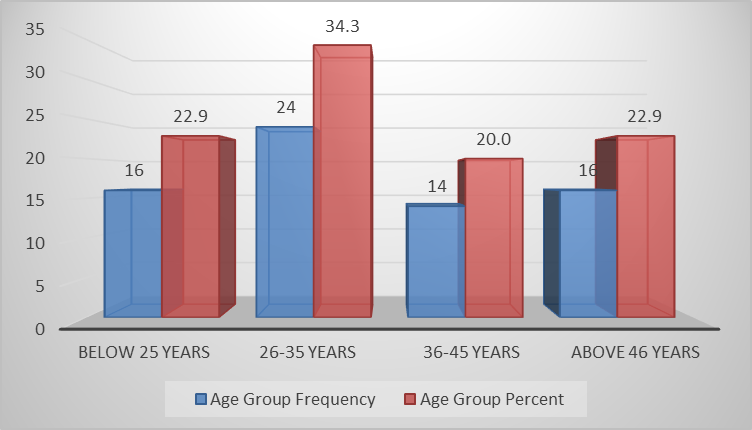
Table:2 Gender of the respondents.
|
Gender |
||
|
|
Frequency |
Percent |
|
Male |
46 |
65.7 |
|
Female |
24 |
34.3 |
|
Total |
70 |
100.0 |
The above table discusses the frequency and percentage of gender of the respondents. In male group, frequency is 46 and percentage is 65.7%. In Female group, frequency is 24 and percentage is 34.3%.
Graph:2 Graphical representation of Gender of the respondents.
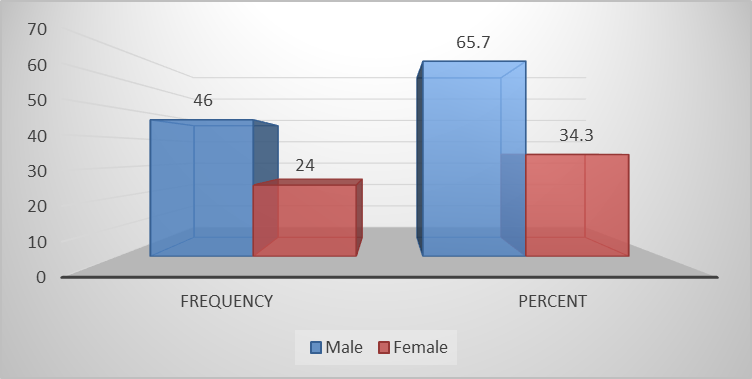
Table:3 Highest Educational Qualification of the respondents.
|
Highest Educational Qualification |
||
|
|
Frequency |
Percent |
|
Higher secondary |
15 |
21.4 |
|
Graduate |
22 |
31.4 |
|
Post graduate |
16 |
22.9 |
|
Other |
17 |
24.3 |
|
Total |
70 |
100.0 |
The above table discusses the frequency and percentage of Highest Educational Qualification of the respondents. In Higher secondary, Frequency is 15 and percentage is 21.4%. In Graduate, Frequency is 22 and percentage is 31.4%. In Post-Graduate, Frequency is 16 and percentage is 22.9%. In Other, frequency is 17 and percentage is 24.3%.
Graph:3 Graphical representation of Highest Educational Qualification of the respondents.
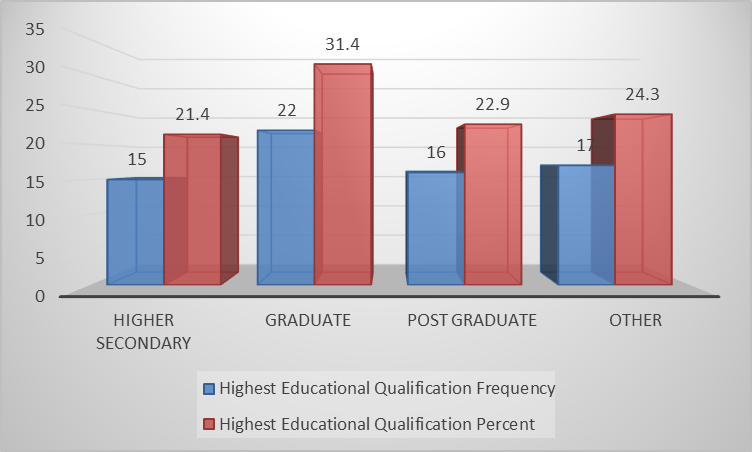
Table:4 Total Work Experience of the respondents.
|
Total Work Experience |
||
|
|
Frequency |
Percent |
|
Below 1 Year |
16 |
22.9 |
|
1-3 Years |
24 |
34.3 |
|
4-6 Years |
16 |
22.9 |
|
Above 7 Years |
14 |
20.0 |
|
Total |
70 |
100.0 |
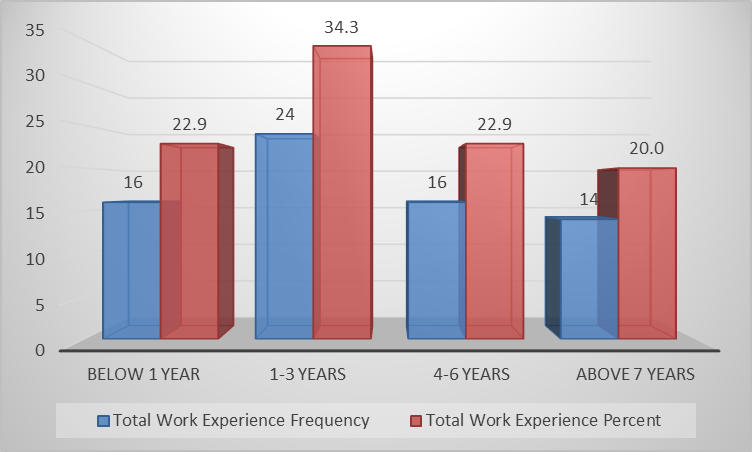
The above table discusses the frequency and percentage of Total Work Experience of the respondents. In Below 1 Year, Frequency is 16 and percentage is 22.9%. In 1-3 Years, frequency is 24 and percentage is 34.3%. In 4-6 years, frequency is 16 and percentage is 22.9%. In above 7 years, frequency is 14 and percentage is 20.0%.
Graph:4 Graphical representation of Total Work Experience of the respondents.
Hypothesis
H1: Flexible work arrangements have a significant impact on employees’ work–life balance.
Table: 5 Regression test.
|
Model Summary |
||||
|
Model |
R |
R Square |
Adjusted R Square |
Std. Error of the Estimate |
|
1 |
.552a |
.304 |
.294 |
.90842 |
|
a. Predictors: (Constant), Flexible Work Arrangements |
||||
|
ANOVAa |
||||||
|
Model |
Sum of Squares |
df |
Mean Square |
F |
Sig. |
|
|
1 |
Regression |
24.528 |
1 |
24.528 |
29.723 |
.000b |
|
Residual |
56.115 |
68 |
.825 |
|
|
|
|
Total |
80.643 |
69 |
|
|
|
|
|
a. Dependent Variable: Work–Life Balance |
||||||
|
b. Predictors: (Constant), Flexible Work Arrangements |
||||||
|
Coefficientsa |
||||||
|
Model |
Unstandardized Coefficients |
Standardized Coefficients |
t |
Sig. |
||
|
B |
Std. Error |
Beta |
||||
|
1 |
(Constant) |
.676 |
.606 |
|
1.115 |
.269 |
|
Flexible Work Arrangements |
.751 |
.138 |
.552 |
5.452 |
.000 |
|
|
a. Dependent Variable: Work–Life Balance |
||||||
The regression analysis shows that flexible work arrangements have a big and good effect on how well employees combine their work and personal lives. The model summary shows that the R value is 0.552, which means that there is a moderate positive association between the variables. The R² value of 0.304 means that flexible work arrangements explain 30.4% of the variation in employees' work–life balance. The ANOVA results show that the model is important because it has a F value of 29.723 and a significance level of 0.000. This means that the regression model is statistically sound. The coefficient results show that flexible work arrangements have a big and positive effect on work-life balance (β = 0.552, t = 5.452, p < 0.001). This means that giving employees more flexibility at work makes it easier for them to balance their work and personal lives. So, the null hypothesis is no longer valid, and the alternative hypothesis is now proven.
H2: Flexible work arrangements have a significant influence on employees’ job satisfaction.
Table:6 Regression test.
|
Model Summary |
||||
|
Model |
R |
R Square |
Adjusted R Square |
Std. Error of the Estimate |
|
1 |
.522a |
.273 |
.262 |
.65469 |
|
a. Predictors: (Constant), Flexible Work Arrangements |
||||
|
ANOVAa |
||||||
|
Model |
Sum of Squares |
df |
Mean Square |
F |
Sig. |
|
|
1 |
Regression |
10.925 |
1 |
10.925 |
25.489 |
.000b |
|
Residual |
29.146 |
68 |
.429 |
|
|
|
|
Total |
40.071 |
69 |
|
|
|
|
|
a. Dependent Variable: Job Satisfaction |
||||||
|
b. Predictors: (Constant), Flexible Work Arrangements |
||||||
|
Coefficientsa |
||||||
|
Model |
Unstandardized Coefficients |
Standardized Coefficients |
t |
Sig. |
||
|
B |
Std. Error |
Beta |
||||
|
1 |
(Constant) |
2.186 |
.437 |
|
5.003 |
.000 |
|
Flexible Work Arrangements |
.501 |
.099 |
.522 |
5.049 |
.000 |
|
|
a. Dependent Variable: Job Satisfaction |
||||||
The regression results show that flexible work arrangements have a big and good effect on how happy employees are with their jobs. The model summary shows that the R value is 0.522, which means that there is a moderate positive link between flexible work arrangements and job satisfaction. The R² value of 0.273 means that flexible work arrangements are responsible for 27.3% of the changes in how happy people are with their jobs. The ANOVA results show that the regression model is statistically strong because it has a F value of 25.489 and a significance level of 0.000. The coefficient analysis also shows that flexible work arrangements have a positive and substantial impact on job satisfaction (β = 0.522, t = 5.049, p < 0.001). This means that more flexibility at work makes employees happier with their jobs. As a result, the null hypothesis is rejected, and the alternative hypothesis is accepted.
DISCUSSION:
This paper looked at how flexible work arrangements affect workers' job satisfaction and work-life balance. We looked at the primary quantitative data from employees of a few organizations. The results show that flexible arrangements are highly good at improving balance and satisfaction, and the study's alternative hypotheses are supported.
The regression analysis indicated a moderate positive association between flexibility and work-life balance. Flexibility played a big role in how well individuals were able to integrate work and personal life.” Flexible hours, timetables, and locations help the personnel meet their family, personal, and work needs. Easier travel, more flexible schedules, and more freedom contribute to less stress and better overall health. This is especially true now that work and personal lines are blurred by digital connectivity and hybrid structures.
The data also shows that being flexible makes people happier at work. Employees who are more flexible also say they are happier, which means that flexible policies improve both emotional and cognitive perceptions of work. Flexibility is an inherent motivation because it gives people freedom, trust, and support from the organization. The more the workforce thinks that their personal needs are being met, the more likely they are to feel appreciated, motivated, and committed to their work.
Even if flexible arrangements are a big part of the difference in work-life balance and happiness, other things are as crucial. The culture of the workplace, the amount of support from supervisors, the amount of work, the remuneration, and the chances for career growth can all affect how employees feel about their jobs. But it's crucial to remember that flexibility is really important, which is why it's a strategic instrument for human resources
Overall, the research shows that flexible arrangements are not merely good things; they are also necessary for long-term success. Flexibility enhances engagement, mitigates burnout, and boosts retention by fostering and fulfilling equilibrium. The findings stress the importance of having flexible policies that are well-organized, fair, and helpful to make sure that employees are as healthy as possible and that the organization runs as efficiently as possible.
CONCLUSION :
The study finds that flexible work arrangements have a big beneficial effect on job satisfaction and the balance between work and life. Studies show that giving employees more flexibility helps them better balance their work and personal lives, which makes them feel less stressed and improves their health. It also makes people happier by giving them more freedom, trust, and a good view of how well the organization supports them. While not the sole reason, flexibility significantly contributes. The null hypotheses are rejected, which shows that this is a good HR strategy. By implementing and maintaining adaptable policies, it is expected that the companies in question will have enhanced employee happiness and morale, resulting in a more stable workforce in the long run, thereby establishing flexibility as a cornerstone of contemporary success.
BIBLIOGRAPHY:
1. Ananda, A. (2024). The Influence of Flexible Work on Work-Life Balance and Employee Performance in Human Resource Management. Devotion : Journal of Research and Community Service, 5(2), 335–340. https://doi.org/10.59188/devotion.v5i2.689
2. Aziz-Ur-Rehman, M., & Siddiqui, D. A. (2019). Relationship between Flexible Working Arrangements and Job Satisfaction Mediated by Work-Life Balance: Evidence from Public Sector Universities Employees of Pakistan. SSRN Electronic Journal. https://doi.org/10.2139/ssrn.3510918
3. Dziuba, S. T., Ingaldi, M., & Zhuravskaya, M. (2020). Employees’ Job Satisfaction and their Work Performance as Elements Influencing Work Safety. System Safety: Human - Technical Facility - Environment, 2(1), 18–25. https://doi.org/10.2478/czoto-2020-0003
4. Fatimah, R. S., Baldina, I. R., Khofifah, G., Nurjanah, I., Taqyun, K., Sekarini, R. A., & Rini, D. P. (2026). PENGARUH WORK LIFE BALANCE, FLEXIBLE WORK ARRANGEMENTS, CAREER PLANNING TERHADAP KEPUASAN KERJA PADA BAZNAS BAZIS PROVINSI DKI JAKARTA. JURNAL RUMPUN MANAJEMEN DAN EKONOMI. https://doi.org/https://doi.org/10.61722/jrme.v3i1.8200
5. Gowthami, G. (2025). Relationship between work-life balance and job satisfaction. Int. J. Sci. Inno. https://doi.org/https://doi.org/10.70849/IJSCI
6. Hasan, J., Hasan, M., Rahman, M. A., & Hossain, M. U. (2024). Job Satisfaction Theories A Literature Review. IST Journal on Business & Technology.
7. Hatfield, L. C. (2024). Job satisfaction. In Encyclopedia of Sport Management, Second Edition. https://doi.org/10.4337/9781035317189.ch304
8. Iqbal, S., Guohao, L., & Akhtar, S. (2017). Effects of Job Organizational Culture, Benefits, Salary on Job Satisfaction Ultimately Affecting Employee Retention. Review of Public Administration and Management. https://doi.org/10.4172/2315-7844.1000229
9. Marecki, L. (2024). Impact of work-life balance on employee productivity and well-being. Journal of Management and Financial Sciences, 50. https://doi.org/10.33119/JMFS.2023.50.9
10. Nandani, H., & Doshi, V. (2022). A study on effect of flexible working arrangements. Inspira-Journal of Modern Management & Entrepreneurship (JMME).
11. Prakash.j, J. jaya. (2021). A STUDY ON QUALITY OF WORKLIFE BALANCE OF EMPLOYEES IN A COMPANY. https://sist.sathyabama.ac.in/sist_naac/documents/1.3.4/bba-bba-batchno-45.pdf
12. Putra, A. A. G. N. P. (2025). The Influence of Flexible Working Arrangement on Job Satisfaction Mediated by Work-Life Balance Among Organic Employees. Journal of Social Science (JoSS), 4(6), 281–296. https://doi.org/10.57185/joss.v4i6.478
13. Reeves, M. (2025). What is Job Satisfaction? Meaning, Importance and Examples. https://www.togetherplatform.com/blog/what-is-job-satisfaction-meaning-importance-and-examples
14. Shanker, A. (2022). Flexible work arrangements and its impact on Work-Life Balance. Management Insight, 18(2), 17–20. https://doi.org/10.21844/mijia.18.2.3
15. T S, D. S., K G, D. R., & M B, D. K. (2026). Work–Life Balance as a Determinant of Job Satisfaction: An Empirical Evaluation of Employees of Private Sector Banks in Kerala. International Scientific Journal of Engineering and Management, 05(01), 1–9. https://doi.org/10.55041/ISJEM05336
16. Tamin, T., & Halim, A. (2025). The Impact of Flexible Work and Social Support on Employees’ Work-Life Balance. Advances in Management & Financial Reporting, 4(1), 18–34. https://doi.org/10.60079/amfr.v4i1.640
17. Veenalatha, K. (2019). A study on work life balance of the employees in the field of education. Interna Ational Journal of Ma Anagement, Technolog Gy, and Social Science Es (IJMTS).
18. Wheatley, D. (2017). Employee satisfaction and use of flexible working arrangements. Work, Employment and Society. https://doi.org/10.1177/0950017016631447