Preparation and Evaluation of niosomal gel formulation containing hydroalcoholic extracts of Blumea lacera (Burm.f.) DC. leaves and Abelmoschus moschatus Medik. Flowers
- Amit Kumar Gupta , Faculty of Pharmacy, Oriental University, Indore, Madhya Pradesh, India
- Rajesh Nagar , Faculty of Pharmacy, Oriental University, Indore, Madhya Pradesh, India
- Sudha Vengurlekar. , Faculty of Pharmacy, Oriental University, Indore, Madhya Pradesh, India
Article Information:
Abstract:
Background: Medicinal plants are widely known for their high phytochemical structure and wide range of medicinal activities; though their therapeutic impact may be limited by a lack of good stability and bioavailability. In order to meet these limitations, a niosomal drug delivery system was used to enhance the stability, encapsulation, and controlled release of the plant extracts. Hydroalcoholic extracts of the plant materials were prepared using a suitable solvent extraction method and incorporated into niosomes prepared by the thin film hydration method using non-ionic surfactants and cholesterol. We evaluated the prepared niosomal formulations based on vesicle size, entrapment efficiency, drug content, and in vitro drug release. It was further added to a suitable gel base for synthesis of niosomal gel formulations. The gels were studied for physicochemical features, specifically pH, viscosity, spreadability, drug content, and in vitro diffusion. The optimized formulations showed high entrapment efficiency, satisfactory drug content, and sustained drug release profile according to the results. Niosomal gel formulations showed satisfactory physicochemical properties and enhanced diffusion behavior relative to conventional formulations. These results indicate that niosomal gel systems using extracts of Blumea lacera leaves and Abelmoschus moschatus flowers may represent good candidates for potential as a topical delivery system for herbal bioactive compounds to stabilize, release controlled, and provide therapeutic action of niosomal gel systems.
Keywords:
Article :
INTRODUCTION:
Medicinal plants have long been recognized as valuable sources of bioactive compounds used in the prevention and treatment of various diseases. In recent years, there has been growing interest in herbal formulations due to their therapeutic potential, safety profile, and minimal side effects compared with synthetic drugs. However, the major limitations associated with many herbal extracts include poor stability, low bioavailability, and limited skin penetration when applied topically. To overcome these challenges, advanced drug delivery systems such as vesicular carriers have been explored to enhance the therapeutic efficacy of herbal medicines. [1]
Niosomes are non-ionic surfactant-based vesicular systems that have gained considerable attention as efficient carriers for drug delivery. These vesicles consist of non-ionic surfactants and cholesterol, forming bilayer structures capable of encapsulating both hydrophilic and lipophilic compounds. Niosomal formulations offer several advantages, including improved drug stability, controlled release, enhanced skin penetration, and reduced toxicity. Incorporation of herbal extracts into niosomal systems, followed by formulation into topical gels, can significantly enhance the delivery of bioactive phytoconstituents across the skin, thereby improving therapeutic outcomes. [2]
Blumea lacera (Burm.f.) DC., a medicinal herb belonging to the family Asteraceae, is widely used in traditional medicine for its anti-inflammatory, antimicrobial, antioxidant, and wound-healing properties. The leaves of this plant contain various phytochemicals such as flavonoids, terpenoids, and phenolic compounds that contribute to its pharmacological activities. Similarly, Abelmoschus moschatus Medik., commonly known as musk mallow and belonging to the family Malvaceae, is valued for its medicinal flowers and seeds, which possess antioxidant, antimicrobial, and anti-inflammatory activities. The presence of flavonoids, phenolic acids, and essential oils in the flowers makes them a promising natural source for topical therapeutic formulations.
Considering the therapeutic potential of these medicinal plants and the advantages offered by vesicular drug delivery systems, the present study aims to develop and evaluate a niosomal gel formulation containing hydroalcoholic extracts of Blumea lacera leaves and Abelmoschus moschatus flowers. The formulation of these extracts into a niosomal gel is expected to enhance the stability, skin permeability, and controlled release of the bioactive constituents, thereby improving the overall effectiveness of the herbal formulation for topical applications. [3] The study focuses on the preparation, characterization, and evaluation of the developed niosomal gel to assess its suitability as a potential herbal topical delivery system.
MATERIALS AND METHODS:
Selection and Procurement of Plant Material
The anti-fungal medicinal plants viz., leaves of Blumea lacera (Burm.f.) DC.was selected based on their traditional uses and were procured from Indore region of Madhya Pradesh and was authenticated from Botanist Dr. Smruti Sohani.
Extraction of plant material
The shade dried coarsely powdered plant material (500 gm) i.e., leaves of Blumea lacera (Burm.f.) DC. was extracted using ethanol:water (70:30) in soxhlet apparatus for about 72 hours. After extraction the filtrate was dried in rotator evaporator and was stored for further use.
spectrophotometrically.
Preparation of Niosomal Gel
The niosomal gel formulation will be prepared using Carbopol-934 as the gelling agent. An accurately weighed quantity of Carbopol-934 will be slowly dispersed in an appropriate amount of distilled water with continuous stirring to obtain a uniform dispersion. The dispersion will then be neutralized by the gradual addition of triethanolamine until a clear and homogeneous gel base is formed. Gel formulations containing 2.5%, 5%, and 7.5% w/w of the drug will be prepared by incorporating the required amount of the drug into the gel base and processing them using the same procedure as described above.
Incorporation of Niosomes of Herbal Extract into Gel Base
The optimized niosomal formulation containing the herbal extract, equivalent to 2.5%, 5%, and 7.5% w/w of the drug, will be incorporated into the prepared gel base. The incorporation will be carried out by gentle mechanical stirring at 25 rpm for approximately 15 minutes to ensure uniform distribution of the niosomes throughout the gel matrix. [4-5]
Table 1: Formulation of Niosomal gel of Plant Extract containing leave extract of Blumea lacera (Burm.f.) DC.
|
Ingredients |
Quantity (100 gm) |
||
|
HAEBLL |
2.5 |
5.0 |
7.5 |
|
Carbopol 934 (2%) |
2 |
2 |
2 |
|
Propylene glycol (10% |
9.6 |
9.6 |
9.6 |
|
Triethanol amine |
qs |
qs |
qs |
|
Distilled water |
qs |
qs |
qs |
Table 2: Formulation of Niosomal gel of Plant Extract containing flower extract of Abelmoschus moschatus Medik.
|
Ingredients |
Quantity (100 gm) |
||
|
HAAMLL |
2.5 |
5.0 |
7.5 |
|
Carbopol 934 (2%) |
2 |
2 |
2 |
|
Propylene glycol (10% |
9.6 |
9.6 |
9.6 |
|
Triethanol amine |
qs |
qs |
qs |
|
Distilled water |
qs |
qs |
qs |
Evaluation of Niosomal Gel and Plain Gel
The prepared niosomal gel and plain topical gel formulations were evaluated for various physicochemical parameters, including pH, viscosity, and spreadability, to assess their suitability for topical application. These parameters help determine the stability, consistency, and ease of application of the gel formulations. [6-7]
Physical Examination: Both the plain gel and the niosomal gel were visually inspected for their physical appearance, including color, clarity, homogeneity, and texture, to ensure the absence of any visible particulate matter or phase separation.
pH Measurement: The pH of the prepared gel formulations was determined using a calibrated digital pH meter to ensure compatibility with the skin and to avoid potential irritation upon topical application.
Viscosity Measurement: The viscosity of the gel formulations was measured using a Brookfield viscometer to evaluate the rheological behavior and consistency of the gels.
Spreadability: The spreadability of the gel formulations was determined using a standard spreadability apparatus. This parameter indicates the ease with which the gel can be uniformly applied over the skin surface.
Drug Content: The drug content of the formulations was determined using the previously described analytical method to ensure uniform distribution of the drug within the gel matrix
.Percentage Drug Release: The in vitro drug release from the gel formulations was evaluated using the method described earlier to study the release profile of the encapsulated drug.
Stability Studies: The selected niosomal gel formulation was packed in tightly closed amber-colored bottles wrapped with aluminum foil and stored under accelerated conditions at 30 ± 2°C and 65 ± 5% relative humidity for three months in a stability chamber. Additionally, samples were stored at refrigerated conditions (2–8°C). After three months of storage, the formulations were evaluated for various physicochemical parameters to assess their stability. [27].
RESULTS:
Based on the results of entrapment efficiency, drug content, and in vitro diffusion studies of the niosomal formulations containing hydroalcoholic extracts of Blumea lacera (Burm.f.) DC. leaves and Abelmoschus moschatus Medik. flowers, formulations coded NBL-8 and NAM-8 exhibited the highest performance. Therefore, these optimized formulations were selected for incorporation into a niosomal gel base. A plain gel containing the respective plant extracts was also prepared according to the methodology for comparative evaluation. The prepared gel formulations were further characterized for various physicochemical and performance parameters. The in vitro diffusion study revealed that the niosomal gel formulations exhibited higher drug release compared to the plain gel formulations containing the same plant extracts, demonstrating the enhanced release properties of the niosomal delivery system.
Table 3: Physical examination and other characterization of plain and niosomal gel formulation containing hydroalcoholic extracts of Blumea lacera (Burm.f.) DC. leaves and Abelmoschus moschatus Medik. Flowers.
|
Formulation Code |
Color |
Homogenity |
Texture |
pH |
Viscosity (cpc) |
Spreadability (gcmsec) |
Drug content (%) |
|
PGBL [2.5%] |
White |
Homogeneous |
Smooth |
6.90 |
6052 |
14.39 |
97.86±0.64 |
|
PGBL [5%] |
White |
Homogeneous |
Smooth |
6.84 |
6048 |
14.29 |
97.80±0.32 |
|
PGBL [7.5%] |
White |
Homogeneous |
Smooth |
6.88 |
6040 |
14.28 |
96.29±0.11 |
|
PGAM [2.5%] |
White |
Homogeneous |
Smooth |
6.72 |
6049 |
14.58 |
97.10±0.59 |
|
PGAM [5%] |
White |
Homogeneous |
Smooth |
6.70 |
6044 |
14.56 |
96.29±0.43 |
|
PGAM [7.5%] |
White |
Homogeneous |
Smooth |
6.70 |
6040 |
14.50 |
95.41±0.41 |
|
NBL-8 [2.5%] |
White |
Homogeneous |
Smooth |
7.02 |
6266 |
16.32 |
98.47±0.32 |
|
NBL-8 [5%] |
White |
Homogeneous |
Smooth |
7.01 |
6260 |
16.30 |
97.64±0.48 |
|
NBL-8 [7.5%] |
White |
Homogeneous |
Smooth |
7.0 |
6250 |
16.22 |
96.52±0.39 |
|
NAM-8 [2.5%] |
White |
Homogeneous |
Smooth |
7.01 |
6264 |
15.22 |
98.12±0.66 |
|
NAM-8 [5%] |
White |
Homogeneous |
Smooth |
7.01 |
6258 |
15.19 |
97.92±0.20 |
|
NAM-8 [7.5%] |
White |
Homogeneous |
Smooth |
7.02 |
6252 |
15.10 |
95.48±0.11 |
Table 4: Comparative In Vitrο Dissοlutiοn Prοfile οf plain and niosomal gel formulation containing Plant Extract.
|
Time (h) |
Cumulative % οf Drug Release |
|||
|
PGBL [2.5%] |
PGAM [2.5%] |
NBL-8 [2.5%] |
NAM-8 [2.5%] |
|
|
0 |
0 |
0 |
0 |
0 |
|
1 |
20.22 |
19.14 |
22.16 |
20.17 |
|
4 |
39.46 |
35.18 |
42.39 |
40.11 |
|
8 |
46.11 |
43.27 |
50.17 |
48.27 |
|
12 |
54.85 |
52.92 |
63.47 |
61.72 |
|
16 |
67.47 |
65.21 |
74.51 |
72.37 |
|
20 |
78.30 |
76.88 |
85.39 |
82.18 |
|
24 |
88.46 |
86.19 |
92.48 |
90.29 |
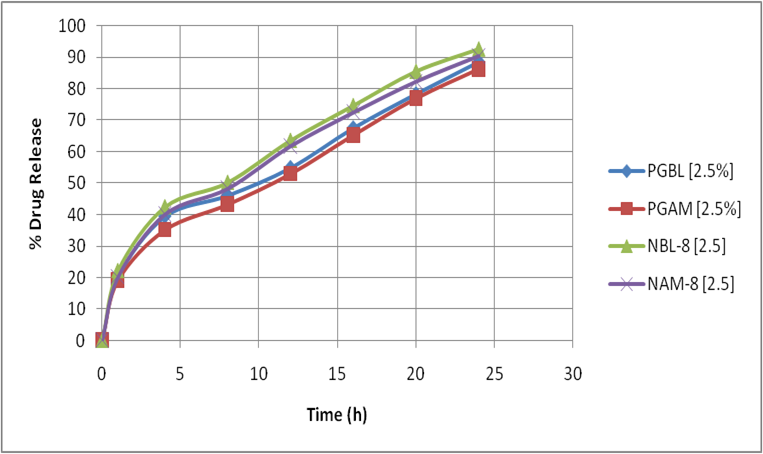
Fig. 1: Comparative % drug release of plain and niosomal gel containing Plant Extract.
The optimized niosomal gel formulation containing the plant extract, designated as NBL-8 (2.5%), was subjected to stability studies under different storage conditions for a period of three months. The formulation was stored at refrigerated temperature (2–8 °C) and at 30 ± 2 °C with 60 ± 5% relative humidity to evaluate its stability. During storage at 30 ± 2 °C and 60 ± 5% RH, slight sedimentation of particles was observed.
The evaluation results indicated that the formulation stored under refrigerated conditions (2–8 °C) did not show any significant changes in its physicochemical parameters. In contrast, a decrease in drug content was observed in samples stored at 30 ± 2 °C and 60 ± 5% RH when compared with the initial values. These findings suggest that refrigerated conditions (2–8 °C) with ambient humidity are the most suitable storage conditions for maintaining the stability of the prepared niosomal formulation containing the plant extract.
Table 5: Stability studies of Niosomal gel [NBL-2.5%] containing Plant Extract
|
Condition |
pH |
Viscosity (cps) |
Spreadability (gcmsec) |
Drug content (%) |
|||||
|
2-8°C |
Initial |
7.02 |
Initial |
6266 |
Initial |
16.32 |
Initial |
98.47±0.32 |
|
|
Final |
7.01 |
Final |
6266 |
Final |
16.30 |
Final |
98.32±0.42 |
||
|
30 ± 2°C |
Initial |
7.02 |
Initial |
6266 |
Initial |
16.32 |
Initial |
98.47±0.32 |
|
|
Final |
6.89 |
Final |
6046 |
Final |
16.10 |
Final |
92.39±0.18 |
||
REFERENCES:
1. Devi VK, Jain N, Valli KS. Importance of novel drug delivery systems in herbal medicines. Pharmacogn Rev. 2010 Jan; 4(7):27–31.
2. Singh Malik D, Mital N, Kaur G. Topical drug delivery systems: a patent review. Expert OpinTher Pat. 2016 Feb;26(2):213–28.
3. Choi MJ, Maibach HI. Liposomes and Niosomes as Topical Drug Delivery Systems. Skin Pharmacol Physiol. 2005;18(5):209–19.
4. Desaia S, Dokeb A, Disouzaa J, Athawale R. Development and evaluation of antifungal topical niosomal gel formulation. Int J of Pharmacy and Pharmaceutical Sci. 2011; 3(5):224-31.
5. Firthouse P.U.M, Halith S.M., Wahab S.U., Sirajudeen M and Mohideen S.K, Formulation and evaluation of miconazole niosomes, International Journal of PharmTech Research, 3(2): 1019–1022, 2011.
6. Mishra S, Gupta RA. Formulation and evaluation of niosomal gel of antifungal luliconazole. J Drug Delivery Ther. 2022;12(6-S):47-54.
7. Goyal P, Jain A, Thomas S, Singhai AK. Formulation and evaluation of niosomal gel for treatment of acne. J Drug Delivery Ther. 2023;13(10):71-75