Biotechnological Evaluation of Antimicrobial Metabolites Produced During Controlled Fermentation for Food Preservation Applications
- Keyur Patel , Independent Researcher, Toronto, Canada
Article Information:
Abstract:
Background: Microbial spoilage and food-borne pathogens continue to reduce the safety and shelf life of foods, while consumer demand increasingly favors preservation systems that are effective yet perceived as natural. Controlled fermentation is important in this context because fermentative microorganisms generate antimicrobial metabolites, including organic acids, bacteriocins, reuterin, and other low-molecular-weight inhibitory compounds. This article synthesizes original and foundational literature published up to 2018 in order to evaluate how fermentation-derived metabolites contribute to food preservation. The evidence published up to 2018 indicates that lactic acid bacteria are the dominant producer group because they combine technological suitability with broad antimicrobial activity. Organic acids remain the most reproducible preservation mechanism, especially in cereal and bakery systems, whereas bacteriocins provide targeted antibacterial activity and reuterin-rich fermentates broaden the applicability of cell-free systems in dairy and animal-protein foods. Studies in bread and sourdough repeatedly show delayed fungal spoilage, while dairy, meat, and seafood studies demonstrate inhibition of organisms such as Listeria monocytogenes and Escherichia coli O157:H7 when fermentation-derived metabolites are delivered directly or through protective cultures. Across matrices, efficacy depends on strain selection, fermentation control, pH buffering, food composition, and delivery format. Overall, antimicrobial metabolites produced during controlled fermentation represent a credible clean-label preservation strategy, but reliable industrial adoption requires metabolite standardization, matrix-specific validation, and integration with sensory and storage studies.
Keywords:
Article :
INTRODUCTION:
Food preservation remains a central technological issue because microbial spoilage reduces product quality, shortens marketable shelf life, and contributes to food loss across supply chains. The Food and Agriculture Organization has long highlighted food losses and waste as a major global inefficiency, with perishability playing a major role in cereals, dairy, meats, seafood, and fresh produce [1]. At the same time, both regulators and consumers have pushed the food industry toward preservation strategies that can reduce reliance on synthetic additives without compromising safety. This context has renewed interest in fermentation, not only as a traditional process but also as a controllable biotechnological platform for generating antimicrobial metabolites [2,3].
Lactic acid bacteria (LAB) are especially important in food biopreservation because they are widely associated with fermented foods, possess a long history of safe use, and generate multiple inhibitory compounds during growth. These include lactic and acetic acids, hydrogen peroxide, diacetyl, reuterin, antifungal compounds, and ribosomally synthesized peptides such as bacteriocins [2-8]. Beyond live protective cultures, literature published up to 2018 also introduced growing interest in non-viable or cell-free preparations rich in fermentation metabolites, now often discussed under the broader concept of postbiotics [9,10].
However, antimicrobial performance in real foods is rarely determined by one metabolite alone. The efficacy of fermentation-derived antimicrobials depends on the producing strain, fermentation time, pH trajectory, nutrient composition, food buffering capacity, storage temperature, and method of application. Therefore, the central question is not only whether fermentation generates inhibitory compounds, but also how well these metabolites perform in specific food matrices under realistic preservation conditions [3-8]..
MATERIALS AND METHODS:
Research Design This study was conducted as a systematic review to evaluate the role of antimicrobial metabolites produced during controlled fermentation in food preservation applications. A systematic design was selected because the topic covers diverse food matrices, microbial producers, metabolite classes, and preservation outcomes, making a conventional narrative review more vulnerable to selection bias and inconsistent interpretation. The review process was informed by the Preferred Reporting Items for Systematic Reviews and Meta-Analyses (PRISMA) guidance and standard systematic review principles relating to search transparency, screening consistency, and reproducible synthesis [24], [25].
The review question was structured using the PEO framework, where the Population (P) was food systems or food products, the Exposure (E) was antimicrobial metabolites generated through controlled fermentation, and the Outcome (O) was inhibition of spoilage organisms and pathogens, together with shelf-life improvement. This framework was considered appropriate because food biotechnology studies often assess microbiological, chemical, and technological outcomes simultaneously rather than focusing on a single intervention endpoint. From the outset, the review was designed for critical narrative synthesis rather than meta-analysis because substantial methodological heterogeneity was expected across the included studies [24], [25].
Literature Search Strategy
A structured literature search was undertaken in PubMed, Science Direct, and Web of Science to identify relevant peer-reviewed studies published between 2000 and 2018. These databases were selected because they collectively provide strong coverage of food microbiology, applied biotechnology, fermentation science, and preservation research. The search strategy combined terms related to fermentation, antimicrobial metabolites, and preservation outcomes. The core search string included combinations such as: (controlled fermentation OR lactic acid fermentation OR sourdough OR fermented) AND (antimicrobial metabolites OR bacteriocin OR organic acids OR reuterin OR postbiotic OR cell-free supernatant) AND (food preservation OR biopreservation OR shelf life OR spoilage inhibition).
Search syntax was adapted to suit the indexing structure of each database. In addition to database retrieval, the reference lists of key review articles and seminal papers were examined manually to identify further studies of relevance. Only English-language articles were included. The time restriction of 2000–2018 was applied deliberately in order to capture the evidence base and foundational work on bacteriocins, organic acids, and metabolite-rich preparations used in food biopreservation [26]–[30]. This date range was also considered appropriate because it covers the period in which fermentation-derived antimicrobial systems became more clearly linked with practical shelf-life and food safety applications.
Eligibility Criteria
Studies were eligible for inclusion if they met all of the following criteria:
1. They were published between January 2000 and December 2018;
2. They were primary experimental studies;
3. They investigated antimicrobial metabolites produced by microorganisms under controlled fermentation or clearly described fermentative conditions;
4. They assessed activity against food-relevant pathogens or spoilage organisms; and
5. They demonstrated clear relevance to food preservation, including in vitro inhibition testing, food model validation, or shelf-life assessment.
Studies were excluded if they were review papers, editorials, conference abstracts, non-English publications, or studies unrelated to food systems. Articles focused only on medical, probiotic-health, pharmaceutical, or environmental applications were also excluded unless a direct preservation relevance to food could be established. Likewise, studies based only on spontaneous fermentation without sufficient process description were excluded, as were studies lacking measurable antimicrobial outcomes. Critically, papers reporting simple acidification alone were not considered sufficient unless the antimicrobial effect was linked to a fermentation-derived metabolite profile and a preservation-related endpoint.
Data Screening
All records retrieved from the databases were exported and screened in a stepwise manner. First, duplicate records were removed. Second, titles and abstracts were assessed against the predefined eligibility criteria. Full texts were then obtained for studies that appeared potentially relevant. During full-text review, each article was checked for evidence of fermentation control, metabolite relevance, antimicrobial testing, and food preservation applicability. Reasons for exclusion at the full-text stage were recorded to maintain transparency in accordance with PRISMA
recommendations [24], [25].
A critical approach was applied during screening. Greater weight was assigned to studies that validated antimicrobial activity in real food systems or under storage conditions than to studies relying only on agar diffusion or broth-based inhibition assays. This was important because in vitro activity does not always translate into efficacy in complex food matrices, where pH buffering, fat content, protein interactions, and background microbiota may alter performance [26]–[29].
Data Extraction and Analysis
Data extraction was carried out using a predefined template. Information collected from each study included author, year, microbial strain or culture system, fermentation conditions, metabolite type, analytical characterization, target microorganisms, assay method, food matrix, preservation outcome, and principal limitations. The extracted studies were then grouped according to metabolite class—for example, organic acids, bacteriocins, reuterin, or mixed metabolite preparations—and according to food application area, such as bakery, dairy, meat, seafood, or plant-based systems.
A meta-analysis was not performed because of major heterogeneity in study design, microbial strains, fermentation conditions, assay methods, units of quantification, and endpoint reporting. Instead, findings were synthesized through a critical narrative approach, with emphasis placed on consistency of antimicrobial effect, clarity of metabolite identification, and translational relevance to food preservation practice [24], [25]. Studies combining metabolite characterization with food validation were regarded as stronger evidence than studies reporting inhibition alone.
Quality Assessment
Methodological quality was evaluated using an adapted appraisal framework suited to fermentation-based food preservation research. The assessment considered microbial identification, control of fermentation conditions, metabolite characterization, antimicrobial testing design, application in food models, replication, controls, statistical analysis, and clarity of reporting. This adapted approach was necessary because generic appraisal tools often do not fully capture technical weaknesses in laboratory-based food biotechnology studies.
Critically, many studies in this field provide strong mechanistic insight but weaker industrial realism. Common limitations include short storage trials, inconsistent reporting of metabolite concentrations, limited sensory evaluation, and overreliance on laboratory inhibition assays rather than distribution-relevant validation. These issues were taken into account during synthesis so that the conclusions reflected not only biological activity but also practical applicability in real food systems [26]–[30].
The study selection process was documented using a PRISMA flow diagram. Records identified through database searching and manual reference screening were combined, after which duplicates were removed. The remaining studies underwent title and abstract screening, followed by full-text eligibility assessment. Articles excluded at the full-text stage were categorized by reason, including lack of food preservation relevance, absence of controlled fermentation, missing antimicrobial outcome data, ineligible publication type, or publication outside the 2000–2018-time frame. The final set of eligible studies was included in the qualitative narrative synthesis, while quantitative meta-analysis was not undertaken because of heterogeneity in methods and outcomes [24], [25].
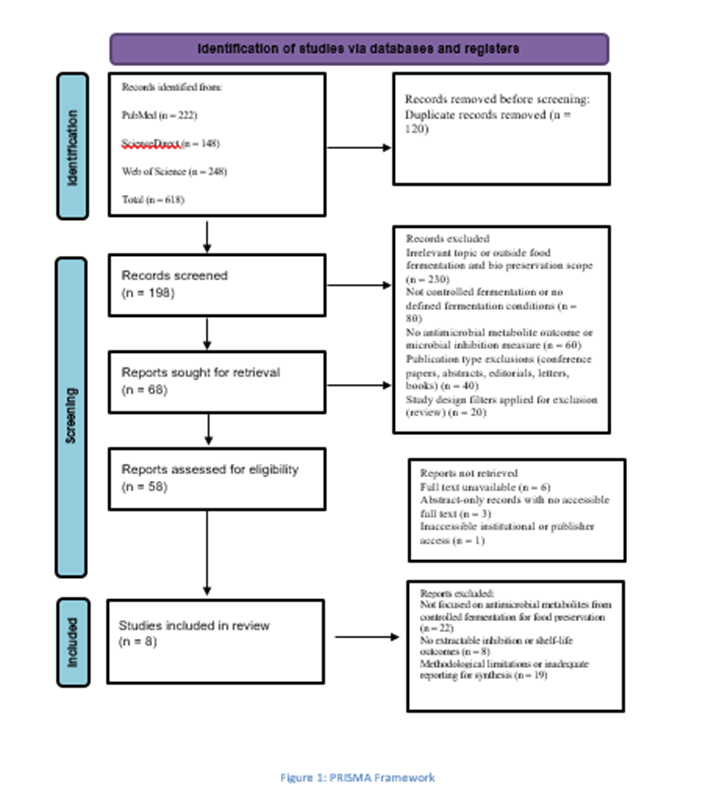
Figure 1. PRISMA flow diagram illustrating the identification, screening, eligibility assessment, and inclusion of studies investigating antimicrobial metabolites produced during controlled fermentation for food preservation applications between 2000 and 2018.
Antimicrobial Metabolites Generated During Controlled Fermentation:
Organic acids and low-molecular-weight antifungal compounds
Organic acids are the most consistently demonstrated antimicrobial outputs of controlled fermentation. Rapid acidification lowers pH, weak acids cross microbial membranes in the undissociated form, and intracellular acidification disrupts enzyme activity and nutrient transport. LAB-driven acidification is therefore the most reproducible explanation for the preservative effect of fermented doughs, vegetables, and many dairy systems [2,3,8]. Yet acidification alone does not explain all observed activity. Multiple earlier studies showed that fermenting LAB can also produce phenyllactic acid and other low-molecular-weight compounds with pronounced antifungal properties [6,7,11,12].
A landmark example is the work of Lavermicocca and colleagues, who purified and characterized novel antifungal compounds from sourdough Lactobacillus plantarum 21B, demonstrating that sourdough-derived LAB could generate specific molecules beyond simple lactic acid accumulation [11]. Magnusson et al. later showed that antifungal activity among environmental LAB isolates was broad and strain dependent, reinforcing the idea that controlled strain selection is essential when fermentation is used as a preservation tool rather than merely as a flavor-generating process [12]. Together, these studies established that controlled fermentation can be tuned to yield both predictable acidification and more specialized antifungal metabolite profiles.
Bacteriocins and peptide-based inhibition
Bacteriocins represent the most intensively studied peptide antimicrobials generated by food-grade bacteria. These ribosomally synthesized compounds are attractive because they can inhibit specific target bacteria at low concentrations and can be incorporated via purified preparations, fermentates, or bacteriocin-producing protective cultures [4-7]. Nisin remains the most commercially established example, but the broader literature has shown the value of many bacteriocinogenic strains for food biopreservation [4-6].
In cereal fermentations, Settanni et al. demonstrated the in situ activity of a bacteriocin-producing Lactococcus lactis strain during sourdough propagation, showing that bacteriocin production can influence microbial interactions during repeated fermentation cycles rather than only under broth conditions [13]. In dairy-associated ecosystems, Perin and Nero isolated antagonistic LAB from goat milk and reported a novel nisin variant in Lactococcus lactis with activity against Listeria monocytogenes, supporting the view that naturally occurring dairy microbiota remain a useful reservoir of food-compatible antibacterial strains [19]. These studies are particularly relevant for clean-label preservation because they show that peptide-based control can be achieved through strains already adapted to food environments.
Reuterin, mixed fermentates, and cell-free systems
Not all effective fermentation-derived preservatives are classical bacteriocins. Reuterin produced by Lactobacillus reuteri is a well-known example of a broader-spectrum antimicrobial metabolite that can act against Gram-positive and Gram-negative bacteria, yeasts, and moulds under appropriate production conditions [6,20,21]. El-Ziney et al. demonstrated early on that reuterin produced by L. reuteri 12002 could be applied to meat decontamination and preservation, achieving notable reductions in E. coli O157:H7 and measurable inhibition of L. monocytogenes on meat surfaces after short exposure [20].
Later, Ortiz-Rivera et al. showed that reuterin could be produced within a fermented milk system, reaching 107.5 mM in aqueous glycerol and 33.97 mM in fermented milk, while still inhibiting pathogens and spoilage microorganisms without drastic deterioration of product quality during storage [21]. Cell-free supernatants have also been investigated for related preservative effects. For example, Özogul et al. reported that LAB cell-free supernatants could reduce the formation of putrescine and other polyamines by foodborne pathogens, indicating that fermentation metabolites may contribute not only to microbial inhibition but also to improved chemical quality of foods [9].
Food Preservation Applications
Bakery and cereal foods
Bakery products provide some of the clearest demonstrations of fermentation-derived antimicrobial performance, especially against mould spoilage. Dal Bello et al. reported that sourdough fermentation with the antifungal strain Lactobacillus plantarum FST 1.7 improved the quality and shelf life of wheat bread, confirming that carefully selected starter cultures can convert in vitro antifungal activity into practical preservation outcomes [14]. Moore et al. extended this concept to gluten-free bread, showing that sourdough fermented by the same strain improved both product quality and microbial shelf life in a matrix that is often highly susceptible to spoilage [15].
Subsequent work refined the concept rather than overturning it. Belz et al. showed that sourdough could help compensate for the shelf-life penalties associated with salt reduction in bread, particularly when compared with calcium propionate-based preservation strategies [16]. Axel et al. later demonstrated improved microbial shelf life in gluten-free quinoa sourdough bread inoculated with Lactobacillus amylovorus DSM19280, and a related study found that selected lactobacilli could extend mould-free shelf life in wheat sourdough bread through production of antifungal carboxylic acids [17,18]. Across these studies, one conclusion is consistent: in cereal systems, preservation performance is strongest when fermentation is controlled around strain identity, acidification profile, and the balance between microbial stability and bread quality.
Dairy systems
Dairy matrices are attractive for fermentation-based preservation because they are already compatible with LAB growth, but they are also challenging because proteins and fat can bind or buffer antimicrobial metabolites. Even so, the older evidence base shows clear promise. Protective or bacteriocinogenic LAB from dairy environments have repeatedly shown activity against Listeria spp. and other undesirable bacteria [7,19]. The work of Perin and Nero is particularly relevant because it links an indigenous dairy source with a novel nisin-producing Lactococcus, suggesting that food-adapted dairy isolates can serve both as technological cultures and as antimicrobial producers [19].
Reuterin-based preservation also extends the dairy evidence base. Ortiz-Rivera et al. demonstrated that reuterin can be generated in a fermented milk product and remain sufficiently active to inhibit pathogens, spoilage microorganisms, and competing lactic acid bacteria while maintaining acceptable physicochemical quality during storage [21]. This is a useful reminder that dairy preservation does not depend exclusively on nisin-like peptides: controlled fermentation can also provide broader-spectrum metabolite systems when process conditions are appropriately designed.
Meat and seafood
Animal-protein foods are more demanding preservation targets because of higher pH, greater nutrient availability, and, in some products, higher fat content. Nonetheless, earlier studies show that fermentation-derived antimicrobials can still be effective when delivered as protective cultures or active fermentates. In meat systems, El-Ziney et al. reported the use of reuterin for meat decontamination and preservation, including reductions of approximately 2.7 log10 CFU/cm2 for E. coli O157:H7 and 0.63 log10 CFU/cm2 for L. monocytogenes after 24 h of treatment [20]. For chilled and processed meats more broadly, Lactobacillus sakei has been repeatedly recognized as a key protective species because of its ecological fitness in meat environments and its ability to suppress competitors during storage [22].
Seafood studies also support a matrix-aware preservation strategy. Boulares et al. showed that lactic acid bacteria combined with citrus essential oil improved the quality of vacuum-packed sea bass fillets during refrigerated storage, illustrating that fermentation-derived antimicrobials can be integrated into hurdle systems rather than used in isolation [23]. This is an important practical lesson: in high-risk protein foods, the method of delivery often matters as much as the metabolite itself. Protective cultures, cell-free metabolites, vacuum packaging, and complementary natural antimicrobials may need to be combined to obtain robust shelf-life extension.
Representative Evidence Base :
Representative Evidence Base
Table 1 summarizes representative original studies published in 2018 or earlier that anchor this article. The table is intentionally selective rather than exhaustive; its purpose is to illustrate how controlled fermentation, metabolite identity, and food matrix interact in the preservation literature.
Table 1 summarizes representative original studies published in 2018 or earlier that anchor this article. The table is intentionally selective rather than exhaustive; its purpose is to illustrate how controlled fermentation, metabolite identity, and food matrix interact in the preservation literature.
Table 1 Summary of Evidence
|
Study |
Food matrix / system |
Metabolite or intervention |
Main preservation relevance |
|
Lavermicocca et al. (2000) [11] |
Sourdough LAB |
Novel antifungal compounds from L. plantarum 21B |
Established that sourdough LAB can generate specific antifungal molecules beyond simple acidification. |
|
Settanni et al. (2005) [13] |
Sourdough propagation |
Bacteriocin-producing Lactococcus lactis |
Showed in situ peptide-mediated control of LAB interactions during controlled fermentation. |
|
Dal Bello et al. (2007) [14] |
Wheat bread |
Antifungal sourdough with L. plantarum FST 1.7 |
Improved bread quality and delayed spoilage, supporting starter-based biopreservation. |
|
Moore et al. (2008) [15] |
Gluten-free bread |
Sourdough fermented by L. plantarum FST 1.7 |
Extended microbial shelf life in a spoilage-prone cereal matrix. |
|
Belz et al. (2012) [16] |
Salt-reduced bread |
Sourdough compared with calcium propionate |
Showed sourdough can compensate for reduced chemical preservation in bread. |
|
Perin and Nero (2014) [19] |
Goat milk isolates |
Antagonistic LAB and a novel nisin variant |
Demonstrated strong antilisterial potential from dairy-adapted LAB. |
|
Ortiz-Rivera et al. (2017) [21] |
Fermented milk product |
Reuterin-producing L. reuteri system |
Inhibited pathogens and spoilage organisms without major quality damage. |
|
Boulares et al. (2018) [23] |
Vacuum-packed sea bass fillets |
LAB combined with citrus essential oil |
Improved refrigerated seafood preservation within a hurdle framework. |
Critical Appraisal and Industrial Implications
The strongest aspect of the evidence base published up to 2018 is its consistency on mechanism. Across foods, acidification remains the most reliable baseline explanation for inhibition, while peptide antimicrobials and metabolites such as reuterin expand antimicrobial breadth and target range [2-10]. The literature also consistently shows that efficacy is strain dependent: merely using “LAB” as a general category is not enough for preservation design. Antifungal activity in sourdough, for example, differs substantially from strain to strain, and antimicrobial performance in protein-rich foods often depends on food-compatible delivery systems [11-18,20-23].
At the same time, the older evidence base has limitations. Many studies are laboratory scale, run over short storage periods, and use challenge conditions that differ from commercial practice. Sensory consequences are not always explored in depth, even when acidification or metabolite concentration could affect taste and texture. Furthermore, antimicrobial activity measured in broth or agar does not always translate directly to real foods because proteins, lipids, and native microbiota can weaken apparent activity [4-8]. For industrial application, the most defensible strategy is therefore not to rely on a single “natural preservative” claim, but to specify strains, fermentation conditions, target metabolites, and product-specific validation criteria.
A practical implication of this evidence base is that controlled fermentation should be treated as a specification-led process. Producers should define the intended metabolite profile, monitor fermentation kinetics, and validate the chosen system in the actual matrix of use. In bread this may mean managing sourdough ecology to generate reproducible antifungal carboxylic acids; in dairy it may involve selecting bacteriocinogenic or reuterin-producing strains that remain active without compromising flavor; and in meat or seafood it may require combining fermentation-derived metabolites with packaging or other mild hurdles [14-23].
CONCLUSION:
Controlled fermentation offers a scientifically credible route to food preservation because it generates antimicrobial metabolites that can suppress spoilage organisms and food-borne pathogens across multiple matrices. The literature published up to 2018 shows that organic acids provide the most reproducible antimicrobial foundation, while bacteriocins, reuterin, and other metabolite-rich fermentates broaden the range and specificity of inhibition. The most convincing applications are seen in sourdough and bread systems, but meaningful preservation effects are also documented in dairy, meat, and seafood products when strain selection and delivery are handled carefully. Overall, fermentation-derived antimicrobials are promising clean-label tools, yet their successful industrial use depends on rigorous strain characterization, controlled production, matrix-specific validation, and integration with sensory and storage performance testing.
REFERENCES:
1. Food and Agriculture Organization of the United Nations. Global food losses and food waste: Extent, causes and prevention. Rome: FAO; 2011.
2. Stiles ME. Biopreservation by lactic acid bacteria. Antonie Van Leeuwenhoek. 1996;70(2-4):331-345.
3. Leroy F, De Vuyst L. Functional lactic acid bacteria starter cultures for the food fermentation industry. Trends Food Sci Technol. 2004;15(2):67-78.
4. Cleveland J, Montville TJ, Nes IF, Chikindas ML. Bacteriocins: Safe, natural antimicrobials for food preservation. Int J Food Microbiol. 2001;71(1):1-20.
5. Deegan LH, Cotter PD, Hill C, Ross P. Bacteriocins: Biological tools for bio-preservation and shelf-life extension. Int Dairy J. 2006;16(9):1058-1071.
6. Gálvez A, Abriouel H, López RL, Ben Omar N. Bacteriocin-based strategies for food biopreservation. Int J Food Microbiol. 2007;120(1-2):51-70.
7. Settanni L, Corsetti A. Application of bacteriocins in vegetable food biopreservation. Int J Food Microbiol. 2008;121(2):123-138.
8. Bintsis T. Lactic acid bacteria: their applications in foods. J Bacteriol Mycol Open Access. 2018;6(2):89-94.
9. Özogul F, Tabanelli G, Toy N, Gardini F. Impact of cell-free supernatant of lactic acid bacteria on putrescine and other polyamine formation by foodborne pathogens in ornithine decarboxylase broth. J Agric Food Chem. 2015;63(24):5828-5835.
10. Aguilar-Toalá JE, Garcia-Varela R, Garcia HS, Mata-Haro V, González-Córdova AF, Vallejo-Cordoba B, Hernández-Mendoza A. Postbiotics: An evolving term within the functional foods field. Trends Food Sci Technol. 2018;75:105-114.
11. Lavermicocca P, Valerio F, Evidente A, Lazzaroni S, Corsetti A, Gobbetti M. Purification and characterization of novel antifungal compounds from the sourdough Lactobacillus plantarum strain 21B. Appl Environ Microbiol. 2000;66(9):4084-4090.
12. Magnusson J, Ström K, Roos S, Sjögren J, Schnürer J. Broad and complex antifungal activity among environmental isolates of lactic acid bacteria. FEMS Microbiol Lett. 2003;219(1):129-135.
13. Settanni L, Massitti O, Van Sinderen D, Corsetti A. In situ activity of a bacteriocin-producing Lactococcus lactis strain: Influence on the interactions between lactic acid bacteria during sourdough fermentation. J Appl Microbiol. 2005;99(3):670-681.
14. Dal Bello F, Clarke CI, Ryan LAM, Ulmer H, Schober TJ, Ström K, Sjögren J, Van Sinderen D, Schnürer J, Arendt EK. Improvement of the quality and shelf life of wheat bread by fermentation with the antifungal strain Lactobacillus plantarum FST 1.7. J Cereal Sci. 2007;45(3):309-318.
15. Moore MM, Dal Bello F, Arendt EK. Sourdough fermented by Lactobacillus plantarum FST 1.7 improves the quality and shelf life of gluten-free bread. Eur Food Res Technol. 2008;226(6):1309-1316.
16. Belz MCE, Mairinger R, Zannini E, Ryan LAM, Cashman KD, Arendt EK. The effect of sourdough and calcium propionate on the microbial shelf-life of salt reduced bread. Appl Microbiol Biotechnol. 2012;96(2):493-501.
17. Axel C, Röcker B, Brosnan B, Zannini E, Furey A, Coffey A, Arendt EK. Application of Lactobacillus amylovorus DSM 19280 in gluten-free sourdough bread to improve the microbial shelf life. Food Microbiol. 2015;47:36-44.
18. Axel C, Brosnan B, Zannini E, Peyer LC, Furey A, Coffey A, Arendt EK. Antifungal activities of three different Lactobacillus species and their production of antifungal carboxylic acids in wheat sourdough. Appl Microbiol Biotechnol. 2016;100(4):1701-1711.
19. Perin LM, Nero LA. Antagonistic lactic acid bacteria isolated from goat milk and identification of a novel nisin variant Lactococcus lactis. BMC Microbiol. 2014;14:36.
20. El-Ziney MG, van den Tempel T, Debevere J, Jakobsen M. Application of reuterin produced by Lactobacillus reuteri 12002 for meat decontamination and preservation. J Food Prot. 1999;62(3):257-261.
21. Ortiz-Rivera Y, Sánchez-Vega R, Gutiérrez-Méndez N, León-Félix J, Acosta-Muñiz C, Sepulveda DR. Production of reuterin in a fermented milk product by Lactobacillus reuteri: Inhibition of pathogens, spoilage microorganisms, and lactic acid bacteria. J Dairy Sci. 2017;100(6):4258-4268.
22. Zagorec M, Champomier-Vergès MC. Lactobacillus sakei: A starter for sausage fermentation, a protective culture for meat products. Microorganisms. 2017;5(3):56.
23. Boulares M, Ben Moussa O, Mankai M, Sadok S, Hassouna M. Effects of lactic acid bacteria and citrus essential oil on the quality of vacuum-packed sea bass (Dicentrarchus labrax) fillets during refrigerated storage. J Aquat Food Prod Technol. 2018;27(6):698-711.
24. D. Moher, A. Liberati, J. Tetzlaff, and D. G. Altman, “Preferred reporting items for systematic reviews and meta-analyses: The PRISMA statement,” PLoS Medicine, vol. 6, no. 7, p. e1000097, 2009.
25. J. P. T. Higgins and S. Green, Eds., Cochrane Handbook for Systematic Reviews of Interventions, Version 5.1.0. London, U.K.: The Cochrane Collaboration, 2011.
26. J. Cleveland, T. J. Montville, I. F. Nes, and M. L. Chikindas, “Bacteriocins: Safe, natural antimicrobials for food preservation,” International Journal of Food Microbiology, vol. 71, no. 1, pp. 1–20, 2001.
27. L. H. Deegan, P. D. Cotter, C. Hill, and P. Ross, “Bacteriocins: Biological tools for bio-preservation and shelf-life extension,” International Dairy Journal, vol. 16, no. 9, pp. 1058–1071, 2006.
a. Gálvez, H. Abriouel, R. L. López, and N. Ben Omar, “Bacteriocin-based strategies for food biopreservation,” International Journal of Food Microbiology, vol. 120, no. 1–2, pp. 51–70, 2007.
28. M. E. Stiles, “Biopreservation by lactic acid bacteria,” Antonie van Leeuwenhoek, vol. 70, no. 2–4, pp. 331–345, 1996.
29. J. E. Aguilar-Toalá et al., “Postbiotics: An evolving term within the functional foods field,” Trends in Food Science & Technology, vol. 75, pp. 105–114, 2018