Design Development and Optimization of a Novel Polymer-Based Film Forming Gel of Sertaconazole Nitrate For Enhanced Transdermal Delivery
- Deep K. Puranik , Sandip University, School of Pharmaceutical Sciences, Sandip University, Nashik, (MH)-443201, India.
- Prashik B. Dudhe1 , Sandip University, School of Pharmaceutical Sciences, Sandip University, Nashik, (MH)-443201, India.
- Hrushikesh M. Suryawanshi , Sandip University, School of Pharmaceutical Sciences, Sandip University, Nashik, (MH)-443201, India.
- Aaknsha V. Sonawane , Sandip University, School of Pharmaceutical Sciences, Sandip University, Nashik, (MH)-443201, India.
- Rajeshwari V. Tambe , Sandip University, School of Pharmaceutical Sciences, Sandip University, Nashik, (MH)-443201, India.
- Abhijeet D. Kulkarni , Sandip University, School of Pharmaceutical Sciences, Sandip University, Nashik, (MH)-443201, India.
Article Information:
Abstract:
Superficial fungal infections require topical drug delivery systems capable of prolonged residence time and controlled drug release. Conventional creams and gels often show limited retention and short duration of action. Film-forming gels provide a topical approach by forming a polymeric film on the skin surface, thereby enhancing drug bioavailability and therapeutic performance.Methods: A film-forming gel containing sertaconazole nitrate was developed using Eudragit RS as the film-forming polymer, Transcutol P as a penetration enhancer, and Sepineo DERM as a gelling agent. Preformulation and compatibility studies confirmed drug stability. A 3² full factorial design evaluated the influence of formulation variables on drying time and in vitro drug release. Formulations were evaluated for pH, viscosity, spreadability, drying time, drug content, in vitro diffusion, antifungal activity, and stability. Results:All formulations exhibited acceptable clarity, homogeneity, and skin-compatible pH. Viscosity increased with polymer concentration, resulting in reduced spreadability and prolonged drying time. Drug diffusion studies demonstrated controlled release, with higher polymer levels retarding release and increased Transcutol P enhancing diffusion. Statistical analysis confirmed significant effects of formulation variables on drying time and drug release responses. The optimized formulation exhibited superior antifungal activity compared to the standard drug, indicating improved therapeutic effectiveness.Conclusion: The developed film-forming gel of sertaconazole nitrate showed controlled drug release and enhanced antifungal activity with suitable physicochemical characteristics. The formulation represents a topical delivery system for management of superficial fungal infections ( ).
Keywords:
Article :
INTRODUCTION :
Fungal infections are among the most common infectious diseases worldwide, affecting the skin, nails, and mucosal tissues. Superficial fungal infections, mainly caused by dermatophytes and yeasts, are especially prevalent in warm and humid climates and often result in itching, inflammation, erythema, and discomfort. Although these infections are generally not life-threatening, improper or inadequate treatment may lead to chronicity, recurrence, and reduced quality of life [1]. Effective localized therapy is therefore essential for successful management of superficial mycoses.
Topical drug delivery systems are widely preferred for treating fungal infections as they deliver the drug directly to the site of action while minimizing systemic exposure and associated adverse effects. In recent years, polymer-based film forming gels have gained significant attention as advanced topical delivery systems. Film forming gels are applied as semi-solid formulations that rapidly form a thin, transparent, and flexible polymeric film on the skin after solvent evaporation. This in situ film acts as a drug reservoir, providing sustained release and prolonged contact with the affected area [2,3].
Polymer-based film forming gels are formulated using film-forming polymers, suitable solvents, plasticizers, and penetration enhancers. The polymers provide mechanical strength and adhesion to the skin, while plasticizers improve film flexibility and comfort. The formed film enhances residence time, protects the formulation from mechanical removal, and improves patient compliance compared to conventional creams or ointments. Additionally, the occlusive nature of the film increases skin hydration, leading to enhanced drug permeation across the stratum corneum and improved bioavailability [4].
Enhanced bioavailability from film forming systems is attributed to prolonged skin contact, controlled drug release, and maintenance of an effective drug concentration gradient. These properties make film forming gels particularly suitable for antifungal therapy, where sustained drug exposure is required for effective eradication of fungal pathogens.
Sertaconazole nitrate is a broad-spectrum imidazole antifungal agent effective against dermatophytes and yeasts. Oral administration of azole antifungals is often associated with adverse effects such as gastrointestinal irritation, hepatotoxicity, and drug interactions, which restrict their long-term use. Moreover, systemic administration may not always achieve adequate drug concentration at the site of infection. Topical delivery of sertaconazole nitrate offers a safer and more effective approach by delivering high localized drug levels with minimal systemic absorption.
Incorporating sertaconazole nitrate into a polymer-based film forming gel can enhance its therapeutic performance by improving skin retention, sustaining drug release, and increasing bioavailability, thereby necessitating the design, development, and optimization of this novel film forming gel system.
MATERIALS AND METHODS:
Sertaconazole nitrate was used as the active pharmaceutical ingredient. Eudragit RS 100 was selected as the film-forming polymer, while Sepineo D.E.R.M served as the gelling agent. Polyvinylpyrrolidone K30 was used as a film modifier, Transcutol P as a penetration enhancer, and propylene glycol as a plasticizer. Methyl paraben was incorporated as a preservative, and ethanol (95%) was used as the solvent. All chemicals and reagents were of analytical grade.
Instrumentation included a UV–Visible spectrophotometer (Jasco V-550, Japan), FT-IR spectrophotometer (Shimadzu IRAffinity-1), Brookfield viscometer (Amtech LVDVE), pH meter (Labman LMPH-10), magnetic stirrer, incubator, melting point apparatus, and stability chamber maintained as per ICH guidelines.
Preformulation Studies
Preformulation studies were performed to obtain preliminary information on the physicochemical properties of sertaconazole nitrate. Organoleptic characteristics, melting point, solubility in various solvents, UV–visible spectrophotometric analysis, and FT-IR spectroscopy were carried out to confirm identity, purity, and suitability of the drug for formulation development.
Drug–Excipient Compatibility Study
Drug–excipient compatibility was assessed by mixing sertaconazole nitrate with selected excipients in a 1:1 ratio and storing the blends at 40 ± 2 °C / 75 ± 5 % RH. Samples were evaluated for any physical changes to ensure compatibility and formulation stability.
Formulation of Sertaconazole Nitrate Film Forming Gel
The film forming gel was prepared by the solvent evaporation method. Sertaconazole nitrate was accurately weighed and dissolved in ethanol to obtain a clear drug solution. In a separate beaker, Eudragit RS 100 was dissolved in ethanol under continuous stirring until a clear polymeric solution was obtained, followed by the addition of PVP K30. Transcutol P and propylene glycol were mixed separately and incorporated into the polymer solution with constant stirring to ensure uniform dispersion.
The drug solution was then added gradually to the polymer–co-solvent mixture under moderate stirring to form a homogeneous drug-loaded system. Sepineo D.E.R.M was dispersed in ethanol, allowed to swell, and added slowly to the formulation to achieve a uniform gel structure. Methyl paraben dissolved in ethanol was incorporated as a preservative. The final weight was adjusted with ethanol, and the formulation was transferred into airtight containers to prevent solvent loss.
Optimization of Film Forming Gel
Optimization of the sertaconazole nitrate film forming gel was carried out using a 3² full factorial design to systematically study the influence of formulation variables on product performance. Eudragit RS 100 (X₁) and Transcutol P (X₂) were selected as independent variables based on their critical role in film formation, drug release, and skin permeation. Drying time (Y₁) and percentage in vitro drug release (Y₂) were chosen as dependent responses.
Both independent variables were evaluated at three concentration levels: low (−1), medium (0), and high (+1), resulting in nine experimental formulations. This experimental design enabled the evaluation of individual as well as interaction effects of polymer concentration and penetration enhancer on the characteristics of the film forming gel. The formulation strategy ensured uniform drug loading and reproducibility across batches. Table no.1 indicates the experimental design for this study.
Table No.1 : Experimental design
|
Independent variables |
Name |
Unit |
Levels |
||
|
Low (-1) |
Middle |
High (+1) |
|||
|
X1 |
Eudragit RS 100 |
% |
4 |
6 |
8 |
|
X2 |
Transcutol P |
% |
6 |
10 |
14 |
|
Responses |
|||||
|
Y1 |
Drying time |
||||
|
Y2 |
% In vitro drug release |
||||
Statistical analysis of the data was carried out to generate response surface plots and polynomial equations describing the relationship between formulation variables and responses. An optimized formulation was selected using desirability function criteria, targeting minimal drying time and maximum drug release while maintaining acceptable viscosity and film integrity. The factorial design thus provided a rational and systematic approach to formulation optimization.
Evaluation of Film Forming Gel
All formulations were evaluated for physical appearance, colour, and odour to assess cosmetic acceptability. The pH was measured using a calibrated digital pH meter to ensure skin compatibility. Viscosity was determined using a Brookfield viscometer at controlled temperature, and spreadability was evaluated by the glass slide method to assess ease of application.
Drying time was determined by spreading the formulation on a glass plate maintained at skin temperature and recording the time required to form a non-tacky film. Drug content was estimated spectrophotometrically at 260 nm after suitable dilution with methanol.
In vitro diffusion studies were performed using a Franz diffusion cell with cellophane membrane and phosphate buffer pH 6.8 as the receptor medium. Samples were withdrawn at predetermined intervals and analyzed to determine cumulative drug release.
Antifungal Activity Study
Antifungal activity of the optimized formulation was evaluated using the disc diffusion method against Candida albicans. Zones of inhibition were measured and compared with a standard nystatin formulation to assess antifungal efficacy.
Accelerated Stability Studies
Accelerated stability studies were conducted for the optimized batch as per ICH guidelines at 40 ± 2 °C / 75 ± 5 % RH for 30 days. Samples were evaluated for physical appearance, pH, drying time, and drug content to assess formulation stability.
RESULT:
Preformulation evaluation of sertaconazole nitrate confirmed its suitability for topical formulation development. The drug was found to be a white, odourless, fine powder with a melting point of 158–160 °C, consistent with reported literature values, indicating acceptable purity. Solubility studies demonstrated good solubility in methanol, DMSO, and DMF, while insolubility in water justified the selection of an organic solvent system. UV spectrophotometric analysis showed a λmax at 260 nm, and the calibration curve exhibited excellent linearity in the range of 5–25 µg/ml with a correlation coefficient of 0.9949. FTIR spectra confirmed the presence of characteristic functional groups, indicating no structural alteration of the drug.
Drug–excipient compatibility studies revealed no physical or chemical interaction between sertaconazole nitrate and formulation excipients. FTIR spectra of physical mixtures showed retention of characteristic peaks, and no conformational changes were observed after one month of accelerated storage at 40 °C/75% RH, confirming compatibility and formulation stability.
All nine film-forming gel formulations were visually clear, smooth, and homogeneous, with no evidence of phase separation or particulate matter. The pH of all formulations ranged from 5.6 to 6.1, closely matching skin pH and indicating suitability for topical application. Drug content across all batches ranged from 97.08% to 100.48%, confirming uniform drug distribution and reproducibility of the formulation process.
Viscosity measurements revealed a clear dependence on polymer concentration. Formulations containing higher levels of Eudragit RS 100 exhibited significantly higher viscosity due to the formation of a denser polymeric network. Viscosity values ranged from 3950 ± 107 cP to 8090 ± 160 cP, with batches F7 and F8 showing the highest resistance to flow. Increasing Transcutol P concentration slightly reduced viscosity, improving flow behavior. The optimized batch exhibited balanced viscosity, allowing ease of application while maintaining effective film-forming characteristics.
Drying time analysis showed pronounced variation across formulations, strongly influenced by polymer and penetration enhancer concentrations. Drying time increased with increasing Eudragit RS 100 concentration due to thicker film formation, whereas higher Transcutol P levels reduced drying time by enhancing solvent evaporation. Table no. 2 gives the details of drying time in response to variation of the polymers. Drying times ranged from 4.07 ± 5 sec to 9.02 ± 12 sec. Statistical analysis using a 3² full factorial design demonstrated that the two-factor interaction (2FI) model best fitted the drying time data. ANOVA confirmed the model to be highly significant (F = 410.23, p < 0.0001), with both Eudragit RS 100 (A), Transcutol P (B), and their interaction (AB) showing significant effects. Fit statistics revealed excellent predictability with R² = 0.9960, adjusted R² = 0.9935, and adequate precision of 59.20, indicating a robust model. Regression analysis confirmed that Eudragit RS 100 exerted a stronger influence on drying time compared to Transcutol P. Figure no. 1 illustrates the 3D plot for drying time.
Table No. 2: Drying time corresponding to polymer ratio
|
Eudragit RS 100 (%) |
Transcutol P (%) |
Drying time (min) |
|
4 |
6 |
5.48 |
|
6 |
14 |
5.11 |
|
8 |
14 |
6.38 |
|
4 |
10 |
4.55 |
|
4 |
14 |
4.07 |
|
6 |
6 |
7.14 |
|
8 |
6 |
9.02 |
|
8 |
10 |
7.47 |
|
6 |
10 |
6.06 |
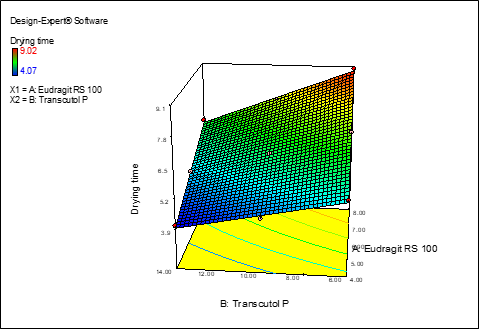
Figure No. 1: 3D plot of drying time
In vitro drug diffusion studies demonstrated controlled release of sertaconazole nitrate from all formulations. Increased polymer concentration significantly retarded drug release due to the formation of a compact diffusion barrier, while higher Transcutol P levels enhanced drug permeation. Table no. 3 gives the details of drug release in response to variation of the polymers. Cumulative drug release after 8 hours ranged from 82.4% to 97.2%. Statistical optimization showed that the linear model best described the drug release data. Figure no. 2 indicates the graphical representation of the cumulative drug release. ANOVA revealed the model to be significant (F = 14.75, p = 0.0048), with both formulation variables significantly affecting drug release. Eudragit RS 100 showed a negative effect on drug diffusion, whereas Transcutol P exerted a positive effect. Fit statistics supported the adequacy of the model with R² = 0.8309 and adequate precision of 10.81, confirming reliable prediction within the design space.
Table No. 3: Drug release corresponding to polymer ratio
|
Eudragit RS 100 (%) |
Transcutol P (%) |
Drying time (min) |
|
4 |
6 |
5.48 |
|
6 |
14 |
5.11 |
|
8 |
14 |
6.38 |
|
4 |
10 |
4.55 |
|
4 |
14 |
4.07 |
|
6 |
6 |
7.14 |
|
8 |
6 |
9.02 |
|
8 |
10 |
7.47 |
|
6 |
10 |
6.06 |
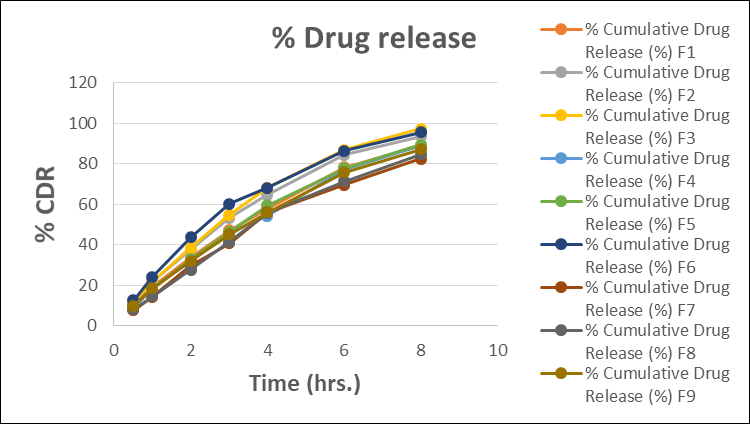
Figure No. 2: % CDR
The statistical analysis lead to optimal selection of the formulation based on the points summarized in table no. 4. Optimization using desirability criteria identified batch F3 as the optimized formulation, providing an ideal balance between drying time and drug release. The optimized batch exhibited rapid drying, controlled drug diffusion, appropriate viscosity, and excellent film-forming properties.
Table No. 4: Summary of optimization
|
Sr. No. |
Independent variables |
Drying time |
% Drug release |
|
1 |
% Eudragit RS 100 in formulation |
Directly proportional (As Eudragit RS 100 increases, drying time increases) |
Inversely proportional (As Eudragit RS 100 increases, % Drug release decreases) |
|
2 |
% Transcutol P in formulation |
Inversely proportional (As Transcutol P increases, drying time decreases) |
Directly proportional (As Transcutol P increases, % Drug release also increases) |
The antifungal activity study further validated formulation effectiveness. The optimized film-forming gel produced a zone of inhibition of 33 mm against Candida albicans, which was significantly higher than that of the standard antifungal agent nystatin (27 mm). This enhanced antifungal activity can be attributed to sustained drug release, improved skin retention, and uniform polymeric film formation.
DISCUSSION :
The present study demonstrates the successful development and optimization of a polymer-based film-forming gel of sertaconazole nitrate intended for enhanced topical antifungal therapy. The preformulation and compatibility findings confirmed the physicochemical suitability of sertaconazole nitrate and its stability with selected excipients, which is consistent with earlier reports on azole antifungal formulations where no significant drug–polymer interactions were observed [5-7].
Viscosity plays a decisive role in determining the spreadability, film integrity, residence time, and drug diffusion behaviour of film-forming systems. In the present investigation, viscosity increased proportionally with polymer concentration due to the formation of a dense polymeric network that restricts molecular mobility. Comparatively, similar trends have been reported in Eudragit-based film-forming gels, where higher polymer content resulted in improved film strength and prolonged drug release [8,9]. Contrastingly, excessively viscous systems have been shown to compromise ease of application and patient comfort, emphasizing the need for optimized viscosity rather than maximum polymer concentration [10,11]. The optimized formulation achieved a desirable balance between flow behavior and structural integrity.
Drying time is a critical performance parameter that directly influences patient compliance and formulation acceptance. The optimized formulation demonstrated rapid yet controlled drying, attributed to the synergistic effect of Eudragit RS and Transcutol P. Similarly, previous investigations on topical film-forming systems have shown that penetration enhancers and volatile solvents facilitate faster film formation without compromising film quality [12]. Statistical analysis confirmed that polymer concentration exerted a more pronounced influence on drying time than penetration enhancer concentration, which aligns with reported factorial design studies on film-forming gels [13].
In vitro drug diffusion studies revealed sustained release of sertaconazole nitrate over an extended period, indicating effective drug entrapment within the polymeric matrix. Increasing polymer concentration resulted in reduced diffusion rates due to the formation of a thicker and less permeable diffusion barrier. Comparatively, analogous findings have been reported for polymeric film-forming
formulations of antifungal agents, where controlled release was achieved through modulation of polymer content [14]. Contrastingly, formulations with lower polymer concentration showed rapid initial release, which may reduce prolonged antifungal efficacy and dosing convenience [15]. The statistical optimization validated the model reliability and enabled precise identification of an optimized formulation with desirable release and drying characteristics.
The enhanced antifungal activity observed for the optimized formulation can be attributed to sustained drug availability, prolonged skin contact, and improved penetration. Similarly, earlier studies have demonstrated superior antifungal efficacy of polymer-based topical systems compared to conventional creams and gels. The increased zone of inhibition reflects improved local bioavailability and supports the therapeutic advantage of the developed film-forming gel system.
CONFLICT OF INTEREST:
The authors declare that there is no conflict of interest regarding the publication of this research work.
ACKNOWLEDGEMENT
The authors express their sincere gratitude to the management, Dean, and faculty members of school of pharmaceutical sciences, Sandip University, Nashik for providing the necessary facilities and support to carry out this research work. Special thanks are extended to the Department for guidance and encouragement throughout the study.
BIBLIOGRAPHY:
1. Qushawy, M., Nasr, A., Abd-Alhaseeb, M., & Swidan, S. (2018). Design, optimization and characterization of a transfersomal gel using miconazole nitrate for the treatment of candida skin infections. Pharmaceutics, 10(1), 26. https://doi.org/10.3390/pharmaceutics10010026
2. Panda, D. S., Dash, D. K., Vaiswade, R., Gupta, G., Giri, R. K., Zafar, A., Alsaidan, O. A., & Magar, S. P. (2025). Development and optimization of setraconazole invasomes, gels, and films for enhanced transdermal delivery and topical fungal treatment. Journal of Pharmaceutical Innovation, 20(4). https://doi.org/10.1007/s12247-025-10040-5
3. Kokate, S., Binnor, H., Mahajan, V., & Ushir, Y. (2024). Design and Development of Film Forming Gel of Tavaborole by using Factorial Design. Research Journal of Pharmacy and Technology, 4029–4034. https://doi.org/10.52711/0974-360x.2024.00625
4. Somwanshi, S. B., & Donde, H. K. (2025). Quality by Design-Driven formulation and evaluation of an Itraconazole Film-Forming gel for enhanced antifungal activity. Journal of Young Pharmacists, 17(3), 636–645. https://doi.org/10.5530/jyp.20250014
5. Patil, S. B., Dandagi, P., Nadaf, R. D., & Hulyalkar, S. (2024). A design of expert-based development and optimization of voriconazole-loaded aspasomal gel for topical delivery. Journal of Applied Pharmaceutical Science. https://doi.org/10.7324/japs.2024.173833
6. Nigam, P., Gupta, A. K., & Vats, A. (2020). Film forming transemulgel- A novel drug delivery system. IP International Journal of Comprehensive and Advanced Pharmacology, 5(3), 100–104. https://doi.org/10.18231/j.ijcaap.2020.022
7. Bornare, S. S., Aher, S. S., & Saudagar, R. B. (2018). A REVIEW: FILM FORMING GEL NOVEL DRUG DELIVERY SYSTEM. International Journal of Current Pharmaceutical Research, 10(2), 25. https://doi.org/10.22159/ijcpr.2018v10i2.25886
8. Alves, T. F. R., Morsink, M., Batain, F., Chaud, M. V., Almeida, T., Fernandes, D. A., Da Silva, C. F., Souto, E. B., & Severino, P. (2020). Applications of Natural, Semi-Synthetic, and synthetic polymers in cosmetic formulations. Cosmetics, 7(4), 75. https://doi.org/10.3390/cosmetics7040075
9. Dalmoro, A., Barba, A. A., Lamberti, G., Grassi, M., & D’Amore, M. (2012). Pharmaceutical applications of biocompatible polymer blends containing sodium alginate. Advances in Polymer Technology, 31(3), 219–230. https://doi.org/10.1002/adv.21276
10. Alyahya, E. M., Alwabsi, K., Aljohani, A. E., Albalawi, R., El-Sherbiny, M., Ahmed, R., Mortagi, Y., & Qushawy, M. (2023). Preparation and optimization of itraconazole Transferosomes-Loaded HPMC hydrogel for enhancing its antifungal activity: 2^3 full factorial design. Polymers, 15(4), 995. https://doi.org/10.3390/polym15040995
11. Souto, E. B., & Müller, R. H. (2006). The use of SLN and NLC as topical particulate carriers for imidazole antifungal agents. PubMed, 61(5), 431–437. https://pubmed.ncbi.nlm.nih.gov/16724541
12. Abdellatif, M. M., Josef, M., El-Nabarawi, M. A., & Teaima, M. (2022). Sertaconazole-Nitrate-Loaded Leciplex for treating keratomycosis: optimization using D-Optimal design and in vitro, ex vivo, and in vivo studies. Pharmaceutics, 14(10), 2215. https://doi.org/10.3390/pharmaceutics14102215
13. Abdullah, N., & Patil, A. B. (2022). DESIGNING OF NOVEL TOPICAL IN SITU POLYMERIC FILM-FORMING SOLUTION SPRAY FORMULATION OF ANTIFUNGAL AGENT: IN VITRO ACTIVITY AND IN VIVO CHARACTERIZATION. International Journal of Applied Pharmaceutics, 169–184. https://doi.org/10.22159/ijap.2022v14i1.43581
14. Szekalska, M., Wróblewska, M., Czajkowska-Kośnik, A., Sosnowska, K., Misiak, P., Wilczewska, A. Z., & Winnicka, K. (2023). The Spray-Dried Alginate/Gelatin Microparticles with Luliconazole as Mucoadhesive Drug Delivery System. Materials, 16(1), 403. https://doi.org/10.3390/ma16010403
15. Shineh, G., Mobaraki, M., Bappy, M. J. P., & Mills, D. K. (2023). Biofilm Formation, and Related Impacts on healthcare, food processing and packaging, industrial manufacturing, marine Industries, and Sanitation–A review. Applied Microbiology, 3(3), 629–665. https://doi.org/10.3390/applmicrobiol3030044