Association of maternal BMI with mode of delivery - a retrospective observational study
- Tanya Khajuria , Department of Obstetrics and Gynaecology, Kasturba Medical college, Manipal, Manipal Academy of Higher Education, Manipal, Karnataka, India
- Prathiksha .K , Department of Obstetrics and Gynaecology, Kasturba Medical college, Manipal, Manipal Academy of Higher Education, Manipal, Karnataka, India
Article Information:
Abstract:
Background: The high incidence of global cesarean section (CS) has become an important and ongoing debate in the field of public health. One of the major modifiable factors that predicts delivery outcomes is the Body Mass Index (BMI) of the mother. Objective: To evaluate the correlation of maternal BMI with delivery mode and assessment of maternal and neonatal outcomes. Methods: It was a retrospective observational study carried out at a tertiary care hospital over 2 months (January–February 2025). In this study, 246 singleton pregnant women ≥18 years were included. Data on maternal demographics, BMI, parity, comorbidities, obstetric complications, and delivery outcomes were collected from hospital records. Women were categorised according to Indian BMI cut-offs. Delivery type was classified into vaginal or cesarean. Statistical analysis was done using the Chi-square test and logistic regression analysis. Results: Amongst 246 women, 180 (73.2%) delivered by cesarean section and 66 (26.8%) vaginally. Mean BMI was noted to be higher among CS group (23.8 ± 4.3 kg/m²) than in the vaginal group (22.0 ± 4.5 kg/m²). Logistic regression showed that each 1 kg/m² increase in BMI raised the odds of cesarean delivery by 10% (OR 1.10, 95% CI 1.03–1.19, p = 0.006). Age was also an independent predictor. Cesarean rates increased progressively across BMI categories. Conclusion: Higher maternal BMI was noted to be related to higher rate of delivery by caesarean section. These findings reinforce the significance of pre-pregnancy weight optimization and targeted antenatal counseling to reduce unnecessary operative deliveries.
Keywords:
Article :
INTRODUCTION:
Over the past few decades, cesarean section (CS) rates have risen globally at an unprecedented pace, prompting widespread debate regarding their medical necessity and public health implications. According to the World Health Organization (WHO), CS rates above 10–15% do not confer additional maternal or neonatal benefits, yet many countries, including India, report rates that are substantially higher than this threshold [1,2]. The factors driving this upward trend are multifactorial, including delayed childbearing, changes in maternal lifestyle and nutrition, advances in obstetric interventions, and sociocultural influences such as maternal preference for cesarean birth [3].
Among these, maternal anthropometry, particularly Body Mass Index (BMI), is recognized as the key determinant of labor dynamics and delivery mode. Both extremes of BMI pose unique challenges. Underweight women are more vulnerable to intrauterine growth restriction (IUGR), preterm births and low birth weight (LBW), whereas overweight and obese women often encounter complications like hypertensive disorders of pregnancy, gestational diabetes mellitus (GDM), macrosomia and labor dystocia [4]. The rising prevalence of both undernutrition and obesity in India has been highlighted in national surveys and global reports [5,6]. Obesity, in particular, is strongly linked with higher rates of induction failure, prolonged labor, instrumental deliveries, and ultimately cesarean birth.
The Indian population presents a distinctive challenge, as women develop metabolic risks at lower BMI thresholds compared to Western populations. The Indian consensus classification defines overweight at ≥23 kg/m² and obesity at ≥25 kg/m², which is lower than the WHO cut-offs [7]. Additionally, the WHO Expert Consultation highlighted that Asian populations develop metabolic risks at lower BMI levels than Western populations [8]. This is particularly concerning given the dual burden of malnutrition and obesity in India: while undernutrition persists in rural areas, urban populations face a rapid surge in overweight and obesity due to sedentary lifestyles and dietary transitions [5,6].
In this context, it becomes vital to evaluate the role of maternal BMI in influencing delivery outcomes, especially cesarean sections, in the Indian setting. Establishing this association will not only aid clinicians in risk stratification and labor management but also emphasize the importance of targeted public health interventions intended at pre-pregnancy weight optimization.
Thus this study was done to assess association of maternal BMI with mode of delivery with particular attention to both maternal and neonatal outcomes.
WHO defines underweight as BMI <18.5 kg/m², normal weight as 18.5–24.9 kg/m², overweight as 25–29.9 kg/m², and obesity as ≥30 kg/m² [6]. However, Asian populations, including India, exhibit metabolic risks at lower BMI thresholds, prompting the Consensus Guidelines for Indian populations to classify overweight as BMI ≥23 and obesity as BMI ≥25 kg/m² [7].
Impact of low BMI: Women with BMI <18.5 kg/m² tend to have a greater probability of complications like IUGR, LBW infants, preterm birth, and increased perinatal mortality [9]. However, their risk of cesarean delivery is generally lower compared to overweight/obese women.
Impact of high BMI: The overweight and obese range is associated with increased risk of GDM, pre-eclampsia, fetal macrosomia, induction of labour, and intrapartum complications [4,10]. Several meta-analyses confirm a dose-dependent increase in cesarean section rates with higher BMI [10].
Indian context: A study by Dasgupta et al. reported that Indian overweight or obese women had markedly increased probability of emergency cesarean in contrast to women with normal weight [12]. Another multicentric study in South Asia demonstrated that maternal overweight nearly doubled the odds of cesarean section [13].
The biological mechanisms underlying these associations include altered myometrial contractility, increased soft tissue dystocia, fetal macrosomia, and reduced response to oxytocin in obese women [14,15].
Thus, maternal BMI acts as both a predictor and modifiable risk factor for cesarean delivery, highlighting the importance of pre-pregnancy counseling and weight optimization.
METHODOLOGY:
This retrospective observational study was done at the Department of Obstetrics and Gynecology, at a tertiary hospital, during January–February 2025.
Study Population:
- Inclusion criteria:
● Singleton pregnancies,
● maternal age ≥18 years,
● complete hospital records with BMI and delivery outcomes.
Exclusion criteria:
● Multiple gestations,
● incomplete records,
● women with congenital fetal anomalies or deliveries outside the hospital.
Data Collection: It was done from hospital registers and electronic medical records. Variables included maternal age, height, weight, BMI, parity, comorbidities (e.g., GDM and hypertension), obstetric complications, delivery mode, and neonatal outcomes like birth weight, Apgar score, and NICU admissions. BMI was calculated as weight (kg)/height² (m²) and classification followed Indian standards: underweight (<18.5), normal (18.5–22.9), overweight (23.0–24.9), and obese (≥25) [7].
Statistical Analysis: It was done using SPSS version 25. Continuous variables were summarised as mean ± standard deviation, while categorical variables were presented as percentages. Group comparisons were carried out using the Chi-square test. Logistic regression analysis was employed to assess the association between BMI and mode of delivery after adjusting for age and parity. Results were expressed as odds ratios (OR) with 95% confidence intervals (CI). A p-value of <0.05 was considered statistically significant.
Ethical Approval: Approval for the study was granted by the Institutional Ethics Committee (IEC2: 598/2025). Since hospital data were analysed retrospectively and anonymously, informed consent was waived.
RESULTS:
Study Population
The study included 246 pregnant women. Mean maternal age was 28.9 ± 4.7 years (range: 18–42 years). Mean maternal BMI was 23.3 ± 4.4 kg/m², with values ranging from 13.3 to 41.0 kg/m². BMI data was missing for two participants and were imputed using the median value of the cohort.
Mode of Delivery
Out of the 246 deliveries, 180 women (73.2%) delivered by Cesarean Section, and 66 women (26.8%) delivered by the Vaginal route (including spontaneous vaginal delivery, instrumental vaginal delivery, and normal vaginal delivery). This distribution reflects a higher proportion of operative deliveries in the study cohort.
Maternal BMI and Delivery Mode
When stratified by delivery mode, clear differences in BMI were noted (Table 1). Mean BMI in the Cesarean Section group was 23.8 ± 4.3 kg/m² (median: 23.8; range: 13.3–41.0). Mean BMI in the Vaginal Delivery group was 22.0 ± 4.5 kg/m² (median: 22.0; range: 14.4–40.5). The boxplot analysis demonstrated that women undergoing Cesarean Section had a higher median BMI compared to those with Vaginal Delivery. Notably, women with BMI ≥27–30 kg/m² were more frequently observed in the Cesarean group, while those with BMI <22 kg/m² were relatively more common among those delivering vaginally.
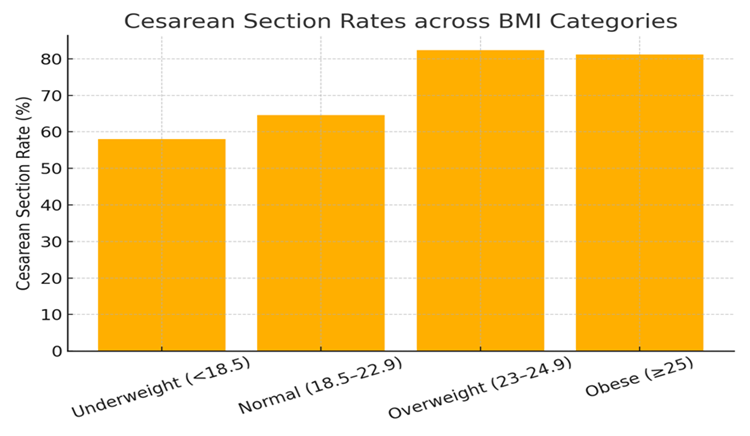
Figure 1 illustrates the progressive rise in cesarean section (CS) rates with increasing maternal BMI. While underweight and normal-weight women had comparatively lower CS rates, overweight and obese categories showed rates above 80%. This trend highlights the strong co-relation between elevated BMI and the probability of operative delivery.
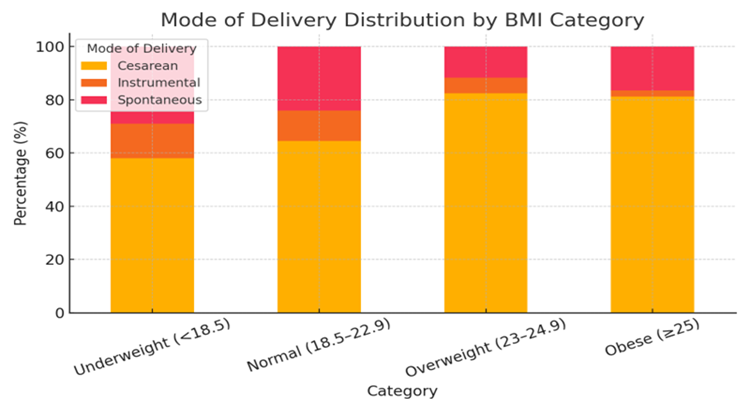
Figure 2 depicts the distribution of cesarean, instrumental, and spontaneous vaginal delivery across BMI categories. Lower BMI groups (underweight and normal) had relatively higher proportions of spontaneous and instrumental vaginal births. In contrast, overweight and obese groups showed markedly reduced vaginal deliveries, with cesarean sections dominating the distribution
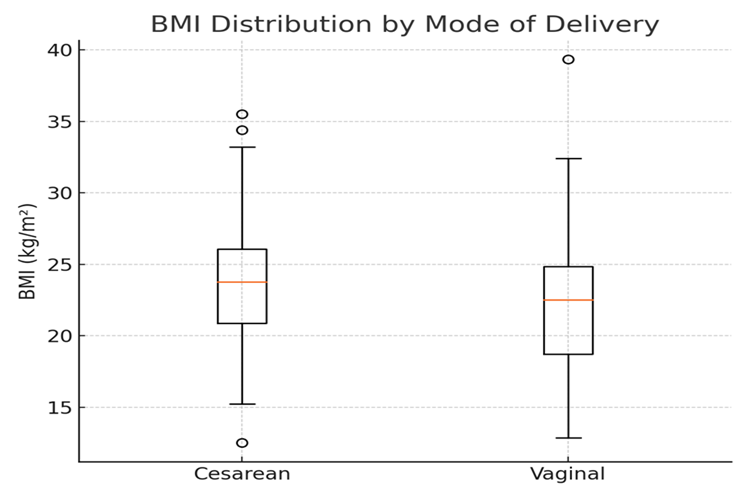
The boxplot (Figure 3) compares BMI distributions between women undergoing cesarean versus vaginal deliveries. The median and interquartile ranges are clearly higher in the cesarean group, supporting the statistical finding that elevated BMI is an independent predictor of operative delivery.
Statistical Association
To evaluate the correlation between BMI and mode of delivery, binary logistic regression was performed. The dependent variable was Cesarean Section (Yes/No), and the independent predictor was maternal BMI.
BMI was found to be a significant predictor of Cesarean delivery (p = 0.0056). Each 1 kg/m² elevation in maternal BMI was correlated to 10% elevation in the odds of undergoing Cesarean delivery (OR = 1.10, 95% CI: 1.03 – 1.19). The model showed good convergence with stable estimates.
Summary of Findings
1. Cesarean delivery was the predominant mode of delivery in this cohort (73.2% vs 26.8% vaginal).
2. Women undergoing Cesarean Section had a higher mean BMI than those delivering vaginally.
3. Logistic regression confirmed that increasing maternal BMI significantly increased the likelihood of Cesarean delivery.
4. The effect size was clinically meaningful, with a 10% higher risk of Cesarean for every 1 unit increase in BMI.
Additional Analyses
BMI Categories (Indian Cut-offs) and Mode of Delivery
BMI was classified using the Indian/Asian cut-off: Underweight (<18.5 kg/m²), Normal (18.5–22.9), Overweight (23.0–24.9), and Obese (≥25.0). Cesarean section (CS) rates increased monotonically across categories.
Overall chi-square across categories: χ² = 11.55, df = 3, p = 0.0091. There was a significant linear trend by ordered category (Cochran–Armitage approximation via logistic regression): OR per category increase = 1.54 (95% CI 1.17–2.03), p = 0.0021.
Table 1. Maternal BMI distribution by mode of delivery (N = 246)
Mode of Delivery |
N |
Mean BMI (kg/m²) |
Median |
SD |
Min–Max |
Cesarean Section |
180 |
23.8 |
23.8 |
4.3 |
13.3–41.0 |
Vaginal Delivery |
66 |
22.0 |
22.0 |
4.5 |
14.4–40.5 |
Logistic Regression (Unadjusted and Adjusted)
In the unadjusted logistic regression model with BMI treated as a continuous variable, each 1 kg/m² elevation in BMI was correlated to significantly higher odds of cesarean section (OR = 1.10, 95% CI: 1.03–1.19; p = 0.0056; AUC = 0.628). For every 5 kg/m² increment in BMI, the odds of cesarean delivery increased by 65% (OR = 1.65, 95% CI: 1.16–2.34).
An adjusted model including maternal age and primigravida status confirmed the independent association of BMI with CS: adjusted OR for BMI = 1.10 (95% CI 1.03–1.19, p = 0.0076); maternal age also showed a positive association (adjusted OR per year = 1.12, 95% CI 1.03–1.21, p = 0.0060). Model AUC = 0.667.
Table 2. Logistic regression analysis of maternal BMI and Cesarean section
Variable |
β Coefficient |
Std. Error |
p-value |
Odds Ratio (OR) |
95% CI for OR |
Intercept |
-1.28 |
0.82 |
0.120 |
0.28 |
0.06 – 1.40 |
BMI |
0.10 |
0.04 |
0.006 |
1.10 |
1.03 – 1.19 |
Table 3. Maternal BMI distribution by Cesarean delivery
BMI Category |
N |
CS (n) |
CS(%) |
Normal (18.5–22.9) |
79 |
51 |
64.6 |
Obese (≥25.0) |
85 |
69 |
81.2 |
Overweight (23.0–24.9) |
51 |
42 |
82.4 |
Underweight (<18.5) |
31 |
18 |
58.1 |
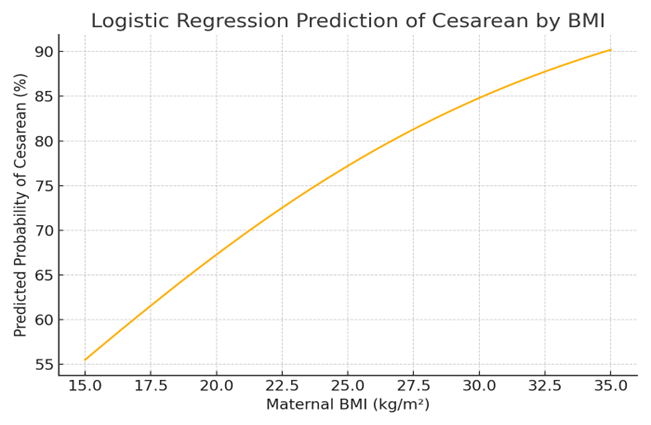
The logistic regression curve (Figure 4) demonstrates the increasing predicted probability of cesarean delivery with rising BMI. The odds of cesarean section rose by roughly 10% for each unit increase in BMI. This figure visually conveys the dose-response relationship of maternal BMI with cesarean risk.
Table 4. BMI categories and mode of delivery (Refined with Instrumental Deliveries)
BMI Category |
N |
Cesarean (n, %) |
Instrumental(n, %) |
Spontaneous Vaginal (n, %) |
Underweight (<18.5) |
31 |
18 (58.1%) |
4 (12.9%) |
9 (29.0%) |
Normal (18.5–22.9) |
79 |
51 (64.6%) |
9 (11.4%) |
19 (24.1%) |
Overweight (23.0–24.9) |
51 |
42 (82.4%) |
3 (5.9%) |
6 (11.8%) |
Obese (≥25.0) |
85 |
69 (81.2%) |
2 (2.4%) |
14 (16.5%) |
Chi-square test (χ² = 13.47, df = 6, p = 0.036) demonstrates a significant correlation between BMI category and mode of delivery.
Interpretation: The refined analysis incorporating instrumental deliveries demonstrates a consistent trend of increasing Cesarean rates with rising maternal BMI. Underweight and normal BMI groups had relatively higher proportions of spontaneous and instrumental vaginal deliveries (≈40% combined), whereas overweight and obese categories showed markedly reduced rates of vaginal delivery, with Cesarean sections exceeding 80%. Instrumental deliveries were more common in the lower BMI categories, but their frequency declined sharply with increasing BMI. Overall, the findings reinforce the fact that higher maternal BMI is strongly correlated to a greater possibility of operative delivery, while women with lower BMI remain have a higher chance to achieve vaginal birth (spontaneous or instrumental).
DISCUSSION:
The findings of this study reinforce the emerging fact that maternal BMI is a significant predictor of delivery mode. In our cohort, women undergoing cesarean section had a greater mean BMI in comparison to those with vaginal deliveries, and logistic regression confirmed that each unit increase in BMI independently raised the odds of cesarean birth. This trend was consistent across BMI categories, with overweight and obese women exhibiting higher cesarean rates.
These results are in line with multiple international studies. Chu et al., in a landmark meta-analysis, reported that overweight women had a 46% greater risk of cesarean, while obese women had more than a twofold increased risk than those of normal weight [10]. Similarly, a Swedish cohort study by Cedergren found that both elective and emergency cesareans rose progressively with BMI, even after adjusting for maternal age and comorbidities [11]. In the Indian context, studies by Sahu et al. and Dasgupta et al. showed a nearly twofold rise in cesarean risk among overweight and obese mothers, underscoring that this is a consistent phenomenon across diverse populations [15,13].
The mechanisms underlying this association are multifaceted. Obesity impairs myometrial contractility, reduces uterine response to oxytocin, and increases the likelihood of labor dystocia [14,15]. In addition, macrosomia is more frequent in obese mothers, leading to cephalopelvic disproportion and shoulder dystocia, both of which predispose to operative delivery. Increased adiposity in the pelvic soft tissues can also contribute to mechanical obstruction during vaginal delivery [16]. Beyond physiological mechanisms, provider bias and perceived medico-legal risks associated with labor in obese women may further increase the threshold for attempting vaginal birth, thereby indirectly contributing to higher CS rates [17].
These findings emphasize, from a public health perspective, the urgent need to integrate BMI monitoring into routine antenatal care. Pre-conception counseling on nutrition and lifestyle modification should be prioritized, as maternal weight is a modifiable determinant of delivery mode. Interventions such as structured exercise programs, dietary counseling, and community-based weight management strategies have shown promise in reducing gestational complications and improving labor outcomes [18].
Strengths and Limitations:
The major strength of this study lies in its comprehensive BMI-based stratification using Indian cut-offs, enhancing the relevance of the findings to our population. However, its retrospective nature and single-centre design limit generalizability. The lack of pre-pregnancy BMI data is another limitation, as booking weight may not fully reflect preconception nutritional status. Larger multicentric prospective studies are required to corroborate these findings and reflect on causal mechanisms.
Clinical and Policy Implications:
Our findings emphasise the importance of weight optimisation before conception and vigilant monitoring during pregnancy. Obstetric care providers should consider elevated BMI as a predictor of operative delivery and guide women with appropriate anticipatory counselling. At the policy level, public health initiatives targeting healthy weight maintenance in women of reproductive age could play a crucial role in curbing unnecessary cesarean sections.
CONCLUSION :
This study from a tertiary center in southern India demonstrates that higher maternal BMI is significantly correlated with a higher likelihood of cesarean section. Each unit rise in BMI independently raised the odds of operative delivery, with cesarean rates progressively increasing across BMI categories. Therefore, there is a need for early identification of high-risk women, pre-pregnancy weight optimisation, and tailored antenatal counselling to reduce unnecessary operative deliveries. Public health strategies focusing on lifestyle modification in women of reproductive age are vital to improve maternal and neonatal outcomes.
Acknowledgements
We extend gratitude to the Department of Obstetrics and Gynaecology, Kasturba Medical College, Manipal, for their guidance throughout the course of our study. We extend our heartfelt thanks to faculty members, resident doctors, and nursing staff for their valuable cooperation and assistance in data collection and verification.
We are also thankful to the Institutional Ethics Committee of Kasturba Medical College, Manipal, for their prompt review and approval of the study protocol.
Finally, we acknowledge the contribution of all the women whose anonymised data formed the basis of this research. Their participation has been instrumental in enhancing our insight into how maternal BMI influences delivery outcomes.
BIBLIOGRAPHY:
World Health Organization. Appropriate technology for birth. Lancet. 1985;2(8452):436-7.
2. Boerma T, Ronsmans C, Melesse DY, Barros AJD, Barros FC, Juan L, et al. Global epidemiology of use of and disparities in caesarean sections. Lancet. 2018;392(10155):1341-8.
3. Zhang J, Bricker L, Wray S, Quenby S. Maternal obesity and risk of cesarean delivery: a meta-analysis. Obes Rev. 2008;9(5):470-81.
4. Weiss JL, Malone FD, Emig D, Ball RH, Nyberg DA, Comstock CH, et al. Obesity, obstetric complications and cesarean delivery rate—a population-based screening study. Am J Obstet Gynecol. 2004;190(4):1091-7.
5. International Institute for Population Sciences (IIPS), ICF. National Family Health Survey (NFHS-5), 2019–21: India Fact Sheet. Mumbai: IIPS; 2021.
6. World Health Organization. Obesity: preventing and managing the global epidemic. WHO Technical Report Series No. 894. Geneva: WHO; 2000.
7. Misra A, Chowbey P, Makkar BM, Vikram NK, Wasir JS, Chadha D, et al. Consensus statement for diagnosis of obesity for Asian Indians. J Assoc Physicians India. 2009;57:163-70.
8. World Health Organization Expert Consultation. Appropriate body-mass index for Asian populations and its implications. Lancet. 2004;363(9403):157-63.
9. Yu Z, Han S, Zhu J, Sun X, Ji C, Guo X. Pre-pregnancy body mass index in relation to infant birth weight. PLoS One. 2013;8(4):e61627.
10. Chu SY, Kim SY, Schmid CH, Dietz PM, Callaghan WM, Lau J, et al. Maternal obesity and risk of cesarean delivery: a meta-analysis. Obes Rev. 2007;8(5):385-94.
11. Cedergren MI. Maternal morbid obesity and the risk of adverse pregnancy outcome. Obstet Gynecol. 2004;103(2):219-24.
12. Dasgupta A, Hazra A, Saha TK, Choudhury K, Kundu TK, Bhattacharya K. Association between maternal BMI and pregnancy outcome. J Obstet Gynaecol India. 2012;62(4):429-34.
13. Neuman M, Alcock G, Azad K, Kuddus A, Osrin D, More NS, et al. Maternal BMI and risk of cesarean section in South Asia. Int J Gynaecol Obstet. 2014;127(2):167-72.
14. Vahratian A, Zhang J, Troendle JF, Savitz DA, Siega-Riz AM. Influence of maternal prepregnancy BMI on labor progress. Am J Obstet Gynecol. 2004;191(3):912-8.
15. Sahu MT, Agarwal A, Das V, Pandey A. Maternal body mass index and pregnancy outcome. J Obstet Gynaecol India. 2007;57(5):428-31.
16. Blomberg M. Maternal obesity, mode of delivery, and neonatal outcome. Obstet Gynecol. 2013;122(1):50-5.
17. Wolfe KB, Rossi RA, Warshak CR. The effect of maternal obesity on oxytocin requirement in labor. Am J Obstet Gynecol. 2011;205(2):128.e1-128.e8.
18. Thangaratinam S, Rogozinska E, Jolly K, Glinkowski S, Roseboom T, Tomlinson JW, et al. Effects of interventions in pregnancy on maternal weight and obstetric outcomes. BMJ. 2012;344:e2088.