Comparative Analysis of Cervical Cerclage and Arabin Pessary in Preventing Preterm Births in Singleton Pregnancies with Cervical Insufficiency
- Kinza Ali , Department of Obstetrics and Gynecology, Fatima Memorial Hospital Lahore, Pakistan
- Rubina Iqbal , Department of Obstetrics and Gynecology, Fatima Memorial Hospital Lahore, Pakistan
- Shahnilah Zafar , Department of Obstetrics and Gynecology, Fatima Memorial Hospital Lahore, Pakistan
- Aqsa Perveen , Department of Obstetrics and Gynecology, Fatima Memorial Hospital Lahore, Pakistan
- Ayesha Mehboob , Department of Obstetrics and Gynecology, Fatima Memorial Hospital Lahore, Pakistan
Article Information:
Abstract:
Introduction: Preterm birth prevention attempts have been focused on treating symptoms or markers of activation of the common pathway of parturition, such as membrane decidual activation, preterm cervical ripening, and/or enhanced uterine contractility. In women at risk, progesterone, cervical cerclage, and cervical pessary have all been shown in individual meta-analyses to be beneficial in reducing PTB when compared to a placebo or standard care. Study design: Descriptive, case series study. Settings: Department of Obstetrics & Gynaecology, Fatima Memorial Hospital, Lahore. Study duration: May 11, 2025 to October 10, 2025. Materials & Methods: The study comprised 130 women aged 18 to 40 who had singleton pregnancies lasting 18 to 24 weeks and cervical length of < 25 mm, with or without funnelling. Exclusion criteria included uterine abnormalities, recurrent miscarriages, dilated cervix and/or protruding amnio-chorial membranes, rupture of the membranes at the time of admission. The number of patients who received Arabin® pessary and cervical cerclage was recorded. Patients who received the Arabin® pessary were in Group A, and patients who had cervical cerclage surgery were in Group B. Additionally, from week 16 to week 36 of pregnancy, all individuals received 200 mg/day of vaginal progesterone. On a specially created proforma, the researcher herself recorded low birth weight and preterm birth (live birth < 37 weeks of gestation). Results: Of the participants in this study, 41 (31.54%) had the Arabin® pessary insertion and 89 (68.86%) had the cervical cerclage surgery. With a statistically significant difference (p = 0.0036), the frequency of premature deliveries was determined to be 21.35% in the cervical cerclage group and 46.34% in the Arabin pessary group. Without a statistically significant difference, the rates of low birth weight and cesarean delivery were 13.48% and 24.72% in the cervical cerclage group and 7.32% and 26.83% in the Arabin pessary group. Conclusion: In comparison to arabin pessary, this study found that cervical cerclage is more effective at preventing premature births in singleton pregnancies with cervical insufficiency.
Keywords:
Article :
INTRODUCTION:
Preterm delivery, defined as being born alive before 37 full weeks of pregnancy, is a major source of neonatal morbidity and the top cause of death for children under five. It is common throughout many nations and is currently on the rise, contributing to roughly 11% of pediatric fatalities.1,2 14.84 million infants were born prematurely worldwide. Most of these births took place in sub-Saharan Africa and Asia. Compared to 9% in higher-income nations, 12% of newborns born in the world's poorest nations are born prematurely on average. Preterm birth is a risk factor for more than 50% of all newborn deaths, and its direct effects cause one million deaths annually.3
Preterm birth can occur spontaneously as a result of vaginal infection and cervical incompetence, or it can be iatrogenic as a result of severe preeclampsia and fetal development limitation. Between 40 and 45 percent of premature births were caused by spontaneous preterm labor.4 It is challenging to diagnose cervical incompetence, which can be hypothesized based on the patient's medical history or an unintentional ultrasound measurement of short cervical length with or without funneling. It is distinguished by the cervix's painless dilation as the pregnancy progresses. Usually, the length of labor is brief, and the gestation of birth decreases as the number of pregnancies increases.5 Because the pathophysiology is not well understood, it is challenging to properly forecast and treat the condition. Short cervical length on transvaginal sonograms performed before 28 weeks of pregnancy is now the best predictor, and the risk rose as length and funneling decreased.6
One silicone device that has been utilized to stop spontaneous preterm birth is the cervical pessary. The two main theories on how it works are that the pessary keeps the cervix closed and alters the cervical canal's inclination to prevent the pregnancy weight from being precisely over the internal os. The most common is the silicon Arabin pessary, which comes in a variety of height and diameter sizes.7
Out of 26 women, 18 had cervical cerclage surgery (18, or 69.2%), and 8 had Arabin® pessary insertion (8, or 30.8%). According to Pizzicaroli et al. (2021), the frequency of preterm deliveries was 17% in the cervical cerclage group and 25% in the Arabin pessary group, with no statistically significant difference (p-value = 0.628).8 According to a study conducted in Greece by Tsikouras et al. (2018), 124 of the 166 women in the study (74%) had a pessary placement, whereas only 20 of them (12%) underwent cervical cerclage surgery. According to the study, there was a statistically significant decrease in preterm births before 33 weeks of pregnancy following Arabian pessary placement (24.2%) as compared to cervical cerclage treatment (50%).9
Given the paucity of data on this particular comparison, it is imperative to compare the effectiveness of cervical cerclage and Arabin pessary in avoiding premature births in singleton pregnancies with cervical insufficiency. To the best of the candidate's knowledge, only these retrospective studies have been published on the subject, which emphasizes the need for a thorough investigation to close this research gap. This study may give a more individualized method of treating cervical insufficiency by shedding light on the relative safety and efficacy of patients undergoing Arabin pessary and cervical cerclage. By filling a gap in the field of maternal-fetal medicine, this study attempts to enhance the treatment and results for expectant patients with this illness.
METHODOLOGY:
This descriptive case series study was carried out from May 11, 2025 to October 10, 2025 in the Department of Obstetrics & Gynecology at Fatima Memorial Hospital, Lahore. The sample size with a 95% confidence level, 8% absolute precision, and 30.8% of patients undergoing arabin pessary placement was calculated using the WHO calculator.8 It is expected that there would be 130 patients in the sample. The study comprised women aged 18 to 40 who had singleton pregnancies lasting 18 to 24 weeks, had experienced two or more late abortions or preterm births, and had a cervical length of less than 25 mm, with or without funnelling. Exclusion criteria included uterine abnormalities, chronic conditions (such as diabetes, kidney failure, or rheumatism), recurrent miscarriages, maternal age greater than 40, history of cervical cerclage or Arabin pessary at other facilities or delivered elsewhere, severe abdominal pain or clinical signs of sepsis, rupture of the membranes (or suspected of rupture) at the time of admission, and fetuses with significant congenital, structural, or chromosomal abnormalities.
The number of patients who received Arabin® pessary and cervical cerclage was recorded. Patients who received the Arabin® pessary were in Group A, and patients who had cervical cerclage surgery were in Group B. First, the medical history and demographic data were collected. A physician who carried out all interventions then examined the patients. Under spinal anesthesia, women assigned to a cervical cerclage underwent the procedure using the Mc Donald technique. Within a week following randomization, four senior clinicians with skill in pessary placement inserted a soft, flexible silicone pessary through the vagina, upward around the cervix.
One week following the intervention, all individuals received standard prenatal care and were visited. Additionally, from week 16 to week 36 of pregnancy, all individuals received 200 mg/d of vaginal progesterone. Women in both groups were questioned about vaginal bleeding, pelvic pain, and increased vaginal discharge at every normal prenatal appointment. The doctor checked for symptoms of infection in women who reported increased vaginal discharge, and if necessary, antibiotic therapy was administered. At the time of delivery, the doctor removed the cervical pessary. Every woman was treated according to protocol, which was adhered to until delivery. On a specially created proforma, the researcher herself recorded low birth weight (weight at delivery less than 2500 grams) and preterm birth (live birth < 37 weeks of gestation).
SPSS version 21 was used to enter and analyze all of the data that was gathered. Maternal age, gestational age, and parity were numerical variables that were displayed as mean ±SD. The frequency and percentage of categorical characteristics, such as low birth weight, delivery method, preterm birth, and kind of treatment (cerclage/arabin pessary), were displayed. The frequency of preterm deliveries, LBW, and delivery method were compared between the groups using the chi-square test, with a p-value of ≤0.05 being considered significant.
RESULTS:
Mean age was 28.91 ± 4.18 years. According to Table I, the majority of the patients 79, or 60.77 percent were between the ages of 18 and 30 years. An average gestational age of 21.43 ± 1.67 weeks was recorded. 3.19 ± 0.89 was the mean parity. A mean height of 159.43 ± 12.39 cm was recorded. It weighed 74.29 ± 8.32 kg on average. A mean BMI of 28.89 ± 3.57 kg/m2 was recorded. Table I displays the distribution of patients with various characteristics.
Of the participants in this study, 41 (31.54%) had the Arabin® pessary placement and 89 (68.86%) had the cervical cerclage surgery (Figure I). According to Table II, the frequency of outcomes was as follows: 38 patients (29.23%) had preterm delivery, 15 patients (11.54%) had low birth weight babies, and 33 patients (25.38%) had cesarean delivery. With a statistically significant difference (p = 0.0036), the frequency of premature deliveries was determined to be 21.35% in the cervical cerclage group and 46.34% in the Arabin pessary group. Without a statistically significant difference (p>0.05), the rates of low birth weight and cesarean delivery were 13.48% and 24.72% in the cervical cerclage group and 7.32% and 26.83% in the Arabin pessary group. (Table II).
Table I: Distribution of different variables (n=130)
|
Confounding variables |
|
Frequency |
%age |
|
Age (years) |
18-30 |
79 |
60.77 |
|
31-40 |
51 |
39.23 |
|
|
Gestational age (weeks) |
18-21 |
72 |
55.38 |
|
22-24 |
58 |
44.62 |
|
|
Parity |
≤3 |
85 |
65.38 |
|
>3 |
45 |
34.62 |
|
|
BMI (kg/m2) |
≤30 |
85 |
65.38 |
|
>30 |
45 |
34.62 |
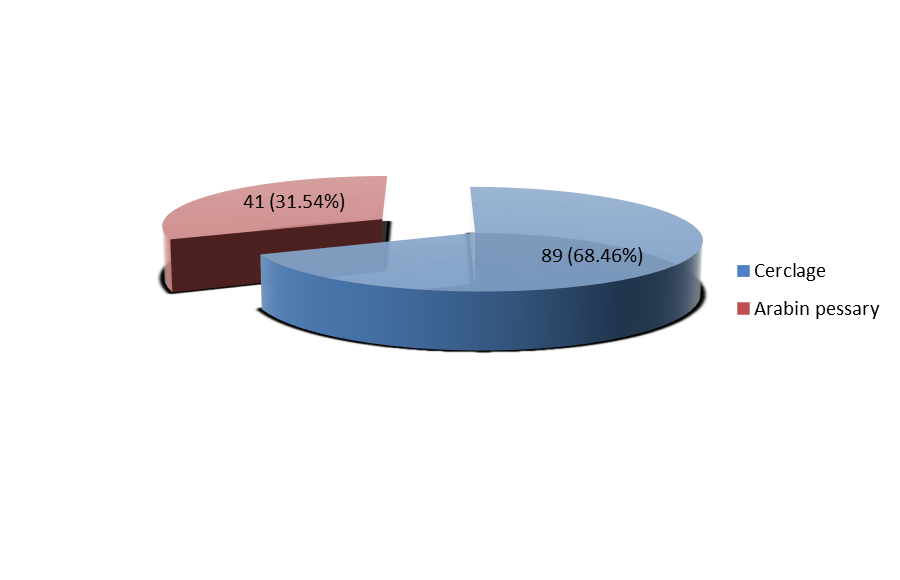
Figure I: Type of treatment (n=130).
Table II: Outcome of study participants
|
Outcome |
Frequency (%) |
|
|
yes |
no |
|
|
Preterm delivery |
38 (29.23%) |
92 (70.77%) |
|
Low birth weight babies |
15 (11.54%) |
115 (88.46%) |
|
Cesarean delivery |
33 (25.38%) |
97 (74.62%) |
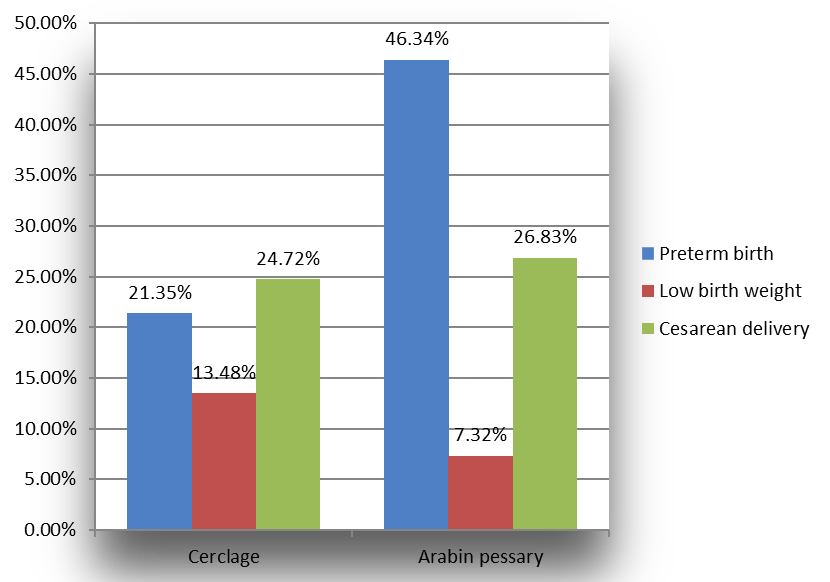
Figure II: Comparison of outcome between cerclage and arabin pessary (n=130).
DISCUSSION:
Clinical and laboratory evidence suggests that concentrating on the uterine cervix may provide strategies to identify patients at risk for preterm delivery and interventions to prevent it, despite reproductive biologists and clinicians having concentrated on detecting increased uterine contractility for decades. Individual meta-analyses have demonstrated that, in comparison to a placebo or conventional care, progesterone, cervical cerclage, and cervical pessary are all helpful in lowering PTB in women who are at risk.10,11
The purpose of this study was to examine the incidence of preterm births in singleton pregnancies with cervical insufficiency treated with cervical cerclage and Arabin Pessary, as well as to determine the frequency of patients undergoing both procedures. Of the participants in our study, 41 (31.54%) had the Arabin® pessary insertion and 89 (68.86%) had the cervical cerclage procedure. The results showed that 38 patients (29.23%) had preterm delivery, 15 patients (11.54%) had low birth weight babies, and 33 patients (25.38%) had cesarean delivery. With a statistically significant difference (p = 0.0036), the frequency of premature deliveries was determined to be 21.35% in the cervical cerclage group and 46.34% in the Arabin pessary group. Without a statistically significant difference, the rates of low birth weight and cesarean delivery were 13.48% and 24.72% in the cervical cerclage group and 7.32% and 26.83% in the Arabin pessary group. Out of 26 women, 18 had cervical cerclage surgery (18, or 69.2%), and 8 had Arabin® pessary placement (8, or 30.8%). According to Pizzicaroli et al. (2021), the frequency of preterm deliveries was 17% in the cervical cerclage group and 25% in the Arabin pessary group, with no statistically significant difference (p-value = 0.628).8 According to a study conducted in Greece by Tsikouras et al. (2018), 124 of the 166 women in the study (74%) had a pessary placement, whereas only 20 of them (12%) underwent cervical cerclage surgery. According to the study, there was a statistically significant decrease in preterm births before 33 weeks of pregnancy following Arabian pessary treatment (24.2%) as compared to cervical cerclage treatment (50%).9
Although the results were mixed, big RCTs conducted 10 years ago on pessary indicated that it might help women with twin pregnancies and a small cervix.12-14 Pessary did not adequately diminish PTB, according to recent trials conducted on women with short cervixes and singleton pregnancies.15 The results of a study showed that in the same high-risk group, cerclage may be more effective than pessary in preventing PTB and low birth weight babies. Therefore, cerclage appears to be the most successful intervention among these three suggested approaches, subject to confirmation in additional research.16
Our findings are supported by a recent study of women with singleton pregnancies with a CL ≤20 mm, which found that 13.1 percent of those randomly assigned to receive a pessary experienced fetal or neonatal/infant death, a secondary outcome, compared to 6.8% of those assigned to receive normal care.15 It should be mentioned that no prior reports of these results in twin pregnancies have been made. One explanation would be because the prior trials applied treatments at a later gestational age12,14,17 and/or employed a higher cut-off CL13,7,18 than our study. Participants with severe CL shortening discovered early in pregnancy whose mean gestational age at randomization was 21 weeks were recruited for the current trial. Furthermore, according to the most recent Cochrane review, many randomized trials had small sample sizes, and the quality of previous research reporting on cerclage was usually regarded as being between average and above average.19 Furthermore, the PTB rates in the pessary group in this investigation were identical to those in the earlier study.16 It is not stated that the damage inflicted by the pessary was the reason for the distinction between cerclage and pessary. However, further explanations for these results must be provided in the future.
The results of this study could alter women with a short CL's perception of cerclage. Since smaller RCTs indicated that cerclage might impair twins, it has long been rejected for this indication.20 In line with our results, a meta-analysis reported that women with a short cervix might gain advantages from cerclage.21 Our study found that cerclage lowered the PTB rate <28 weeks to 1%, however no RCT on prophylactic therapy has shown this impact.22,23
An open-label, multicenter randomized controlled experiment was carried out by Groussolles et al.24 to evaluate the effectiveness of the Arabin pessary in lowering unfavorable newborn outcomes in twin pregnancies with a short cervix. At 16–24 weeks of gestation, 315 twin pregnancies with cervical lengths less than 35 mm were recruited for the investigation and randomly assigned to either the standard care group or the pessary placement group. The study's findings demonstrated that the preterm birth rates in the two groups did not differ significantly (p=0.32). This suggests that in twin pregnancies with a short cervix, the Arabin cervical pessary had no discernible impact in lowering unfavorable newborn outcomes.24
Barinov et al.25 investigated the efficacy of progesterone-only treatment compared to progesterone plus cervical pessary. Two hundred seventeen women were participated in a randomized controlled trial (RCT). Patients were divided into two groups at random at weeks 18–20: group 1 continued to receive progesterone-only therapy, whereas group 2 had cervical pessary insertion. Placenta migration was evaluated by ultrasound exams and routine patient monitoring. The combination treatment led to a reduction in preterm deliveries, with rates of 8.6% and 23.5%, respectively, compared to progesterone-only treatment.25
The following are the study's shortcomings: (1) small sample size; (2) one-center study (at a single hospital); and (3) limited outcome measures. Although the study's main focus was preterm birth, it did not look at other important outcomes like cost-effectiveness or patient acceptance.
CONCLUSION:
In comparison to arabin pessary, this study found that cervical cerclage is more effective at preventing premature births in singleton pregnancies with cervical insufficiency. Therefore, in order to lower perinatal mortality and morbidity for both the mother and the fetus, we advise that cervical cerclage be utilized as the first line of treatment for women with singleton pregnancies who have cervical insufficiency
REFERENCES:
1. McDougall AR, Hastie R, Goldstein M, Tuttle A, Ammerdorffer A, Gülmezoglu AM, et al. New medicines for spontaneous preterm birth prevention and preterm labour management: landscape analysis of the medicine development pipeline. BMC Pregn Child. 2023;23(1):1-6.
2. Akello J, Namusoke F, Alia G, Mwaka S. Management of preterm birth using protocols in a low resource setting. Plos One. 2023;18(4):e0284894.
3. Chawanpaiboon S, Vogel JP, Moller AB, Lumbiganon P, Petzold M, Hogan D, et al. Global, regional, and national estimates of levels of preterm birth in 2014: a systematic review and modelling analysis. Lancet Global Health. 2019;7(1):e37-46.
4. Rahman RA, Adan IK, Ali A, Kalok AM, Ismail NA, Mahdy ZA, et al. Use of the Arabin pessary in women at high risk for preterm birth: long-term experience at a single tertiary center in Malaysia. BMC Pregn Child. 2021;21(1):1-7.
5. Dehaene I, Scheire E, Steen J, De Coen K, Decruyenaere J, Smets K, et al. Obstetrical characteristics and neonatal outcome according to aetiology of preterm birth: a cohort study. Arch Gynecol Obstet. 2020;30(2):861-71.
6. Sargsyan GS, Bespalova ON. Assessment of the risk of spontaneous preterm birth in pregnant women with the Arabin cervical pessary. J Obstet Women's Dis. 2022;71(2):49-60.
7. Pratcorona L, Goya M, Merced C, Rodó C, Llurba E, Higueras T, et al. Cervical pessary to reduce preterm birth< 34 weeks of gestation after an episode of preterm labor and a short cervix: a randomized controlled trial. Am J Obstet Gynecol. 2018;219(1):99-03.
8. Pizzicaroli C, Arciero V. Comparative assessment of Arabin pessary and cervical cerclage in the management of cervical insufficiency. Clin Exp Obstet Gynecol. 2021;48(5):1111-1116.
9. Tsikouras P, Anastasopoulos G, Maroulis V, Bothou A, Chalkidou A, Deuteraiou D, et al. Comparative evaluation of arabin pessary and cervical cerclage for the prevention of preterm labor in asymptomatic women with high risk factors. Int J Environ Res Public Health. 2018;15(4):791-96.
10. Perin J, Mulick A, Yeung D, Villavicencio F, Lopez G, Strong KL, et al. Global, regional, and national causes of under-5 mortality in 2000–19: an updated systematic analysis with implications for the Sustainable Development Goals. Lancet Child Adolesc Health. 2022;6(2):106–15.
11. He YTN, Pham HNH, Nguyen TC, Bui TQ, Vuong NT, Nguyen DTN, et al. Cervical cerclage versus cervical pessary with or without vaginal progesterone for preterm birth prevention in twin pregnancies and a short cervix: A two-by-two factorial randomised clinical trial. PLoS Med. 2025;22(2): e1004526.
12. Goya M, de la Calle M, Pratcorona L, Merced C, Rodo C, Munoz B, et al. Cervical pessary to prevent preterm birth in women with twin gestation and sonographic short cervix: a multicenter randomized controlled trial (PECEP-Twins). Am J Obstet Gynecol. 2016;214(2):145–52.
13. Liem S, Schuit E, Hegeman M, Bais J, de Boer K, Bloemenkamp K, et al. Cervical pessaries for prevention of preterm birth in women with a multiple pregnancy (ProTWIN): a multicentre, open-label randomised controlled trial. Lancet. 2013;382(9901):1341–9.
14. Nicolaides KH, Syngelaki A, Poon LC, de Paco Matallana C, Plasencia W, Molina FS, et al. Cervical pessary placement for prevention of preterm birth in unselected twin pregnancies: a randomized controlled trial. Am J Obstet Gynecol. 2016;214(1):3 e1–9.Hoffman MK, Clifton RG, Biggio JR, Saade GR, Ugwu LG, Longo M, et al. Cervical Pessary for Prevention of Preterm Birth in Individuals With a Short Cervix: The TOPS Randomized Clinical Trial. JAMA. 2023;330(4):340–8.
15. Dang VQ, Nguyen LK, Pham TD, He YTN, Vu KN, Phan MTN, et al. Pessary Compared With Vaginal Progesterone for the Prevention of Preterm Birth in Women With Twin Pregnancies and Cervical Length Less Than 38 mm: A Randomized Controlled Trial. Obstet Gynecol. 2019;133(3):459–67.
16. Berghella V, Dugoff L, Ludmir J. Prevention of preterm birth with pessary in twins (PoPPT): a randomized controlled trial. Ultrasound Obstet Gynecol. 2017;49(5):567–72.
17. Zhuang Y, Li H, Na Q, Yin S, Li N. Prevention of preterm birth by cervical pessary combined with vaginal progesterone: a systematic review and meta-analysis with trial sequential analysis. Reprod Sci. 2023;30:93-110.
18. Rafael TJ, Berghella V, Alfirevic Z. Cervical stitch (cerclage) for preventing preterm birth in multiple pregnancy. Cochrane Database Syst Rev. 2014;2014(9):CD009166.
19. Shennan A, Story L, Jacobsson B, Grobman WA, Birth FWGfP. FIGO good practice recommendations on cervical cerclage for prevention of preterm birth. Int J Gynaecol Obstet. 2021;155(1):19–22.
20. Liu Y, Chen M, Cao T, Zeng S, Chen R, Liu X. Cervical cerclage in twin pregnancies: An updated systematic review and meta-analysis. Eur J Obstet Gynecol Reprod Biol. 2021;260:137–49.
21. Norman JE, Norrie J, MacLennan G, Cooper D, Whyte S, Chowdhry S, et al. Evaluation of the Arabin cervical pessary for prevention of preterm birth in women with a twin pregnancy and short cervix (STOPPIT-2): An open-label randomised trial and updated meta-analysis. PLoS Med. 2021;18(3):e1003506. pmid:33780463
22. Brizot ML, Hernandez W, Liao AW, Bittar RE, Francisco RPV, Krebs VLJ, et al. Vaginal progesterone for the prevention of preterm birth in twin gestations: a randomized placebo-controlled double-blind study. Am J Obstet Gynecol. 2015;213(1):82 e1–e9.
23. Groussolles M, Winer N, Sentilhes L. Arabin pessary to prevent adverse perinatal outcomes in twin pregnancies with a short cervix: a multicenter randomized controlled trial (PESSARONE). Am J Obstet Gynecol. 2022, 227:271.e1-13.
Barinov SV, Shamina IV, Di Renzo GC. The role of cervical pessary and progesterone therapy in the phenomenon of placenta previa migration. J Matern Fetal Neonatal Med. 2020, 33:913-9