DEVELOPMENT AND VALIDATION OF MENTAL WELL-BEING SCALE FOR WORKING WOMEN: PILOT STUDY
- Seema Sharma , Ph D Scholar, Department of Clinical Psychology, Santosh Medical College & Hospital, SDTU, Ghaziabad-Delhi NCR.
- Dr. Rani Srivastava , Professor & Head, Department of Clinical Psychology, Santosh Medical College & Hospital, SDTU, Ghaziabad-Delhi NCR.
- Dr Uday K Sinha , Professor & Head, Department of Clinical Psychology, Institute of Human Behaviour and Allied Sciences (IHBAS), Delhi.
- Dr Niharika Arora , Assistant Professor, Department of Clinical Psychology, Santosh Medical College & Hospital, SDTU, Ghaziabad-Delhi NCR.
- Dr Vikash Singh Patel , Assistant Professor cum Statistician, Department of Community Medicine Santosh Medical College & Hospital, SDTU, Ghaziabad-Delhi NCR.
Article Information:
Abstract:
Background: Over the past decade, interest in the concept of mental well-being has increased along with the recognition of its impact on public health. The workplace is one of the environments that affect mental well-being and health. In the 21st century, there is no doubt about the attitude of society is changing positively towards women, especially- working women for taking care of their physical & mental health. As the mental well-being is an important part of overall health but still there is no such measures designed (especially for working women) which can measure the status of their mental well-being and give a chance to prevent it in advance. Aim and Objectives: This study aims to develop a reliable and valid scale for assessing the Mental Well-being of Working Women. Method: The procedure of Scale development was done in many phases, as phase I- Item development (Identification of Domain and Item Generation, content validity, and reliability), Phase II- Scale development (pilot study based on developed scale, N=60) and Phase III- Scale evaluation. Results: Results were calculated by using SPSS for Content validity, Reliability, Internal consistency, and Inter Item Correlation etc. of a developed scale for mental wellbeing of working women. Over all reliability was 0.92, it was greater than acceptable value (≥0.75) and content validity was S-CVI = 0.87, which is greater than acceptable value (≥0.78) but Inter-Item correlation (two tailed validity) was not found satisfactory (17 items were deleted out of 88). Conclusion: considering the suggestions and comments of the Expert panel, it was decided to review and modify the generated items and domains for a valid and reliable measure.
Keywords:
Article :
INTRODUCTION:
In the 21st century, there is no doubt about the attitude of society is changing positively towards women, especially- working women for taking care of their physical & mental health. Interest in human psychological well-being has been growing steadily within the health and social sciences (Ryff,1985), Mental well-being is an essential component of a fulfilling life, particularly for working women who navigate the challenges of professional responsibilities and personal obligations (Ryff & Keyes,1995). Over the past decade, interest in the concept of mental well-being has increased along with the recognition of its impact on public health (WHO, 2013). “Mental well-being can be described as a combination of how we feel (our emotions and life satisfaction) and how we function (relationships with others, personal control, purpose in life, and independence). It is something that affects everyone, old and young, and anyone can experience good or poor mental well-being.”
At the current scenario, the definition of a woman has evolved to reflect changing societal norms, attitudes, and advancements in gender. “Here a woman who carries a proper salaried job belonging to Pvt./Govt. whether it is a fourth-class employee/technical job/teaching or any academically oriented job/trained or untrained professional, irrespective of belonging to any socio-economic status but at least should be literate.” Women who worked outside the home are required to make many social readjustments that can contribute to stress, anxiety, and psychological well-being (Madhu & Anis, 2021). Women take up the myriad roles in the family and in workplace milieu and transcend boundaries and excel in various domains. The workplace is one of the environments that affect mental well-being and health (Harnois & Gabriel, 2000). Globally, there is growing focus on assessing people's well-being, including men, women, and children. However, a dedicated scale for measuring women's well-being has not received much attention (Ryan 2019 & Butler, 2016). Studies have shown that higher well-being leads to greater satisfaction, resulting in increased productivity, improved relationships, better performance (at work and home), and better physical health. We know well-being is a multidimensional concept which consist of multiple domains (Junça Silva, 2023), but there is no consensus on what dimensions the coverage of entire range of well-being exists.
“Scales are a manifestation of latent constructs; they measure behaviours, attitudes, and hypothetical scenarios we expect to exist as a result of our theoretical understanding of the world, but cannot assess directly” (DeVellis, 2012). Scales are typically used to capture a behaviour, a feeling, or an action that cannot be captured in a single variable or item. The use of multiple items to measure an underlying latent construct can additionally account for, and isolate, item-specific measurement error, which leads to more accurate research findings. Thousands of scales have been developed that can measure a range of social, psychological, and health behaviours and experiences.
As science advances and novel research questions are put forth, new scales become necessary. Scale development is not, however, an obvious or a straightforward endeavour. There are many steps to scale development, there is significant jargon within these techniques, the work can be costly and time consuming, and complex statistical analysis is often required. Further, many health and behavioural science degrees do not include training on scale development. Despite the availability of a large amount of technical literature on scale theory and development (Raykov T, 2011, Streiner DL, 2015, McCoach DB, 2013, Morgado FFR, 2018, Glanz K, 2015, Ajzen I., 1985,) There are three phases to creating a rigorous scale—item development, scale development, and scale evaluation (Hinkin,1995); these can be further broken down into nine steps.
Need of the study: Based on review of literature, it was found that the existing scales in the literature for mental well-being, not having the range of dimensions or domains which can assess the mental well-being of working women. When they are performing their responsibilities (at home and at workplace), most of the time they are unable to express themselves in front of the family, friends and at workplace because of social taboo, cultural delicacies, even lack of acceptance in the society regarding mental health, which makes them freeze to talk about their mental well-being and after a period of time there is a possibility of emotional disturbances, suppression of their caliber, changes in behavior etc., can negatively impact their mental well-being and may develop into a mental illness or disorder.
REVIEW OF LITERATURE
A review of literature helps to build-up the empirical base and conceptual understanding needed for developing a reliable and valid psychological scale. The mental well-being of working women has become an important topic in recent years because of rapid socio-economic changes, higher female participation in the workforce, changing family structures, and increasing workplace demands. Working women often carry both professional responsibilities and traditional household expectations. This combination makes their experiences unique and different from the general population. Review of literature was carried out under three broad themes: (i) Mental Well-being, (ii) Working Women, (iii) Scale Development and its validation.
The first formal conceptualization of mental wellbeing emerged at the First International Congress of Mental Health, held in London from August 16-21, 1948. J.C. Flugel, who served as the Chairman of this historic congress, proposed to define mental health as "a condition which permits the optimal development, physical, intellectual and emotional, of the individual, so far as this is compatible with that of other individuals." This was a pivotal moment that shifted international discourse from the narrower concept of "mental hygiene" to a more comprehensive understanding of mental health and wellbeing.
Dr. Sushila Nayar, a Gandhian physician and public health pioneer, played a foundational role in establishing a holistic health framework during India's post-independence period. Though her work predated the formal terminology of "mental wellbeing," she was instrumental in integrating mental health into India's broader public health agenda. Under her leadership as part of the Mudaliar Committee in the 1960s, a comprehensive plan for district mental health units, school mental health programs, and mental health education at the community level was developed. Her philosophy emphasized the integration of preventive care, community involvement, and mental health as an inseparable component of overall wellbeing.
International research on mental wellbeing scales for working women emphasizes multidimensional frameworks capturing occupational stressors alongside psychological resilience, often through rigorous psychometric development tailored to employed females. Ryff's Scales of Psychological Well-Being (PWB, 1989/2006) have been extensively validated for working populations, with Abbott et al. (2006). Indian scholarship reveals nuanced patterns in working women's mental wellbeing, predominantly using adapted international scales while exposing gaps in indigenous instrumentation tailored to cultural-professional stressors.
Existing Mental Health and Well-Being Scales: Several standardized scales exist, such as: (i) Ryff’s Psychological Well-Being Scale (1989), (ii) Warwick–Edinburgh Mental Well-Being Scale (Tennant et al., 2007), (iii) WHO-5 Well-Being Index. However, Indian researchers (Sharma & Kapur, 2021; Saroj, 2025) note that these scales are: (i) Not gender-specific, (ii) Do not adequately capture Indian socio-cultural realities, (iii) Fail to address work–family dynamics unique to working women. Most Indian studies rely on adapted or generalized scales rather than context-specific, validated scales. Considering the Gaps in Existing Literature, it is needed to develop a scale for the mental wellbeing of working women.
Aim and objective of this study aims to develop a Valid and Reliable scale, in order to assess the mental well-being of working women in the Indian scenario.
MATERIAL AND METHOD:
The Cross-Sectional study design was used for the proposed study. Sample (N=60) was selected using purposive sampling as: Working Women in different professions (Group A- Technical & Non-teaching working women), Group B- Teaching professionals (school, college, university), Group C- Higher Professionals (Doctors, Engineers (CT/IT), Management, Judiciary, Administration, Miscellaneous). Inclusion Criteria: Working women who gave consent, Working women across various professions, Age 20 years – 64 years. Exclusion Criteria: Working women who was already diagnosed/under treatment for mental illness/disorder, who did not give consent. Place of Study: Since the study was conducted under the Department of Clinical Psychology, Santosh Medical College and Hospital, Santosh Deemed to be University, Ghaziabad (Delhi NCR).
METHODOLOGY
The entire process of scale development has been carried out in three phases, as: Phase 1- Item development: Step (1) Identification of Domain and Item Generation Step, (2) Consideration of content validity and face validity, Step (3) Consideration of test-retest reliability. Phase 2- Scale development: Step (4) Pre-testing questions/pilot study Step (5) Sampling & administration. Phase -3 Scale evaluation: Step (6) Test reliability, Step (7) Test validity.
Measures: 1. Consent Form, 2. Personal Information Sheet & Brief Clinical assessment Proforma. 3. A newly developed Scale for Mental Well-being of Working Women. Instructions: Here instructions mean, subjects instructed to rate their responses on 5-points rating scales, so that refinement in the answering can be judged. Instructions are: “Listed below are several items that indicate your mental well-being at present. Each item has five (5) options: “1” = Never, “2” = Seldom, “3” = Occasionally, “4” = Frequently, “5” = Always. Please tick mark the option which is applied to you. There is no right or wrong answer.” Time: This is a self-rating scale. It takes 20-30 minutes to respond for all 88 items but this time can be increased or decreased as per individual’s responsivity style of the participants. Administration: This scale was administered in groups or individually depending upon the availability of the concern subject. Scoring: As per the rating responses of the participant, scores were given from “1” – “5” as rating code. Interpretation: Total scores on the scale were interpretated for the status of mental well-being. High score means good mental wellbeing and low score means poor mental wellbeing.
Procedure: Phase 1- Item development: This phase of item development was initiated by following three steps: Step (1) Identification of domain and item generation with the help of (i) existing literature and (ii) focused group discussions including semi-structured interviews with working women from different professions, age group, and cultural backgrounds to understand their real-life experiences. Following an extensive review of literature and insights gathered through focused group discussions, the process of item generation was undertaken. At the item-generation stage, the initial pool consisted of 200 statements arranged in pairs. Each paired item was carefully reframed, resulting in a refined set of 100 unique items. these items were further reviewed, and non-sensitive items were excluded. Ultimately, 88 items (out of 100 Items) were identified as both sensitive and conceptually appropriate. These 88 items were then categorized into eleven domains as: (1) Feeling Healthy (2) Facing life with bold and positive attitude (3) Bodily (Vegetative) symptoms (4) Own ability testing changing (5) Mood and Emotions (6) Self-punitive / Personal harm (7) My priorities (8) My confidence (9) Social awareness (10) Feeling of fear (known/unknown) (11) Feeling worthless. Each ‘Domain’ comprised ‘8’ Items, representing different facets of mental well-being among working women. (iii) Experts’ Input: Experts’ input was taken from selected ten experts (five Clinical Psychologist and five Psychiatrists).
Step (2) Consideration of Content and face Validity: (i) Content Validity: During this exercise we went for experts’ judgement (five Clinical Psychologist and five Psychiatrist) to collect the relevance of each item related to all the domains and we concentrated on “4” important point in relation to relevance like: 1 = The item is not relevant to the measured domain. 2 = The item is somewhat relevant to the measured domain. 3 = The item is quite relevant to the measured domain. 4 = The item is highly relevant to the measured domain. So, based on “4” point rating scale, the relevance response of ten (10) experts, I-CVI, S-CVI and S-CVR (Item – Content Validity Index, Scale - Content Validity Index and Scale- Content Validity Ratio) was calculated by using statistical Analysis. For CVI Calculation the following steps were taken: (1) Preparing content validation form, (2) Selecting a review panel of experts (3) Conducting content validation (4) Providing score on each item (5) Calculating CVI. Formula: I-CVI (Item-level) = (Number of experts rating 3 or 4) / (Total experts). Acceptance Criteria: (i) I-CVI > 0.79: Acceptable, (ii) I-CVI b/w 0.70-0.79: Needs revision, (iii) I-CVI < 0.70: Consider elimination. Scale-level CVI (S-CVI): Average of all I-CVI scores. Acceptance Criteria: (i) S-CVI > 0.79: Acceptable, (ii) S-CVI b/w 0.70-0.79: Needs revision, (iii) S-CVI < 0.70: Consider elimination. Calculated content validity results are, I-CVI = 0.80 and S-CVI= 0.87, which is greater than acceptable value (0.79) of content validity. Two items were excluded due to less than acceptable value. Face Validity (Evaluation by target population) Face validity testing was done by Conducting individual interviews and discussions with focused group to assess mental well-being, whether they found the scale's items: (1) Clarity: Are the items easy to understand? Do respondents interpret the question the way it is intended? (2) Relevance: Does each question truly measure the construct/dimension of scale (e.g., Health Contentment of working women)? (3) Wording issues: Are any questions confusing, double-barrelled, too long, or culturally inappropriate? (4) Response format: Do people understand the Likert scale or response choices? (5) Time taken: Does the scale take too long time to complete/rate the response?
Step (3) Consideration of Test-retest Reliability: Retest was conducted of one month interval and test-retest reliability were calculated with the help of statistics analysis, the value of test-retest reliability was 0.85 and it was greater than acceptable value (0.75).
Phase 2- Scale development: Step (4) Pre-testing questions/ ‘Pilot Study-I’: The developed scale (11 domains with 86 items) was administered on sample size of 60 working women in Delhi NCR and Uttar Pradesh from different age group and different profession. Result was calculated by SPSS.
RESULTS:
The result on experts’ judgement for content validity, “2” items (Q 65 and Q 87 out of 88 Items) were excluded due to low relevance of items (0.4) and “7” items were suggested to modify (Q12, Q45, Q63, Q67, Q69, Q75, Q77, Q87,). All over result of content validity refer to table -1, figure-1.
Table 1: Content validity
|
Content validity |
CVI Value |
Acceptable Value |
|
I-CVI |
0.80 |
≥ 0.79 |
|
S-CVI |
0.87 |
≥ 0.79 |
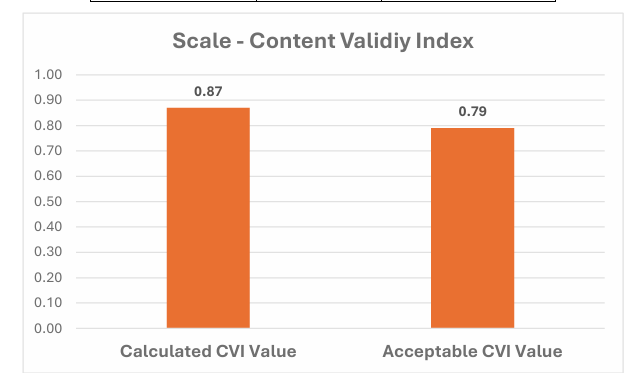
Figure-1 Content validity
Result of test-retest reliability was 0.85 and it was greater than acceptable value (0.75), table-2 and figure-2 as below:
Table 2: Test-retest Reliability
|
Types of Reliability |
Calculated Value |
Accepted Value
|
|
Test-retest Reliability (one month interval)
|
0.85 |
≥0.75
|
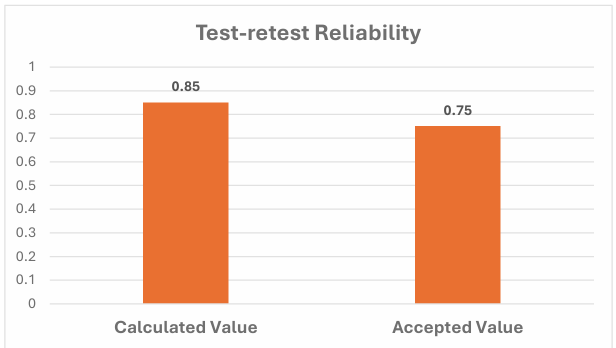
Figure 2: Test-retest Reliability
Cronbach’s Alpha Reliability (N=60) refers table-3, Figure-3 as follows:
Table 3: Cronbach's Alpha Reliability (N=60)
|
Types of Reliability |
Calculated Value |
Accepted Value
|
|
Cronbach’s Alpha
|
0.92 |
≥0.75
|
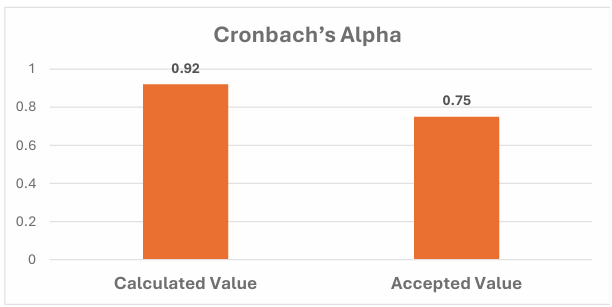
Figure 3: Cronbach's Alpha Reliability (N=60)
Pearson (r) Inter Item Correlation: It was calculated by SPSS (N=60) and 15 items (items- Q9, Q21, Q22, Q26, Q31, Q32, Q33, Q35, Q38, Q39, Q48, Q54, Q65, Q75, Q76, out of 86 Items) were found ‘invalid’. Total valid items were only 71 for use of this newly developed scale. Table – 4 is the result of valid and invalid items.
Table-4: Inter-Item Correlation (r):
|
Items |
Correlation |
Items |
Correlation |
|
1 |
.428** |
44 |
.551** |
|
2 |
.497** |
45 |
.263* |
|
3 |
.419** |
46 |
.374** |
|
4 |
.276* |
47 |
.512** |
|
5 |
.459** |
48 |
0.228 |
|
6 |
.387** |
49 |
.285* |
|
7 |
.562** |
50 |
.402** |
|
8 |
.431** |
51 |
.409** |
|
9 |
0.226 |
52 |
.339** |
|
10 |
.537** |
53 |
.435** |
|
11 |
.307* |
54 |
0.193 |
|
12 |
.454** |
55 |
.428** |
|
13 |
.512** |
56 |
.292* |
|
14 |
.322* |
57 |
.558** |
|
15 |
.328* |
58 |
.443** |
|
16 |
.489** |
59 |
.479** |
|
17 |
.538** |
60 |
.498** |
|
18 |
.459** |
61 |
.431** |
|
19 |
.461** |
62 |
.441** |
|
20 |
.463** |
63 |
.529** |
|
21 |
0.236 |
64 |
.539** |
|
22 |
0.186 |
65 |
0.166 |
|
23 |
.479** |
66 |
.326* |
|
24 |
.525** |
67 |
.421** |
|
25 |
.428** |
68 |
.414** |
|
26 |
0.253 |
69 |
.280* |
|
27 |
.419** |
70 |
.311* |
|
28 |
.312* |
71 |
.548** |
|
29 |
.322* |
72 |
.522** |
|
30 |
.263* |
73 |
.340** |
|
31 |
0.157 |
74 |
.390** |
|
32 |
0.011 |
75 |
0.182 |
|
33 |
0.047 |
76 |
0.202 |
|
34 |
.463** |
77 |
.611** |
|
35 |
0.212 |
78 |
.430** |
|
36 |
.524** |
79 |
.416** |
|
37 |
.463** |
80 |
.480** |
|
38 |
0.201 |
81 |
.426** |
|
39 |
0.203 |
82 |
.499** |
|
40 |
.465** |
83 |
.519** |
|
41 |
.443** |
84 |
.678** |
|
42 |
.502** |
85 |
.429** |
|
43 |
.364** |
86 |
.333** |
CONCLUSION:
The result of the entire exercise is a newly developed scale with 71 items (and 11 domains) and established reliability and validity. All over reliability is 0.92 which is an excellent but validity (Inter item correction) was not found satisfactory (deleted 17 items out of 88). So, considering the suggestions and comments of the Experts’ panel, it was decided to review and modify the generated Items and domains. So, therefore ‘Pilot Study modified’ is in progress to develop a standardize scale for Mental Well-being of Working Women.
REFERENCES:
1. Ryff, C.D. (1985) Adult Personality Development and the Motivation for Personal Growth. In: Kleiber, D. and Maher, M., Eds., Advances in Motivation and Achievement: Motivation and Adulthood, Vol. 4, JAI Press, Greenwich, 55-92.
2. Ryff, C. D., & Keyes, C. L. (1995). The structure of psychological well-being revisited. Journal of Personality and Social Psychology, 69(4), 719-727.
3. World Health Organization (2013).
4. Priya, M., & Ahmad, A. (2021). A study of subjective well-being among housewives and working women of Khagaria District, North Bihar, India. EAS Journal of Psychology and Behavioural Sciences, 3(5), 80-85. https://doi.org/10.36349/easjpbs.2021.v03i05.001
5. Harnois, G., Gabreiel, P., & World Health Organization (2000). Mental health and work: impact, issues and good practice, Geneva. WHO.
6. Ryan J, et al. Psychometric properties of the PERMA Profiler for measuring wellbeing in Australian adults. Plos One. 2019;14(12): e0225932.
7. Butler J, Kern ML. The PERMA-Profiler: A brief multidimensional measure of flourishing. International Journal of Wellbeing. 2016;6(3):148. https://doi.org/10.5502/ijw.v6i3.526.
8. Junça Silva A, Dias R. The role of financial status attitudes behaviours and knowledge for overall well-being in Portugal: the mediating role of financial well-being. Int J Organ Anal. 2023;1(7):3668–85.
9. DeVellis RF. Scale Development: Theory and Application. Los Angeles, CA: Sage Publications (2012).
10. Raykov T, Marcoulides GA. Introduction to Psychometric Theory. New York, NY: Routledge, Taylor & Francis Group (2011).
11. Streiner DL, Norman GR, Cairney J. Health Measurement Scales: A Practical Guide to Their Development and Use. Oxford University Press (2015).
12. McCoach DB, Gable RK, Madura, JP. Instrument Development in the Affective Domain. School and Corporate Applications, 3rd Edn. New York, NY: Springer (2013).
13. Morgado FFR, Meireles JFF, Neves CM, Amaral ACS, Ferreira MEC. Scale development: ten main limitations and recommendations to improve future research practices. Psicol Reflex E Crítica (2018) 30:3. doi: 10.1186/s41155-016-0057-1
14. Glanz K, Rimer BK, Viswanath K. Health Behaviour: Theory, Research, and Practice. San Francisco, CA: John Wiley & Sons, Inc (2015).
15. Ajzen I. From intentions to actions: a theory of planned behaviour. In: Action Control SSSP Springer Series in Social Psychology Berlin; Heidelberg: Springer, (1985). p. 11–39.
16. Hinkin TR. A review of scale development practices in the study of organizations. J Manag. (1995) 21:967–88. doi: 10.1016/0149- 2063(95)90050-0
17. Boateng GO, Collins SM, Mbullo P, Wekesa P, Onono M, Neilands T, et al. A novel household water insecurity scale: procedures and psychometric analysis among postpartum women in western Kenya. PloS ONE. (2018). doi: 10.1371/journal.pone.0198591
18. Beatty PC, Willis GB. Research synthesis: the practice of cognitive interviewing. Public Opin Q. (2007) 71:287–311. doi: 10.1093/poq/nfm006
19. Alaimo K, Olson CM, Frongillo EA. Importance of cognitive testing for survey items: an example from food security questionnaires. J Nutr Educ. (1999) 31:269–75. doi: 10.1016/S0022-3182(99)70463-2