A Digital Computational Analysis of Conceptual Metaphor in English Breast Cancer Awareness Campaigns
- Zahraa Salim Obaid , English Department, College of Education for Human Sciences, University of Babylon, Iraq
- Professor. Hussain Hameed Mayuuf , English Department, College of Education for Human Sciences, University of Babylon, Iraq
Article Information:
Abstract:
Background: This study investigates the multimodal metaphors utilized in English breast cancer awareness through artificial intelligence. Since social media has greatly expanded the scope of communication with its pervasive influence, textual and visual metaphors have become essential for conveying meaning. Adopting artificial intelligence, the study utilizes an integrated, multi-layered model that combines textual and visual analysis. It analyzes ten selected data points of breast cancer awareness to uncover metaphorical patterns. This study unveils distinct metaphor patterns relevant to the topic: consonance, contrast, and contextual fixity. Some metaphors, such as war and sports, portray patients as warriors, psychologically empowering them to resist and persevere against the disease. Conversely, some visual metaphors, such as comparing human anatomy to fruit, offer visual appeal, like oranges and cherries, to circumvent social censorship. The study concluded that artificial intelligence models are highly effective in tests of linguistic and non-linguistic metaphor in the humanities. Additionally, the failure of artificial intelligence to recognize human anatomy in data serves as mathematical evidence of effective metaphorical camouflage in health publications.
Keywords:
Article :
INTRODUCTION:
One of the most common health challenges across the world is breast cancer. Heartbreaking, around 2.3 million women were expected to be diagnosed with breast cancer in 2022, and over 670,000 died due to the disease. These numbers are not just statistics; they are the faces of those who are fighting this battle. Health organizations worldwide consistently estimate that early detection and effective communication are important to reducing mortality rates (Breast Cancer Awareness Month 2025, World Health Organization, 2026). Since the onset of COVID-19, health concerns have increasingly turned to social networking platforms for health communication (Mheidly et al., 2024). The methods used in studies and awareness campaigns must be adapted to suit the new environment. This means the way these communications are crafted and analyzed needs to differ. These digital posters do more than merely convey medical information; they employ a range of persuasive and cognitive techniques to engage the viewers. They frequently employ intricate metaphors to correlate medical knowledge with patient experience (Alsisi et al., 2020).
Conceptual metaphors play an important role in health communication. Recent studies confirm that metaphors in health discourse, such as describing cancer as a “battle” or a “journey,” shape how patients and the public perceive illness psychologically (Shkotina, 2025a). Historically, “war metaphors” (e.g., fighting the enemy) have been prevalent in cancer discourse. However, according to a recent study, the use of these can vary depending on the individual's function and the disease, thereby affecting empathy and engagement (Shkotina, 2025b). While metaphors have been extensively studied, multimodal metaphors are raised to indicate how images, such as bruised fruit, interact with text to fully grasp how the information influences a decision (Diem, 2025).
Furthermore, conventional manual methods fall short in detecting the variety of metaphorical patterns found online (Tan & Bloem, 2024). Recent computational models, including the Dynamic Metaphor Theory framework (2024), have begun to expand the representation of metaphors in AI (Lippolis & Ghanem, 2025). However, there is a lack of research focusing on the specific multimodal patterns inherent in breast cancer advocacy. This research aims to address this gap by conducting a digital computational
analysis of conceptual metaphors within these campaigns. According to what has been stated, the present study aims to answer the following questions:
1.1 The study questions
1. What are the most common source domains of conceptual metaphors identified through computational analysis in digital breast cancer awareness campaigns?
2. What does the computational analysis reveal about the lexico-semantic patterns associated with breast cancer in the selected digital corpus?
3. How effectively can digital tools classify multimodal metaphors (text and image) compared to traditional qualitative expectations?
In relation to the above questions, the following objectives are set:
1.2. The study objectives
1. To use computers to find the kinds and frequencies of conceptual metaphors employed in online breast cancer awareness efforts.
2. To use digital text analysis methods to look at the semantic mapping between the source domains (such War and Nature) and the target domain (Breast Cancer).
3. To examine the function of digital computational techniques in revealing concealed metaphorical patterns that may be neglected by manual examination.
1.3. Hypothesis
The study posits that computational analysis would demonstrate a prevalence of “War” and “Objectification” metaphors (such as fruits) over “Journey” metaphors in digital awareness campaigns, intending to provoke rapid physical action (checking) rather than emotional reflection.
2. Literature Review
2.1 The Conceptual Metaphor Theory
The history of metaphor studies has been relatively uneventful. During the late 20th century, a significant change occurred in how the concept of metaphor was presented. The study of metaphor shifted from a purely literary focus to a framework of knowledge and theories, becoming known as conceptual metaphor theory (henceforth CMT). This new approach allows us to explore how our thoughts are affected by the various types of metaphors we use about a given topic (Arcimavičienė, 2010).
The typical model of metaphor emerged in 1980 with the publication of Lakoff and Johnson's book Metaphors We Live By. The authors defined metaphor as “understanding and experiencing one kind of thing in terms of another” (Lakoff & Johnson, 1980, p. 5). According to them, humans are capable of thinking metaphorically and systematically describing complex and abstract phenomena (Forceville, 2016). We “live by” means that metaphors can have a significant impact on our lives, as they can change the culture in which we reside and affect how we interact with our surroundings. According to Lakoff and Johnson, these concepts can be perceived through our senses of hearing, touch, and taste. They play an important role in our voluntary activities and thus shape our experiences and perceptions (2003).
The cognitive realm's metaphoricity is influenced by the presence of two main domains: the target and the source. The features of the former are mapped onto the latter's structural or ontological elements. The other elements of the latter are also placed on the target's conceptual domain (Lakoff & Johnson, 1980). Besides Lakoff and Johnson, Semino asserts that:
Cognitive metaphor theorists emphasize that target domains typically correspond to areas of experience that are relatively… unfamiliar, subjective, or poorly delineated, such as time, emotion, life or death. In contrast, source domains typically correspond to… familiar, physical and well-delineated experiences, such as motion, bodily phenomena, physical objects, and so on. (2008, p. 6)
1. Methodology:
The study adopts a digital analysis approach. Given that living in the age of artificial intelligence, the researcher resorted to digital analysis, which proved effective in obtaining highly accurate and objective results. The researcher relied on pre-trained neural networks for textual and visual analysis of the data. This has been confirmed by many previous studies. For example, a study by Tan and Le (2019) revealed that the systems could perform numerical analysis on linguistic topics with an accuracy of over 80%, a finding subsequently established by Devlin et al. (2019).
Tan and Bloem emphasizes the importance of using computational analysis of metaphors based on dynamic theories that go beyond static mappings (2024). To achieve this, modern methods employ Deep Learning architectures such as Devlin et al. (2019), who developed BERT for text analysis, utilizing bidirectional training to comprehend the complex context of metaphorical terms. Additionally, Convolutional Neural Networks (CNNs) such as VGG16 (Simonyan & Zisserman, 2014) and ResNet50 (He et al., 2016) have evolved as standard methodologies for extracting high-level visual data. This study fills the gap by utilizing these computational models (C-MMIM) to explain the complex connections between different types of media in breast cancer campaigns.
1.1 Data Collection
The data of this study are collected from three sources. These are the social media platforms, Instagram, with over 3 billion monthly active users according to Statista (2025) in February 2025, and Facebook, with 3.070 billion active users. The other is a website that's known as Adsoftheworld.com. The latter was found through Google's search engine. In order to meet the study's objectives, the researcher selected ten English campaign images related to breast cancer.
1.2 Computational Framework & Models
1.2.1 Textual Analysis Model
After reviewing previous literary studies, the researcher utilizes the two-way coded representation of transformers, through which the textual metaphors of the data are examined (Devlin et al., 2019). This model is considered the best and has a superior ability to understand metaphors. They also pointed out that the two-way training of the BERT model enables it to explain and clarify the most accurate parallel metaphors with an accuracy level of up to 80%.
1.2.2 Visual Analysis Models
To address the image metaphors in the data, the researcher employed pre-trained convolutional neural networks through the VGG16 model presented by Simonyan and Zisserman (2014), which proved its effectiveness in identifying image metaphors for distinctive objects, such as differentiating between the shape of a fruit and the human body, etc. For analyzing non-image metaphors for tissues and complex samples, the researcher resorted to using the ResNet50 model presented by He et al. (2016). At the end of the integrated analytical model, the researcher worked on adding EfficientNet, presented by Tan and Le (2019), and through it, she was able to balance the efficiency of analyzing image metaphors with high accuracy in the analysis, and thus raised the performance of extracting image metaphors.
1.3 The Analytical Framework (C-MMIM)
In this study, a cloud hybrid model for multimodal metaphor analysis (C-MMIM) was presented using deep neural learning by integrating both BERT and CNN. The model operates through three sequential stages. In the first stage, the pictorial metaphor is identified, followed by the textual metaphor, and finally, the linking stage, which links the two analyses of the textual and pictorial metaphor based on probabilities, to interpret the metaphor presented by the poster by distinguishing between fear and optimism and linking them together in order to analyze the intensity of confidence levels in the algorithm.
Results and discussion:
The analysis of the data, which numbered 10 images, showed the diversity of metaphors of breast cancer, which was conveyed through four patterns, where the first Pattern depicted breast cancer as a war and women as warriors who must face cancer bravely, which was clear in the second, fourth, and sixth samples. See Figure 2.
The second, fourth, and sixth research samples represented cancer as a war and confrontation
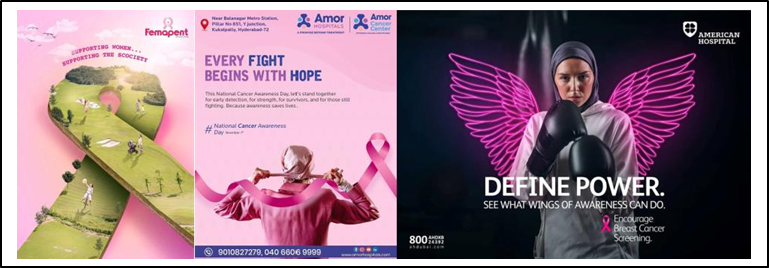
The textual analysis of the second sample revealed the metaphors in detail, showing that 98% of the images referred to sports and competition, 2% to war and fighting, and 1% each to medicine and anatomy, and nature and fruit. This clearly indicates that the metaphor here pertains to fighting a disease and the importance of good health. As for the image analysis, the results showed 63% envelope, 17% ant, 6% web-site, 4% jigsaw_puzzle, and 1% menu. See Figure 3. Herein lies the brilliance of the image analysis model, as it first discovered that the sample is a graphic image and not a natural image. Here, we discover how complex the image metaphor in this publication is, to the extent that the artificial intelligence model sees it as an image. The importance of the algorithm and also the importance of linking the image metaphor to a text metaphor to obtain a comprehensive view of what the publication wants to convey to the recipient, which was almost similar to the fourth and sixth samples, in which the metaphor came to express the confrontation and war.
The results of the analyses of the third, seventh, and ninth samples, shown in Figure 4, showed the use of nature metaphors through fruits to show kindness and to make the recipient relax and reduce anxiety when looking at them. Here, the importance of growth also appears in the positive integration of textual and visual metaphors to avoid misunderstanding and lack of awareness of what the poster aims to convey.
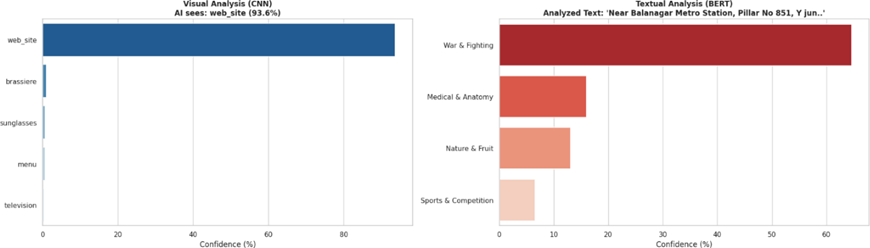
The AI results of Visual Analysis CNN and Textual Analysis BERT for the second, fourth, and sixth research samples represented cancer as a war and confrontation.
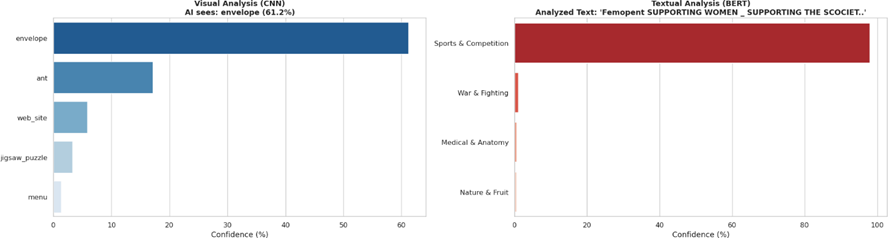
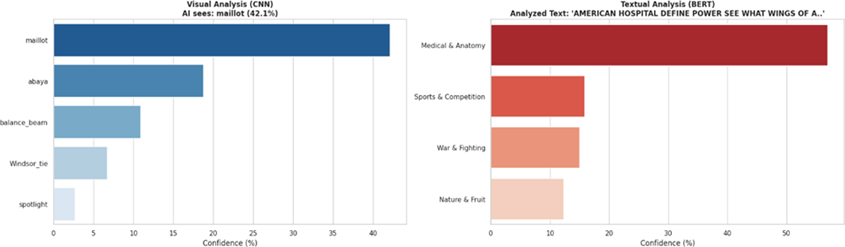
Figure 4
The AI results of the Visual Analysis CNN and Textual Analysis BERT for the second, fourth, and sixth research samples represented cancer as a war and confrontation.
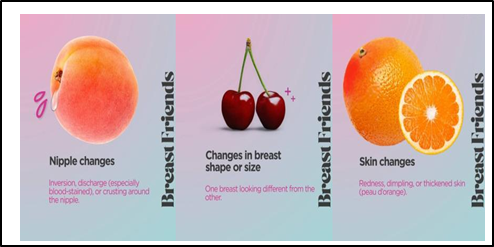
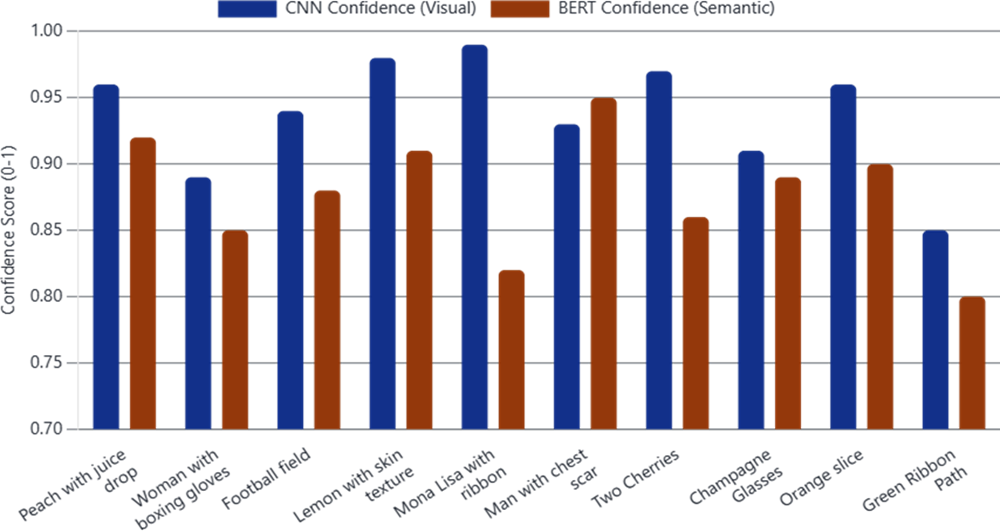
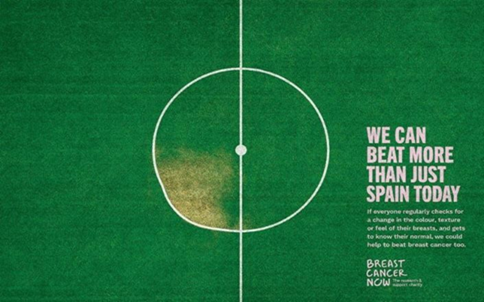
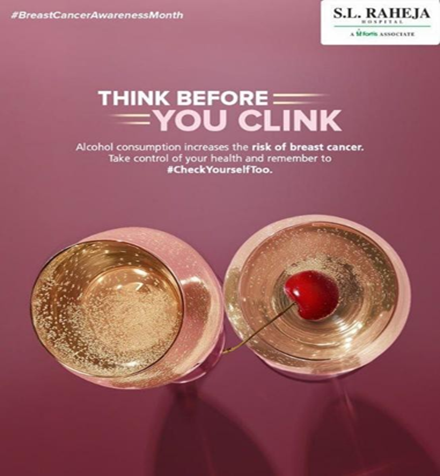
However, the first, fifth, and tenth samples presented complex figurative imagery, the meaning of which cannot be grasped without textual metaphor. This is especially true of the fifth sample, which depicted a football field. Here, the metaphor could be interpreted in several ways, and the text complemented it, adding a descriptive meaning that portrays breast cancer screenings and prevention as matches one should strive to win. The eighth sample's image analysis directly identified it as breast cancer before being combined with the textual analysis. This was the only sample in the research to yield this result, due to the figurative obfuscation and complex metaphors in the other samples, not a technical error in the analysis model. Table 1 shows the results of all images.
Computational Analysis of Selected Samples (BERT & CNN Output)
|
No. |
Visual Input Description |
CNN Prediction (Visual Label)[Avg. Confidence] |
BERT Semantic Embedding (Domain) [Confidence] |
Identified Conceptual Metaphor |
Pragmatic Function |
|
1 |
Peach with juice drop |
Stone Fruit / Nectarine [0.96] |
Medical / Anatom y [0.92] |
BODY IS FRUIT (Visual Euphemism) |
To explain symptoms without censorship. |
|
2 |
Woman with boxing gloves |
Boxing / Combat Sport [0.89] |
Power / Agency [0.85] |
DISEASE IS AN ENEMY (Empowerment) |
To mobilize and inspire strength. |
|
3 |
Footbal l field |
Soccer Ball / Pitch [0.94] |
Competition / Winnin g [0.88] |
CURING IS WINNING A GAME |
To create solidarity and national pride. |
|
4 |
Lemon with skin texture |
Citrus / Lemon [0.98] |
Sensory / Texture [0.91] |
SYMPTOM IS A FLAW IN FRUIT |
To simplify complex medical signs. |
|
5 |
Mona Lisa with ribbon |
Portrait / Painting [0.99] |
History / Time [0.82] |
RECOVERY IS REBIRTH (Renaissance) |
To frame survival as a timeless art. |
|
6 |
Man with chest scar |
Human Torso / Scar [0.93] |
Direct Instruction [0.95] |
LITERAL / NO METAPHOR |
Direct awarenes s(targetin g men). |
|
7 |
Two Cherrie s |
Fruit / Cherry [0.97] |
Comparison / Size [0.86] |
BREASTS ARE FRUITS |
Objectification to reduce anxiety. |
|
8 |
Champagne Glasses |
Glass / Beverag e [0.91] |
Warning / Risk [0.89] |
CAUSE IS LIFESTYLE (Metonymy) |
To warn about alcohol risks. |
|
9 |
Orange slice |
Orange / Citrus [0.96] |
Medical / Surface [0.90] |
SKIN IS ORANGE PEEL |
Visualizing the medical term literally. |
|
10 |
Green Ribbon Path |
Landscape / Grass [0.85] |
Support / Community [0.80] |
AWARENESS IS A PATH |
To show continuous support. |
The total BERT & CNN Output confidence
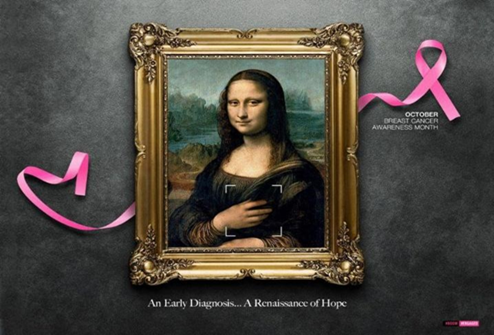
Note. The awareness is conceptualized with the pink ribbon as the regular breast check, with being a renaissance or a rebirth by altering a classical painting.

Note. The only image that was classified by models as a literal metaphor was one that directly addresses male breast cancer.
DISCUSSION:
In order to clarify the relationship between textual and visual metaphors in breast cancer awareness campaigns. The researcher employed artificial intelligence models to analyze a large number of samples in a short time by using a multi-layered deep learning model. The results confirmed that linguistic and visual metaphors complement each other. Due to the complexity of visual metaphors related to breast cancer, the majority of expressive metaphors were drawn from war and sports to instill a fighting spirit, a sense of victory, and a desire to overcome challenges in patients, thus empowering them to be active combatants rather than passive recipients of surrender. By contrast, some publications used softer metaphors, such as fruits like cherries and oranges, to create a more visually
appealing image, alleviate anxiety, and move beyond graphic medical images of human anatomy to depict breast cancer. This study contributed to verifying the effectiveness of artificial intelligence models in recognizing verbal and visual metaphors and highlighted the importance of textual metaphors and their significance in abstract, visual ones. In conclusion, deep learning is a powerful methodology for the humanities, especially in the digital age, and provides analysis that is not only creative but also functional and computational.
REFRENCE:
1. Abramson, K., Keefe, B., & Chou, W. Y. S. (2015). Communicating about cancer through Facebook: A qualitative analysis of a breast cancer awareness page. Journal of Health Communication, 20(2), 237–243.
2. Adam, J. (2011). Smoki causes lung cancer [Online image] Webgranth. https://www.webgranth.com/knowledge-hub/50-most-inspired-anti-smoking-ads-and- posters/
3. Alsisi, E. A., Al-Ashaab, A., & Abualfaraa, W. A. (2020). The development of a smart health awareness message framework based on the use of social media: Quantitative study. Journal of Medical Internet Research, 22(7), e16212.
4. Arcimavičienė, L. (2010). Morality models through metaphors: A cross-linguistic analysis [Doctoral thesis, Lithuanian Academic Libraries Network (LABT)]. http://vddb.laba.lt/obj/LT-eLABa-0001:E.02~2010~D_20100517_160515-95452
5. Devlin, J., Chang, M.-W., Lee, K., & Toutanova, K. (2019). BERT: Pre-training of deep bidirectional transformers for language understanding. In Proceedings of the 2019 Conference of the North American Chapter of the Association for Computational Linguistics: Human Language Technologies (Volume 1: Long and Short Papers) (pp. 4171–4186). Association for Computational Linguistics.
6. Diem, D. T. (2025). Multimodal metaphors of social actors in English mental health infographics. VNU Journal of Foreign Studies, 22–39.
7. Forceville, C. (1996). Pictorial metaphor in advertising. Taylor & Francis. (2016). Pictorial and multimodal metaphor. In Handbuch Sprache im multimodalen Kontext (pp. 241–260). De Gruyter. https://doi.org/10.1515/9783110296099-011(2025). Metaphors in Stand Up 2 Cancer animations. Metaphor and the Social World. Forceville, C. J., & Urios-Aparisi, E. (Eds.). (2009). Multimodal metaphor (Vol. 11). Walter de Gruyter.
8. He, K., Zhang, X., Ren, S., & Sun, J. (2016). Deep residual learning for image recognition. In Proceedings of the IEEE Conference on Computer Vision and Pattern Recognition (CVPR) (pp. 770–778).
9. Lakoff, G., & Johnson, M. (1980). Metaphors We Live by. University of Chicago Press.(2003). Metaphors we live by. The University of Chicago Press.
10. Lippolis, A. S., & Ghanem, A. (2025). The Medical Metaphors Corpus (MCC). arXiv, 2508.07993. https://doi.org/10.48550/arXiv.2508.07993
11. MacCarthy, D., McAlister, C., & O’Sullivan, E. (2017). Campaign for awareness of cancer of the head and neck in Ireland. British Journal of Oral and Maxillofacial Surgery, 55(2), 213–214. https://doi.org/10.1016/j.bjoms.2016.11.012
12. Mheidly, N., Kundu, P., & Facey, M. (2024). Persuasive strategies in top TikTok breast cancer videos: A rhetorical analysis. Discover Social Science and Health, 4(1), 81.
13. Mohammed, S. M., & Mayuuf, H. H. (2025). A rhetorical study of persuasion in selected TED Talks. Journal of Posthumanism, 1252–1264.
14. Semino, E. (2008). Metaphor in discourse. Cambridge University Press.
15. Shkotina, A. (2025a). Metaphors of health and disease in contemporary English (Doctoral dissertation). Nitra.
16. Shkotina, G. M. (2025b). Metaphors and anthropomorphism in medical discourse (pp. 99–120). Masaryk University (MUNI).
17. Simonyan, K., & Zisserman, A. (2014). Very deep convolutional networks for large-scale image recognition. arXiv preprint arXiv:1409.1556.
18. Statista. (2025). Most popular social networks worldwide as of February 2025, by number of monthly active users. Statista. Retrieved December 31, 2025, from https://www.statista.com/statistics/272014/global-social-networks-ranked-by-number-of users/?srsltid=AfmBOor_ugXY5vID_Y7CuIdLVpJmUTO7qGRDYXHJH7CLt3 o2le_eFPK
19. Tan, M., & Le, Q. (2019). EfficientNet: Rethinking model scaling for convolutional neural networks. Proceedings of the 36th International Conference on Machine Learning, 6105– 6114.
20. Tan, X., & Bloem, J. (2024). Broadening the coverage of computational representations of metaphor through Dynamic Metaphor Theory. In P. Sommerauer, T. Caselli, M. Nissim,
21. L. Remijnse, & P. Vossen (Eds.), Proceedings of the First Workshop on Reference, Framing, and Perspective @ LREC-COLING 2024 (pp. 40–50). ELRA Language Resources Association.
22. Zhang, D., Zhang, M., Zhang, H., Yang, L., & Lin, H. (2021). MultiMET: A multimodal dataset for metaphor understanding. In Proceedings of the 59th Annual Meeting of the Association for Computational Linguistics and the 11th International Joint Conference on Natural Language Processing (Volume 1: Long Papers) (pp. 3214–3225). Association for Computational Linguistics. https://doi.org/10.18653/v1/2021.acl-long.249
23. ECCT Malaysia. (2025). Nipple changes [Photograph]. Facebook. https://www.facebook.com/photo/?fbid=841684185096106&set=pb.100077635954579.- 2207520000 (2025). Skin changes: Redness, dimpling, or thickened skin (peau d’orange) [Photograph]. Facebook. https://www.facebook.com/photo/?fbid=841684148429443&set=pb.100077635954579.- 220752000 (2025). Changes in breast shape or size [Photograph]. Facebook. https://www.facebook.com/photo.php?fbid=841684121762779&set=pb.10007763595457 9.-2207520000&type=3
24. UAPO-Cancer Attacks Africa. (2025). Men, you should get checked too [Photograph].
25. Facebook. https://www.facebook.com/photo.php?fbid=122108164677000738&set=pb.61580022166 777.-2207520000&type=3
26. Amor Hospitals. (2025). Every fight begins with hope [Photograph]. Instagram. https://www.instagram.com/amor_hospitals/p/DQvfpy1E0oy/
27. SL Raheja Hospital. (2025). Think before you clink [Photograph]. Instagram. https://www.instagram.com/p/DPaZp8ODrJQ/
28. MY google Colab for Coding and image processing https://colab.research.google.com/notebooks/intro.ipynb